

Age Estimation API for U.S. Businesses





#1
Global Age Estimation Provider
Ranked by NIST
#1
Global Child
Online Safety
MAE
Ranked by NIST
#1
Global
Mugshot MAE
Ranked by NIST
Under ±2.5-Year Average Error¹
No ID Upload Required
No Facial Images Retained
Clear & Competitive Pricing
Self-Service Production Access
One API Request per Estimate
¹ ROC-003 achieved mean absolute error below 2.5 years on NIST’s Visa, Application, and Mugshots, and Border datasets (ages 18–30), and 1.9447 years on the Child Online Safety dataset (ages 13–16). Results from NIST FATE AEV, Sept, 2026.
REGULATORY READINESS
Meet Evolving Age
Assurance Requirements
Online safety mandates are shifting from passive terms of service to strict, enforceable statutory requirements. Add a NIST-benchmarked estimated age signal to support the safeguards, privacy workflows, and compliance obligations that apply to your business.
ROC provides the statistical signal while you maintain oversight and control over user-access decisions.
COPPA
Stronger protection for children.
The amended COPPA Rule strengthens protections for children under 13. ROC provides an upstream age-gating signal to help platforms apply child-specific safeguards and direct under-13 users to independent, verifiable parental-consent mechanisms.
KOSA & Emerging
Federal Legislation
Responding to new online safety expectations.
The proposed Kids Online Safety Act would introduce new responsibilities for covered platforms serving children and teens under 17, including protective default settings and tools for parents. As KOSA and related federal legislation advance, ROC provides an estimated age signal that can help platforms apply age-appropriate experiences and protections without requiring an ID from every user.
State Age-Gating
& AADC
A growing patchwork of state standards & age-assurance requirements.
States are introducing new youth privacy laws and Age-Appropriate Design Codes (AADC) frameworks, alongside mandatory age-verification statutes for certain age-restricted online content in more than 20 states. Measures in California, Maryland, Colorado, Texas, and elsewhere create new responsibilities for covered platforms and developers. ROC provides an estimated age signal that can support risk-based age-assurance workflows alongside the requirements that apply to each business.
Zero-Retention
Biometric Privacy
Age assurance without persistent identity data.
For businesses navigating CCPA/CPRA, GDPR, BIPA, and other privacy frameworks, ROC is designed to support age-aware workflows without requiring an ID upload or identifying the user. ROC operates statelessly: processing and analysis occurs ephemerally in RAM. No facial templates are constructed, no individual identities are resolved, and submitted images are never retained, logged, or used to train ROC models.
API INTEGRATION
Go From Face Image to Age Estimate in One API Request
Send a supported facial image and receive a structured response for use within your own age thresholds, access rules, and escalation workflows.
01
Request
Connect your application to ROC’s production API and submit a supported facial image using your API credentials.
02
Response
ROC analyzes the image and returns a structured age estimate with available supporting fields for use in your application.
03
Decision
Apply the result to your own thresholds, access rules, or escalation logic. ROC provides the intelligence. You decide what happens next.
Submit a
supported
facial image.
fetch('https://api.roc.ai/v1/face/age', {
  method: 'POST',
  headers: {
    'Content-Type': 'application/json',
    'Authorization': 'Bearer
<YOUR_API_KEY>'
  },
  body: {
    image: '<BASE64_IMAGE_DATA>'
  }
})
Receive a
structured
age estimate.
{
"age": 35.26,
"quality": "high"
}
Apply your
own rules.
Use the returned estimate within your own rules to support access decisions, apply age-appropriate safeguards, or trigger a higher-assurance verification method.
Age Estimation API Pricing
Some Self-Serve APIs List 10¢ per Check
ROC pricing is as low as 0.5¢ per check. Start with 100 free production API credits,
then choose from simple packages with lower per-request pricing at higher volumes.
STARTER
For initial deployment
and lower-volume applications.
- 1,000 API credits
- 5¢ per request
- 1¢ per additional request
GROWTH
For applications with steady,
growing usage.
- 10,000 API requests
- 1¢ per request
- 0.75¢ per additional request
ENTERPRISE
For high-volume
enterprise workloads.
- 100,000 API requests
- 0.5¢ per request
- 0.4¢ per additional request
Available to eligible U.S.-based businesses only; not available for individual or personal use. Credit card and acceptance of the applicable Terms of Service are required to activate free production credits. After the first 100 API requests, billing begins automatically on the Starter package at $49/mo. unless you cancel service or change packages. ROC acts only as a service provider and processor on the customer’s behalf. Each customer is responsible for its own end-user notices, consents, and compliance with applicable privacy and biometric laws.
WHERE AGE MATTERS
Build Trusted
Age-Aware Experiences
Child online safety
Use age estimates to trigger age-appropriate experiences, protections, or higher-assurance verification flows.
Social & community platforms
Add low-friction selfie-based age checks to onboarding and safety workflows without requiring an identity document from every user.
Age-gated content & services
Support age-assurance decisions for restricted content and digital services.
Gaming & gambling
Support age gating, responsible gaming controls, and risk-based workflows with configurable thresholds and step-up verification.
Digital onboarding & identity
Add low-friction age assurance to onboarding flows and determine when users need additional verification.
Age-restricted commerce
Support eligibility decisions for regulated products and services by adding a low-friction age signal to the purchase journey.


FROM PROOF TO PRODUCTION
01
Independently Evaluated Performance
Build with confidence using top-tier performance validated by NIST FATE AEV. ROC gives you an independently evaluated foundation for age-assurance decisions, with transparent benchmark data that helps you assess fit for your own age-assurance workflows.
02
Low Friction Age Assurance
Minimize unnecessary ID checks. Use a selfie to estimate a user’s likely age before asking for an identity document. Add a low-friction signal to your workflows and reserve higher-assurance verification for cases where your policies require it.
03
Privacy-Preserving Processing
ROC processes submitted facial images in real time to generate an age estimate, then immediately discards them. Facial images and biometric data are not retained or stored, and requests are processed without human review. This data-minimizing approach supports customers building deployments subject to GDPR, CCPA, and COPPA requirements.
04
Transparent API Pricing
Try ROC in production at no upfront charge. Start with 100 free credits, then scale with clear, volume-based pricing. Monthly pricing, included credits, per-request rates, rate limits and concurrency are all published upfront, so you know exactly what to expect as usage grows.
05
Live Production Access
Build and test against the same API you’ll use in production — no separate sandbox or migration between environments. Start with production credentials from your first request, with ROC Customer Support available from initial setup through deployment.
06
Clear API Documentation
Get the technical details you need to integrate. Review the age estimation endpoint, supported image inputs, request and response schemas, and other implementation guidance.

Ready to build?
Start testing in production.
Try ROC for free. Start with live production access from your first request.
Available to eligible U.S.-based businesses only.
FREQUENTLY ASKED QUESTIONS
What does the ROC Age Estimation API do?
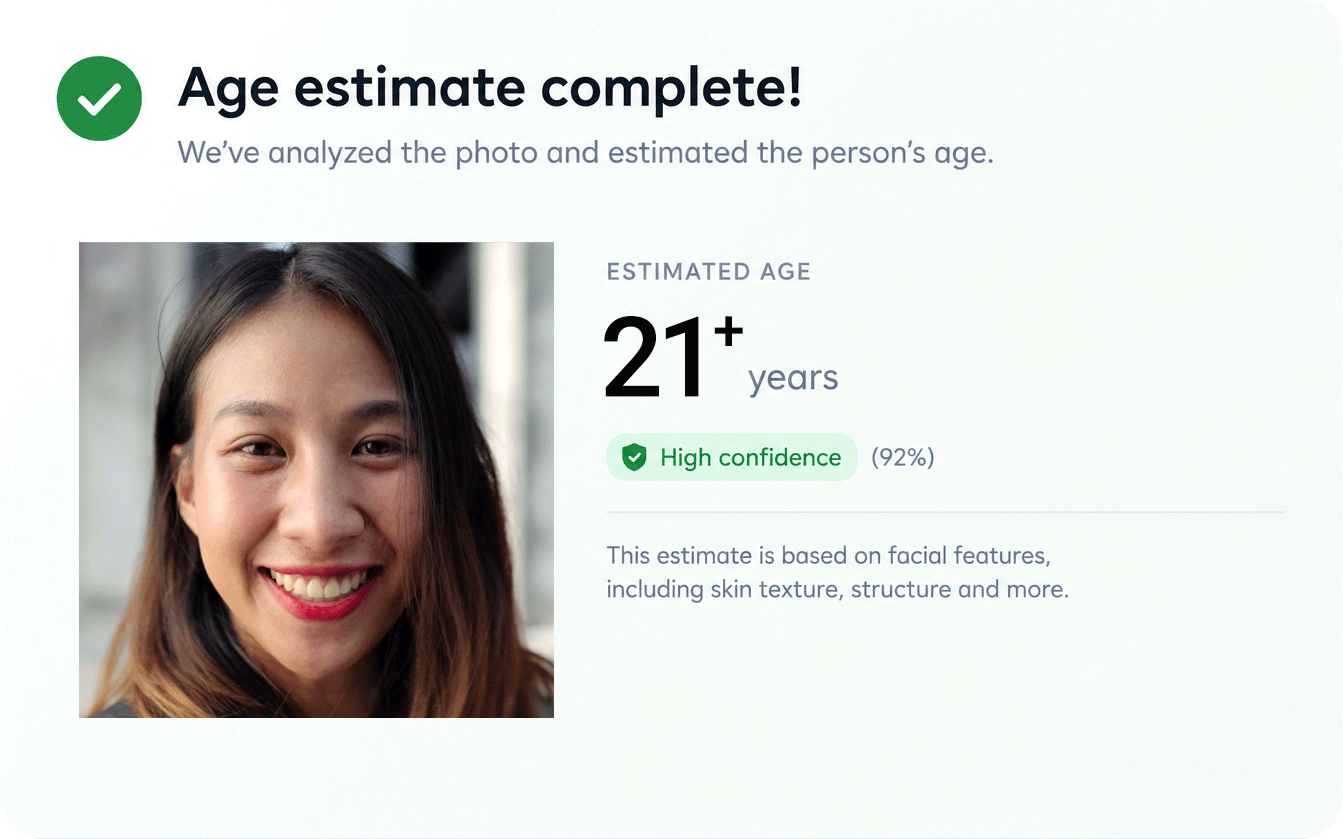
The ROC Age Estimation API accepts a supported face image and returns an estimated age as a numeric value. Your application can use that estimate to apply its own age thresholds, access rules, safeguards, and escalation paths.
What is the difference between age verification and an age estimation?
Age estimation predicts a person's likely age from a facial image, while age verification confirms age against an authoritative source such as a government-issued ID or a database record. The practical differences:
- ROC Age estimation API: One supported face image or selfie in, and a numeric age estimate out. No identity document required and near-zero friction.
- Age verification: Additional document or database check. Validates age or date of birth against an authoritative source, providing higher assurance with additional user friction. Additional document or database check. Validates age or date of birth against an authoritative source, providing higher assurance with additional user friction.
Most modern age assurance workflows combine both: estimation clears the majority of users instantly, and verification is triggered only when the estimate falls near your policy threshold. ROC provides the estimation layer and returns structured data you can use to trigger any step-up verification method you choose.
How accurate is ROC's facial age estimation?
ROC is the #1 global age estimation provider ranked by NIST, ranks #1 globally in the Child Online Safety and the Visa MAE, Application MAE, and Mugshots MAE categories of the NIST FATE Age Estimation and Verification benchmark (as of September 2026). MAE stands for Mean Absolute Error, the average difference in years between the estimated and actual age; lower is better. NIST results are public, so you can independently review ROC's accuracy across age groups and demographics before integrating the API.
Do users need to submit an ID document?
No. The API works from a single supported facial image, such as a selfie captured during onboarding. This lets you apply age-appropriate rules without asking every user for an identity document. You decide when an estimate is sufficient and when your policies require escalating to a higher-assurance method.
Does ROC retain submitted images or biometric data?
No. ROC does not retain facial images and does not store biometric templates from API requests. Submitted images are processed to generate the age estimate and are not retained. The API returns a structured response, and your organization controls how it uses and retains the returned estimate within its own systems.
Which laws and regulations can ROC age estimation help support?
ROC can help support age-assurance and privacy workflows developed in response to COPPA, CCPA/CPRA, GDPR, and emerging age-assurance requirements. The API provides an age signal your application can use to apply age-appropriate safeguards, introduce consent steps, or route a user to additional verification. Requirements vary by jurisdiction and use case, so organizations remain responsible for determining and meeting their applicable legal obligations.
How do I integrate age estimation into my application?
Integration is a single REST call:
- Request: send a supported facial image to the API endpoint with your credentials.
- Response: receive a structured JSON response with the estimated age, confidence data, and supporting fields.
- Decision: apply the result inside your own thresholds, access rules, and escalation logic.
ROC provides the intelligence, you decide what happens next.
Can I test the API before purchasing?
Yes. Eligible U.S.-based businesses can start with 100 free production requests at no upfront charge. A credit card and acceptance of the applicable Terms of Service are required to activate the credits. After the first 100 requests, billing automatically begins on the Starter package at $49 per month unless you cancel service or change packages.
Who can sign up, and is there a review process?
The service is available to eligible U.S.-based businesses and is intended for business use only - not for individual or personal use. Sign-up is self-service and testing starts immediately; account review runs in the background:
- Create an account in the ROC portal.
- Accept the Terms of Service, Customer Agreement, Acceptable Use Policy, and Privacy Policy.
- Complete your business profile.
- Add a payment method to activate your 100 free production credits.
- Begin testing against the live production API.
What happens after I use my 100 free credits?
After the first 100 API requests, service automatically continues on the Starter package at $49 per month unless you cancel service or select another package. The Starter package includes 1,000 API requests per month, with additional requests billed at the published overage rate.
How does age estimation API pricing work?
Pricing is credit-based, with one credit equal to one API request. Eligible U.S.-based businesses receive 100 free production credits at no upfront charge after adding a credit card and accepting the applicable Terms of Service. After the first 100 API requests, billing automatically begins on the Starter package at $49 per month unless you cancel service or change packages.
- Starter — $49/month: 1,000 API requests included, 1¢ per additional request, 1 request per second, and 5 concurrent requests.
- Growth — $99/month: 10,000 API requests included, 0.75¢ per additional request, 10 requests per second, and 20 concurrent requests.
- Enterprise — $499/month: 100,000 API requests included, 0.4¢ per additional request, 1,000 requests per second, and 100 concurrent requests.
There is no separate sandbox tier: you test against the same production API you deploy on.
Should I use the cloud API or the ROC SDK?
Choose the deployment model that best fits your environment. Both models run on the same NIST-ranked algorithms:
- Cloud API: The fastest path to production. Get self-service, cloud-hosted access with credit-based billing and no infrastructure to manage.
- ROC SDK: The most control over deployment, workflow logic, and integration. Run age estimation on premises, at the edge, on device, or in air-gapped environments, and combine it with ROC capabilities such as face recognition and liveness inside your own applications.
Where can I find the ROC Age Estimation API documentation?
The ROC developer documentation includes the current endpoint specification, accepted image inputs, request parameters, response schema, error responses, and implementation requirements.