

ROC EvidenceDigital Evidence
Management
System
An American-made digital evidence platform connecting
forensic processing, investigative review, biometrics, video
intelligence, and eDiscovery in one secure workspace.
ROC EvidenceDigital Evidence Management System
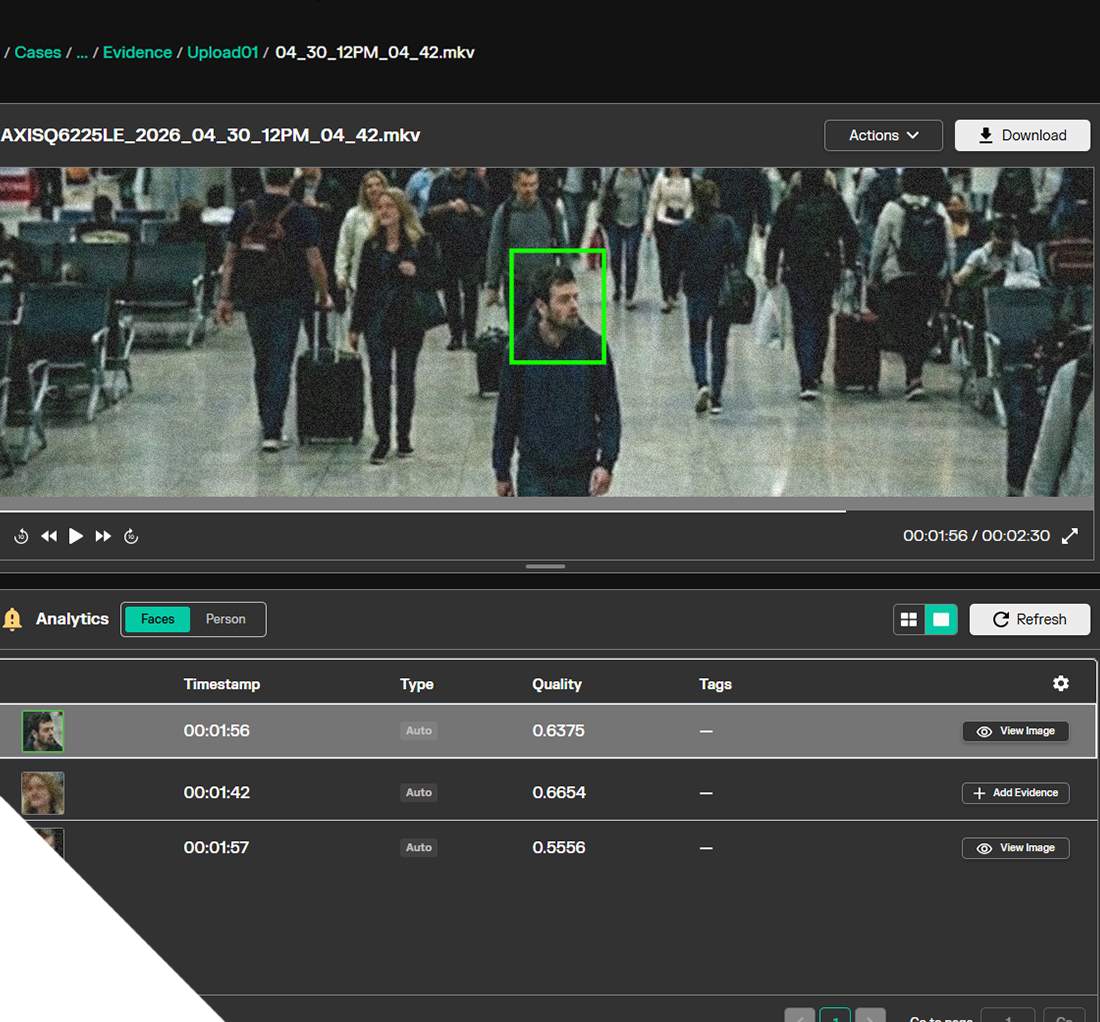
Digital Evidence
Management Software
Turn Fragmented
Evidence Into
Actionable
Intelligence
Modern investigations drown teams in data: phone extractions, social media returns, cloud backups, video, images, messages, documents, and geolocation data. Most platforms force tradeoffs between speed and sovereignty, analytics and openness, simplicity and control. ROC Evidence brings examiners, investigators, analysts, and litigators into one secure workspace to search, tag, enrich, and connect evidence across cases. AI surfaces relevant leads, native biometrics and video analytics close the loop, and non-proprietary data formats keep agencies in control of their evidence. Unlike legacy evidence management software built around storage alone, ROC Evidence features integrated forensic and eLitigation workflows to reduce app-switching and carry teams from investigative review through defensible discovery.
Digital Evidence Management Software
From Evidence Processing to
Feed-Forward Intelligence
Unified
Ingestion
Ingest and index device extractions, provider returns, cloud backups, video, documents, loose media, and third-party forensic outputs in one case file while preserving source hierarchy and metadata. No more stitching evidence together across disconnected tools.
AI-Powered
Investigative Analysis
Stop drowning in manual review. ROC Evidence automatically detects and tags faces, vehicles, license plates, pedestrians, and objects while making documents and text searchable. It then de-duplicates and organizes high-volume collections so teams can find relevant evidence faster.
NIST-Ranked Biometric
Identification
Apply ROC identity intelligence directly to digital evidence using NIST-ranked face recognition, tattoo recognition, biometric enrollment, and ABIS search. Compare identities across media, cases, and datasets without leaving the evidence workflow.
Video Analytics +
Video Forensics
Bring native video analytics and native video evidence management into investigations. Integrated investigative AI tools help teams cluster recurring identities, connect appearances across locations and timelines, surface patterns of life, and locate relevant footage without manually scrubbing hours of video.
Feed-Forward
Intelligence
Vetted leads from one case can inform the next, helping agencies turn isolated evidence into searchable enterprise intelligence. Link analysis connects known and unknown identities across cases and datasets to reveal networks and relationships that might otherwise remain hidden.
Collaborative
Casework
Distributed teams. Complex cases. One secure interface. Examiners, investigators, analysts, and litigators can search, tag, annotate, and review the same case simultaneously, replacing single-license, workstation-bound handoffs.
Text + Data
Enrichment
Make text searchable across messages, emails, social posts, documents, and other returns. Where enabled, native OCR combined with extensible integrations for LLMs, audio transcription, and multilingual translation help extract entities, relationships, and case-relevant information.
Chain of Custody +
Reporting
Track every item of evidence from ingestion to production: chain of custody is maintained through preserved source metadata, activity logging, and a complete audit trail. Built-in privilege review, redaction, reporting, tagged review sets, and Bates-stamped exports support accountable casework and defensible discovery.

Unify the
Evidence
Workflow
ROC Evidence collapses investigative silos by unifying forensic parsing, investigative review, and litigation workflows in a single case workspace for collaborative casework, parallel processing, and defensible discovery.
Search
Review
Tag
Analyze
Collaborate

Examiner
Parses raw device extractions and source data.

Investigator
Hunts for leads and surfaces actionable findings.

Litigator
Manages case privilege, review, and defensible discovery.
Evidence
Inputs
Ingest raw data from every source: mobile devices, computers, cloud platforms, service providers, and loose files while preserving original structure and metadata.
Hierarchical
Processing Pipeline
Normalize, enrich, de-duplicate, and organize evidence at scale while preserving source hierarchy, chain of custody, and a complete audit trail.
Court-Ready
Production
Produce defensible, deadline-ready review sets, reports, Bates-stamped exports, and audit-ready discovery packages.
Built for the Mission
ROC Evidence delivers the speed, scale, security, and sovereign control required for high-stakes digital
evidence operations, from local field offices to large-scale federated systems.
Government Justice & Legal Process
Purpose-built for the rigorous chain-of-custody, discovery, and production requirements across federal agencies, district attorneys, and other government legal teams. Selected by the U.S. Department of Justice to support the ingestion, review, analysis, and production of eDiscovery content for federal prosecutions, ROC Evidence carries evidence from intake through privilege review, redaction, Bates stamping, and audit-ready production — helping teams manage complex cases and high-volume cellphone, social media, and other digital evidence under deadline.
Law Firms & Litigation Teams
Bring high-volume digital evidence into a collaborative review environment built for complex litigation. Attorneys, investigators, and experts can search messages, documents, media, and provider returns; manage privilege; tag and redact relevant material; and produce Bates-stamped, audit-ready discovery packages without repeatedly moving evidence between forensic and eDiscovery tools.
Fusion Centers & Intelligence Operations
Extend intelligence beyond live monitoring by bringing device extractions, provider returns, video, biometrics, and case data into a shared, searchable environment. Authorized teams can cluster identities, connect activity across locations and timelines, apply link analysis, and carry vetted leads across cases and partner agencies. ROC Evidence supports deeper evidence exploitation and collaborative investigation, while ROC Watch powers live video monitoring and alerting.
Law Enforcement Operations
Bring device extractions, provider returns, cloud backups, video, images, messages, and documents into a secure investigative environment built for local, state, and federal teams. Preserve original source hierarchy, metadata, chain of custody, and a complete audit trail while investigators search, tag, annotate, and share findings across the same case — reducing reliance on disconnected, single-license, workstation-bound tools.
Interagency & Federated Systems
Break down silos between regional bureaus and federal partners with a federated, searchable evidence layer that scales across the enterprise. Authorized teams can jointly share, review, and act on evidence while participating organizations maintain custody and control of their data, supporting coordinated multi-agency operations without locking every partner into the same closed system.
American-Made Digital
Evidence Platform
Sovereign Control
Government evidence should remain under government control. ROC Evidence is designed for sovereign deployment inside a government agency’s private Microsoft Azure tenant, helping agencies retain custody, control, and sovereignty over sensitive investigative data. The platform can also support secure Azure, hybrid, and on-premises deployment models without sacrificing performance or control. Through Azure Marketplace private offerings, agencies can streamline procurement, reduce deployment complexity, and leverage existing authorities to operate.
No Vendor Lock-In
ROC Evidence is built around open, non-proprietary data formats that help agencies maintain long-term control over their evidence, workflows, and integrations. The platform integrates with existing commercial off-the-shelf (COTS) and government off-the-shelf (GOTS) tools, reducing dependence on closed systems and proprietary evidence formats.
Made in USA
Built, owned, and supported in the United States for agencies with sovereign technology requirements, ROC Evidence is a 100% American-made digital evidence management solution designed to help agencies modernize evidence workflows, reduce vendor lock-in, and keep control of their data where it belongs: with the government.
Security & Compliance
ROC Evidence deploys directly within your agency’s Azure tenant, inheriting Microsoft’s FedRAMP High authorized infrastructure while maintaining full alignment with FBI CJIS Security Policy standards. Built to protect sensitive investigative data, the platform enforces FIPS-compliant encryption in transit and at rest, granular role-based access controls (RBAC), and immutable audit logging on every piece of evidence to guarantee court-admissible chain of custody.
Proven for High-
Stakes Investigations
Proven for
High-Stakes Investigations
Built by digital forensics experts with decades of experience supporting federal law enforcement and government agencies, ROC Evidence is operationally hardened through critical incidents, major cases, and complex multi-jurisdictional investigations. We help agencies move beyond evidence storage to faster analysis, coordinated casework, and defensible production while keeping sensitive information secure, searchable, and under government control.

FREQUENTLY ASKED QUESTIONS
What is a digital evidence management system (DEMS)?
A digital evidence management system (DEMS) is software that ingests, organizes, analyzes, and produces digital evidence – phone extractions, video, cloud returns, documents – while preserving chain of custody from intake to courtroom. The category emerged because the storage-era tools agencies still rely on were never built for a world where a single homicide case can hold terabytes of footage and three phone extractions. ROC Evidence is a 100% American-made DEMS built by digital forensics experts with decades of federal law enforcement experience – and the only one with NIST-ranked biometrics and native video analytics inside the platform rather than bolted on.
What types of digital evidence can ROC Evidence ingest?
Everything a modern case produces, ingested once and processed in parallel:
- Device extractions - cellphone and computer forensic outputs from the third-party tools your lab already uses
- Provider returns - social media, email, and carrier records, plus cloud backups and geolocation data
- Video - body-worn camera, CCTV, and surveillance footage from mixed legacy and modern equipment
- Documents, images, messages, and loose media
Source hierarchy and metadata are preserved on every item, so nothing arrives stripped of its forensic context. One case file, one search - no more stitching an investigation together across disconnected tools.
How does ROC Evidence maintain chain of custody?
By making it impossible to lose. Original source metadata and file hierarchy are preserved at ingestion, every subsequent action - view, tag, annotation, export - lands in the activity log, and the complete audit trail is available the day the defense challenges it. When a case is reopened years later, the evidence and its custody record are exactly where they were left: nothing is overwritten, and the record of who touched what, when, survives personnel turnover and system migrations. Productions go out Bates-stamped and audit-ready, which is precisely why the platform was trusted for federal prosecution work.
How does AI accelerate evidence review in ROC Evidence?
The heavy lifting happens before an investigator opens the case. At ingestion, ROC Evidence automatically detects and tags faces, vehicles, license plates, pedestrians, and objects across the entire collection, de-duplicates high-volume media, and runs OCR so messages, emails, social posts, and documents become searchable text. On the video side, investigative AI clusters recurring identities, connects appearances across locations and timelines, and surfaces patterns of life - the work that used to mean scrubbing hours of footage by hand. Extensible integrations add LLM-powered enrichment, audio transcription, and multilingual translation where enabled.
What makes ROC Evidence biometrics different from other evidence platforms?
No other DEMS has them natively - and ROC's are independently benchmarked by NIST, not self-reported. Face recognition ranks in the global top tier of NIST FRVT with near-zero error-rate differences across demographic cohorts. Latent fingerprint search earned the #1 global NIST ELFT ranking, returning results in about 15 seconds where the next-fastest provider needs around 42 minutes. Tattoo recognition leads NIST Tatt-E at forensic-grade thresholds. In practice this means an unknown face in CCTV footage, a print from a device, and a booking record connect inside the evidence workflow - at the scale of ROC's largest federal deployment, a 500M-template gallery.
Source: NIST FRVT, ELFT, Tatt-E -
More: roc.ai/abis
Can ROC Evidence deploy in our own cloud or on-premises?
Yes - and the difference from most evidence platforms is who holds the keys. ROC Evidence is designed for sovereign deployment inside your agency's own private Microsoft Azure tenant: the vendor never takes custody of your evidence, because government evidence should remain under government control. Secure Azure, hybrid, and fully on-premises models are supported at identical performance, and Azure Marketplace private offerings let agencies procure through existing authorities to operate instead of a new contracting cycle.
How does ROC Evidence support prosecutors and eDiscovery teams?
ROC Evidence was selected by the U.S. Department of Justice to support the ingestion, review, analysis, and production of eDiscovery content for federal prosecutions - high-volume cellphone, social media, and digital evidence, under deadline. The same workflow is built into every deployment: privilege review and redaction inside the evidence workspace, tagged review sets for team-based case preparation, and Bates-stamped, audit-ready production packages. Attorneys, investigators, and experts work the same case simultaneously instead of e-mailing exports between a forensic tool and a separate eDiscovery platform.
Does ROC Evidence integrate with our existing forensic and records tools?
Yes. The platform is deliberately built on open, non-proprietary data formats - including an open JSON schema - so it complements the commercial and government off-the-shelf (COTS/GOTS) tools an agency already owns rather than replacing them. Extraction reports, lab outputs, and provider returns flow in; open-format exports flow out to case management and court systems. The strategic point is bigger than any single integration: your agency keeps long-term control of its evidence, workflows, and data - and if you ever leave, your evidence leaves with you. No proprietary formats holding your cases hostage.
Which agencies and teams is ROC Evidence built for?
The same platform runs from a county agency's first DEMS to large-scale federated systems:
- Local, state, and federal law enforcement - replacing single-license, workstation-bound tools with shared casework
- District attorneys and government legal teams - chain-of-custody, discovery, and production requirements at federal rigor
- Law firms and litigation teams - collaborative review for evidence-heavy litigation
- Fusion centers and intelligence operations - link analysis and identity clustering across cases and partner agencies
- Interagency and federated deployments - shared evidence, while each partner keeps custody and control of its own data
Source hierarchy and metadata are preserved on every item, so nothing arrives stripped of its forensic context. One case file, one search - no more stitching an investigation together across disconnected tools.
What makes ROC Evidence different from other digital evidence management software?
Most digital evidence management software is storage with a review interface: your evidence sits in the vendor's cloud, in the vendor's formats, analyzed by third-party add-ons. ROC Evidence inverts all three. It deploys in your own Azure tenant, so the vendor never holds your evidence. It runs on open, non-proprietary formats, so there is no lock-in to leave behind. And its intelligence layer - NIST-ranked face, fingerprint, and tattoo recognition plus native video analytics - is the platform, not a plug-in. Built, owned, and supported entirely in the United States, selected by the U.S. Department of Justice for federal prosecution eDiscovery, and hardened through critical incidents and multi-jurisdictional investigations.