

For more than two decades, ZTC has helped government teams solve some of the most complex challenges in digital forensics. With ZTC now part of ROC, that expertise is helping build something larger: a unified, American-made platform connecting forensic ingestion, collaborative analysis, biometric identity, video intelligence, and case production across the entire investigative lifecycle.
Going Beyond the Extraction
A device extraction is not the end of the forensic process. It is the beginning of the investigation. ZTC specializes in ingesting, processing, and preserving complex digital evidence. Behind that capability is more than two decades of forensic parsing expertise, continuously refined across new devices, services, provider returns, and legacy file formats. Its cloud-native architecture is designed to process large volumes of devices and data sources in parallel, moving beyond the traditional one-device, one-examiner workflow.
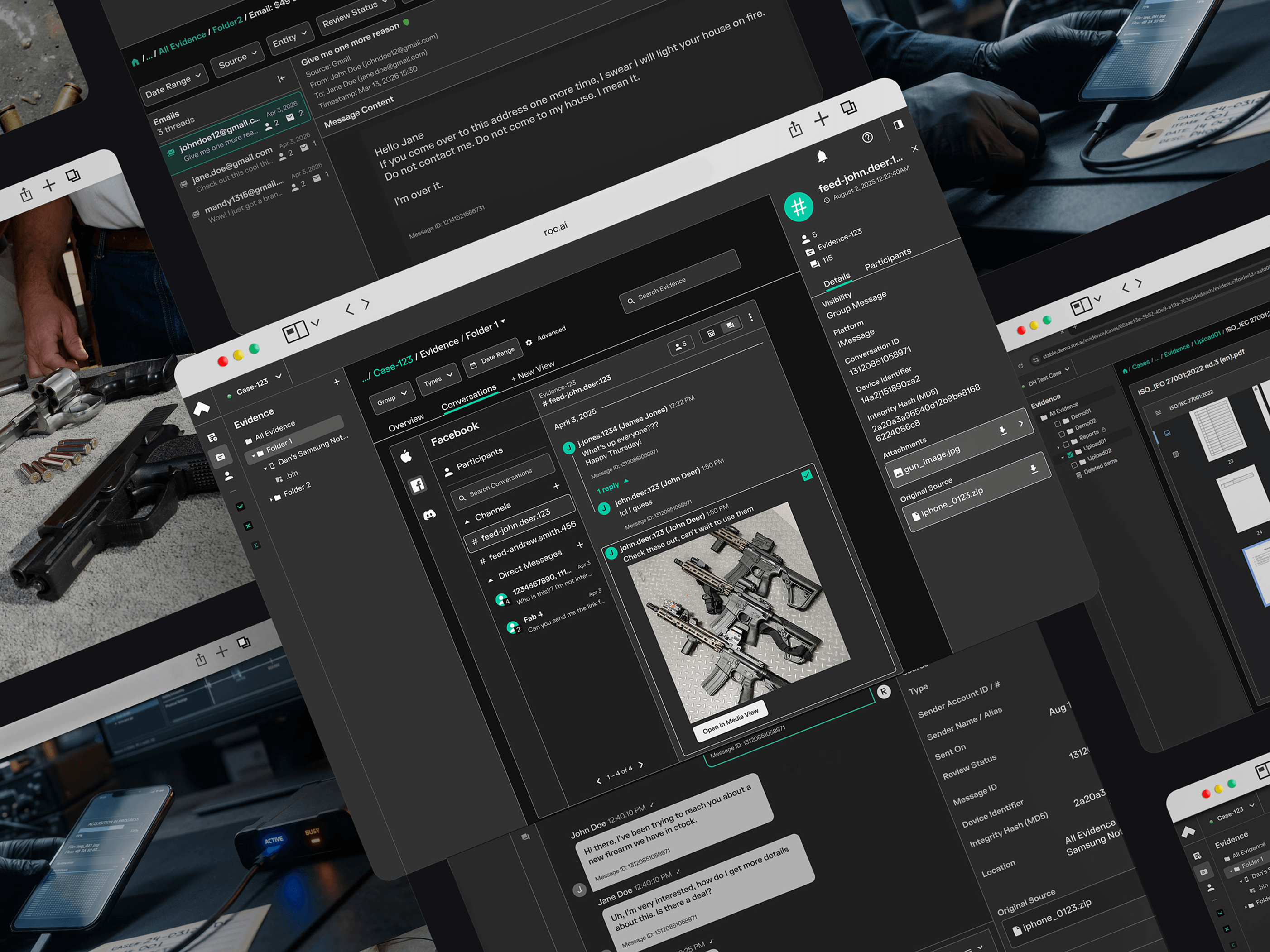
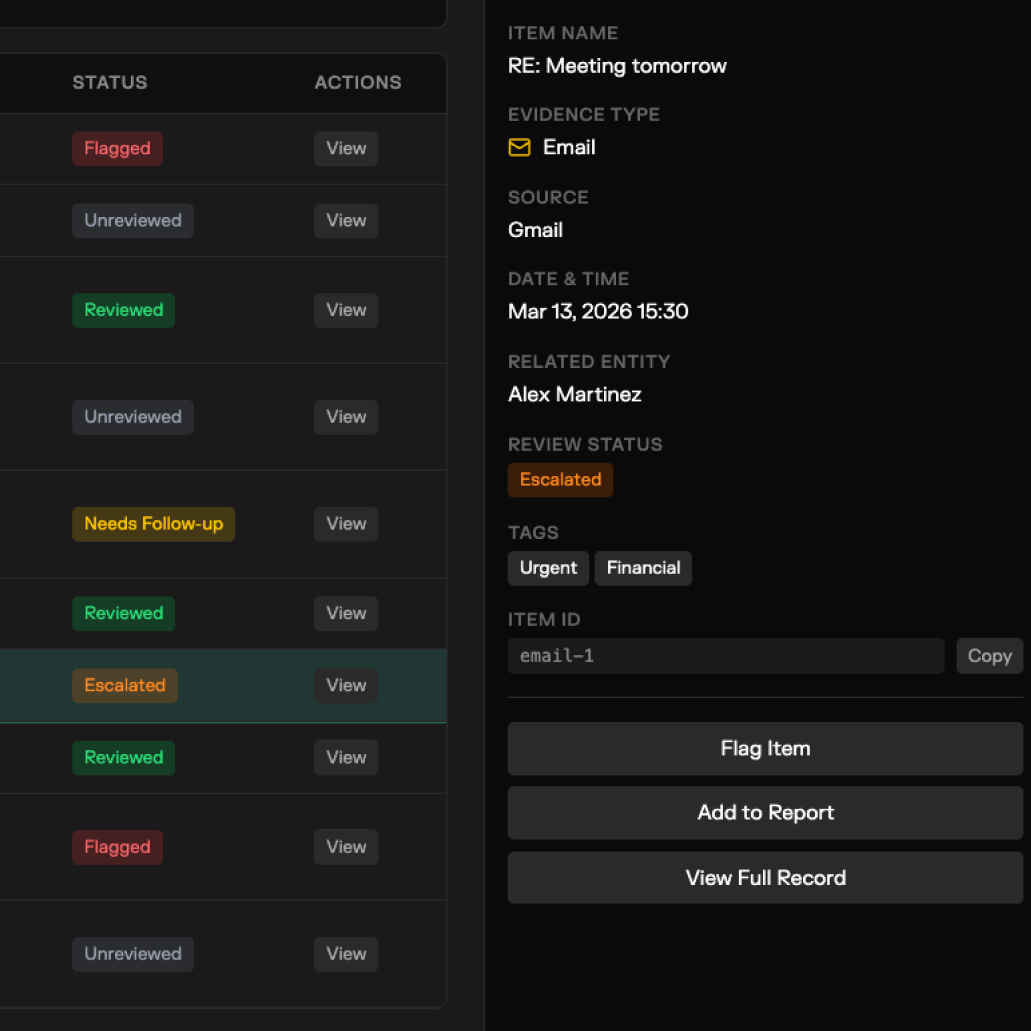
Meanwhile, ROC Evidence gives investigative teams a shared environment to search, analyze, connect, review, and act on that evidence. Together, these capabilities are designed to reduce the handoffs between forensic tools, static reports, evidence systems, and review platforms. Investigators can work from the underlying evidence, while examiners, analysts, prosecutors, and legal teams contribute to the same case. The goal is simple: preserve context, connect teams, and help investigators move from extraction to action faster.
“We didn’t buy a product; we brought in a capability the market has been asking someone to build for twenty years. ROC ABIS answers who. ROC Watch answers where. ROC Evidence, strengthened by ZTC’s digital forensics capabilities, answers what happened. Bringing these together in one platform, under one chain of custody, creates an end-to-end investigative capability that replaces the disconnected tools, data movement, and manual handoffs investigative teams have had to manage themselves.”

The Digital Evidence Equation Has Changed
Modern investigations are not short on evidence. They are overwhelmed by it. A single case may span mobile devices, computers, cloud accounts, social platforms, provider returns, security video, images, messages, documents, audio, location data, and decades of legacy file formats. Each source can hold part of the story, but that story often remains scattered across different tools and teams.
- More sources: Evidence now moves across devices, platforms, media types, cloud services, and third-party providers.
- More volume: Investigative teams may need to process thousands of devices and collections measured in terabytes or petabytes.
- More complexity: Messages, identities, locations, objects, relationships, and timelines must be reconstructed across structured and unstructured data.
- More collaborators: Examiners, investigators, analysts, prosecutors, litigators, and partner agencies may all need to work from the same evidence with different levels of access.
- Less time: The value of a lead often depends on how quickly teams can find it, understand it, and put it into action.
Yet much of today’s investigative technology remains organized around isolated tasks. Many systems were built for a narrower era: forensic workstations process devices, video platforms review footage, biometric systems search for identities, and litigation platforms manage documents and production.
The investigation itself, however, happens across all of these silos.
Each handoff can create delays, duplicate data, strip away context, and make important signals harder to see. The next generation of digital evidence technology must do more than just process larger collections. It must be the glue that connects the people, evidence, and intelligence surrounding an investigation.
“ZTC was built to solve the problems conventional tools were never designed to handle. We spent two decades reverse-engineering the hardest problems in digital forensics at operational scale. Inside ROC, that capability can support a connected workflow from the first extraction to the courtroom while preserving every ounce of fidelity, provenance, and control.”
Built for How Investigations Actually Work
This is what a unified evidence workflow makes possible.
Bring Every Source Into One Investigation
Ingest mobile and computer extractions, provider returns, cloud data, video, images, messages, documents, audio, and loose media.
Preserve Evidence from Intake to Courtroom
Maintain source hierarchy, metadata, chain of custody, and evidentiary context through analysis, review, redaction, and production.
Surface Leads Faster
Extract and connect searchable text, identities, media, locations, relationships, and timelines across large, complex collections.
Work the Same Case Together
Enable examiners, investigators, analysts, prosecutors, and legal teams to search, tag, annotate, and review evidence within one live workspace.
Scale Beyond the Workstation Bottleneck
Process large collections and multiple data sources in parallel while supporting more cases and authorized users.
Keep Control of Your Data
Use customer-controlled deployment and open, non-proprietary formats that support long-term evidence sovereignty and interoperability with existing COTS and GOTS systems.
One Workflow Across the Digital Evidence Lifecycle
Digital evidence may pass through many hands, but it should not fracture into separate workflows. ROC Evidence brings forensic examiners, investigators, and litigators into a shared case workspace, giving each role the access and tools it needs while keeping everyone connected to the same underlying evidence.
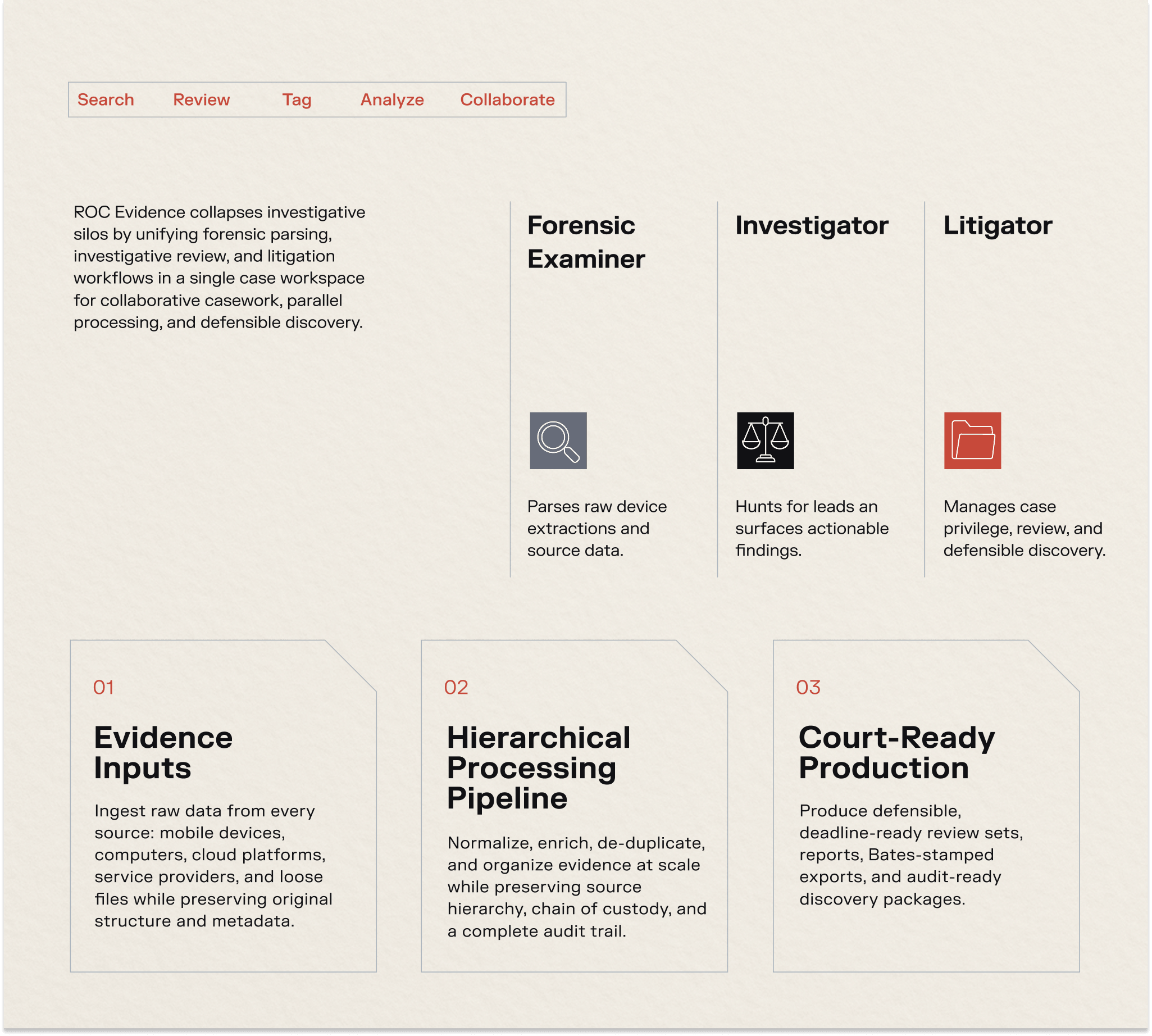
ZTC strengthens the front of this workflow, where raw data is parsed, structured, and preserved. From there, ROC Evidence carries that information forward through investigative analysis, collaborative review, and court-ready production.
“Most digital forensics products still operate as individual tools: one examiner, one machine, one extraction. At today’s evidence volumes, that creates two bottlenecks: workstation-bound processing and repeated handoffs between systems. ROC Evidence was architected to remove both. Its cloud-native architecture processes large collections in parallel, while one shared case workspace lets examiners, investigators, analysts, and litigators work the same evidence at the same time and carry it forward to court-ready production without repeatedly moving or rebuilding the case.”
Connecting Evidence to the Larger Picture
Digital evidence rarely stands alone. A face, message, location, vehicle, or object may connect identities and events across multiple sources. ROC’s unified Vision AI platform is designed to connect these signals across the full investigation. ROC Evidence organizes the investigative record, ROC ABIS connects biometric identity, and ROC Watch extends intelligence across live and recorded video — giving teams a more complete view of the people, places, relationships, and events shaping an investigation.
See how ROC is unifying digital forensics, investigative review, and evidence production in one American-made platform. Explore ROC Evidence
Future-ready insights.
Straight from the source.
Subscribe for Vision AI insights, product updates, and stories from the front lines of identity and intelligence.