
Biometric Access Control
Where Access Control Meets Intelligence.
Move beyond credentials. Bring biometric identity,
intelligent access control, and real-time security
awareness together at every point of entry.

ROC AccessROC Access is an intelligent biometric access control system that combines real-time face recognition, video analytics, and flexible access workflows to help organizations make stronger access decisions based on who is present and what is happening at the point of entry.
Where
Access
Control
Meets
Intelligence
ACCESS
NIST-Ranked Facial Recognition
Real-Time Gun & Threat Detection
Flexible Access Control Workflows
Secure-Side Biometric Processing
Works With Existing PACS
Single Door to Enterprise Scale
What Is Biometric Access Control?
Biometric access control is a physical security method that uses a person’s unique biological characteristics, such as their face, fingerprint, or iris, to verify identity before granting access. Unlike a badge, PIN, or mobile credential, a biometric connects the access decision to the person physically present. Badges and devices can be lost, stolen, or shared, while PINs can be forgotten, observed, or disclosed.
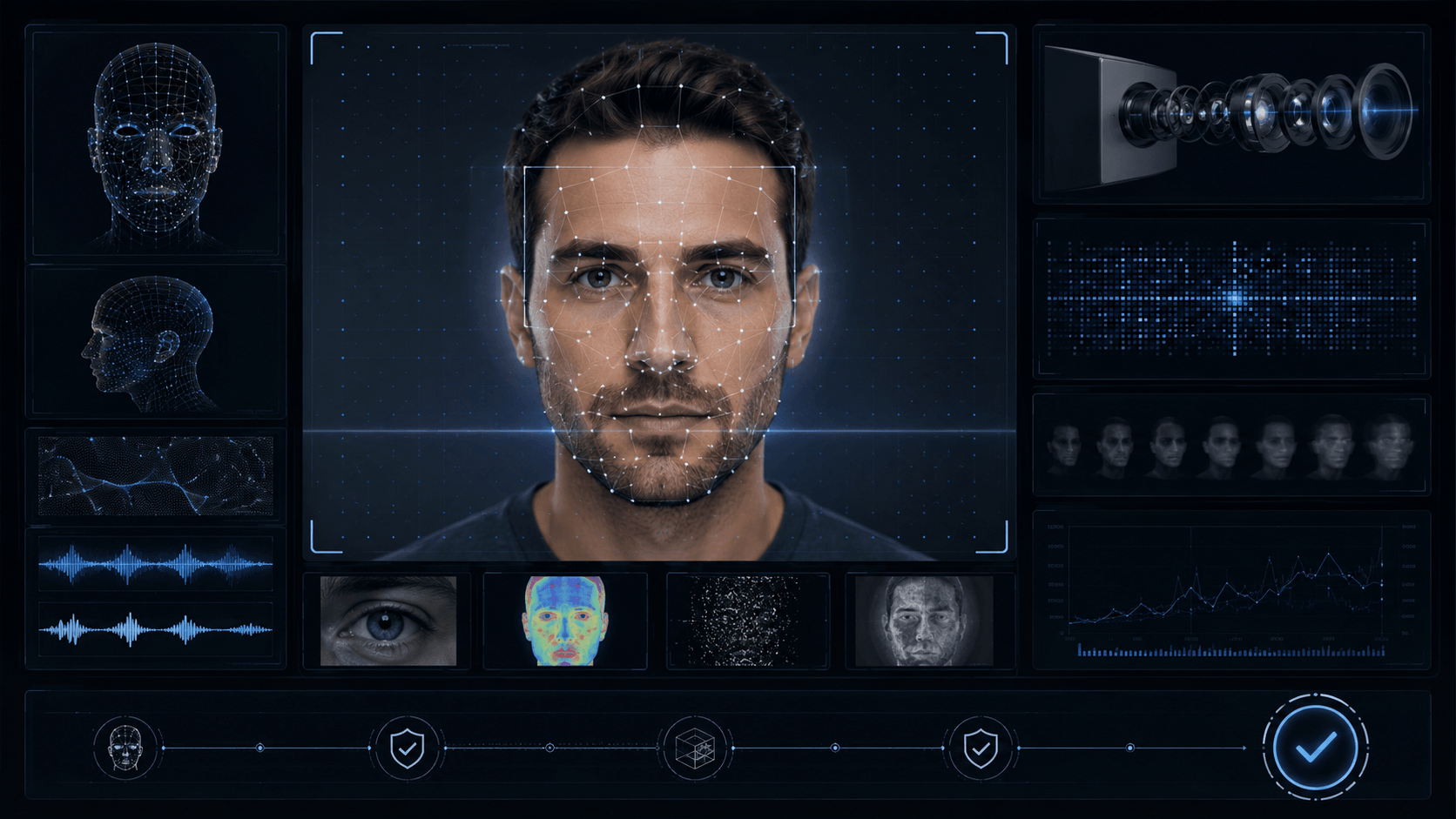
Facial recognition access control systems close this gap by verifying the person rather than only the credential. The system captures a live face image and compares it against an enrolled biometric template. Depending on workflow, it can authenticate a claimed identity through one-to-one matching or identify an individual from an authorized gallery through one-to-many matching. Depending on the security requirements, biometrics can enable frictionless entry or support multifactor authentication alongside a badge, PIN, or mobile credential.

HOW IT WORKS
Turn Every Access Point Into a Proactive Intelligence Layer
Biometrics, video analytics, and intelligent access — working as one.
Traditional access control readers perform their primary function when someone presents a credential. ROC Access is designed to provide value beyond that moment, combining biometric identity with real-time video analytics to understand the wider scene around a door or barrier. ROC Access can identify multiple people in parallel, screen watchlists, detect guns, and determine whether established access rules are being followed.

Analyze the Live Scene
Video analytics evaluates the wider scene as users approach the access point, generating scene intelligence on people, watchlist matches, visible firearms, vehicles and license plates, and other configured threats.
1
2

Verify Identity & Authenticate Access
At the door, top-tier NIST-ranked face matching verifies the identity of the person requesting entry, screens relevant watchlists, and supports touchless entry, visitor management, and QR-based multifactor authentication.

Apply the Access Rules
Apply customizable access logic to the identity and scene results, including single-person access, accompanied visitor requirements, two-person rules, tailgate detection, and other workflows.
3
4

Connect the Decision to Action
Extend biometric identity and scene intelligence to existing PACS. Current infrastructure manages doors, zones, and permissions, while ROC Access initiates actions — such as a door lockdown when a visible weapon or watchlist match is detected — and routes events for alerting, review, and audit.
Together, these capabilities transform the access point from a siloed reader and passive checkpoint into a persistent intelligence layer — connecting identity, activity, and action.
Turn Every Access Point Into a Proactive Intelligence Layer
Biometrics, video analytics, and intelligent access — working as one.
Traditional access control readers perform their primary function when someone presents a credential. ROC Access is designed to provide value beyond that moment, combining biometric identity with real-time video analytics to understand the wider scene around a door or barrier. ROC Access can identify multiple people in parallel, screen watchlists, detect guns, and determine whether established access rules are being followed.
1
Analyze the Live Scene
Video analytics evaluates the wider scene as users approach the access point, generating scene intelligence on people, watchlist matches, visible firearms, vehicles and license plates, and other configured threats.
2
Verify Identity &
Authenticate Access
At the door, top-tier NIST-ranked face matching verifies the identity of the person requesting entry, screens relevant watchlists, and supports touchless entry, visitor management, and QR-based multifactor authentication.
3
Apply the Access Rules
Apply customizable access logic to the identity and scene results, including single-person access, accompanied visitor requirements, two-person rules, tailgate detection, and other workflows.
4
Connect the
Decision to Action
Extend biometric identity and scene intelligence to existing PACS. Current infrastructure manages doors, zones, and permissions, while ROC Access initiates actions — such as a door lockdown when a visible weapon or watchlist match is detected — and routes events for alerting, review, and audit.
Together, these capabilities transform the access point from a siloed reader and passive checkpoint into a persistent intelligence layer — connecting identity, activity, and action.
CONFIGURABLE WORKFLOWS
Flexible Access
Control Workflows
ROC Access identifies and tracks multiple faces in parallel, allowing organizations to apply adaptive access logic based on everyone present, not only the person who initiated the request. Workflows can range from frictionless, high-throughput entry to controlled, high-security access across government and defense facilities, critical infrastructure, enterprise campuses, schools, and other sensitive environments.
Frictionless, high-throughput access
Recognize multiple authorized people in parallel without forcing everyone into a one-at-a-time credential workflow.
Enforced single-person access
Grant access only when a single authorized individual is present at a controlled door or barrier.
Accompanied
visitor rules
Verify that a visitor is physically accompanied by a designated employee or authorized escort.
Two-person rule
Require two authorized individuals to be present before access can proceed in sensitive environments.
Tailgate detection
Detect when additional persons attempt to enter behind an authorized user and route the event for review.
Visitor management

Support touchless visitor entry, QR-based credentials, identity verification, and watchlist screening through a connected access workflow.
Download the ROC Access Product Guide
POWERED BY ROC WATCH
One View for Access
Control and Video Analytics
ROC Access is powered by ROC Watch, ROC’s unified video analytics platform. Together, they connect biometric identity, live threat detection, alerting, and investigative search across access points and surrounding camera networks. Compared with static access logs, ROC Watch connects each interaction to a continuous operational picture that authorized teams can monitor, review, search, and investigate.

Live Identity and Watchlist Screening
Purpose-built for the rigorous chain-of-custody and discovery requirements of the Department of Justice, district attorneys, and global legal systems.
Real-Time Gun and Threat Detection
Move from mass ingestion to "signal" discovery. Rapidly exploit evidence using native NIST-ranked biometrics and Vision AI (object, vehicle, and weapon detection) alongside automated transcription, OCR, and multi-language translation.
Searchable Encounters
A secure environment for device extractions and cloud returns that meets the highest security standards for local, state, and federal investigators.
AI-Enabled Video Forensics
Break down silos between regional bureaus and federal partners with a unified, searchable evidence layer that scales across the enterprise.
Download the ROC Watch Product Guide


Modernize Access Without
Replacing What Works
ROC Access is designed to complement existing physical access control systems rather than replace them. Organizations can preserve the infrastructure managing doors, zones, and permissions while adding biometric identification, video analytics, and real-time security intelligence.
01
Compatible with
existing PACS
Built on an open, vendor-agnostic architecture, ROC Access integrates with existing physical access control systems and panels to maximize the value of infrastructure already in place. Current systems continue controlling doors, zones, and permissions while ROC adds biometric identity and scene intelligence.
02
Connect across the
security ecosystem
Connect ROC Access with PACS, VMS platforms, IP and mobile cameras, identity systems, and watchlists to bring real-time identity intelligenace and situational awareness into the wider security environment. Link what happens at the door with activity across the facility for more informed alerting, review, and response.
03
Deploy and scale
on your terms
Deploy on-premises, in the cloud, or across hybrid environments, scaling from a single door to enterprise-wide implementations. Secure-side multi-reader support and redundancy add flexibility for larger environments.
04
Security, privacy,
and accountability
Support secure, privacy-aware biometric workflows with configurable role-based access, data retention policies, redaction, and touchless user-trigger modes. Reporting and system-level audit tools help maintain accountability, while deployment environments and biometric data remain under your control.
ROC ACCESS FACE1

Smarter Access Control
Award-winning biometric access reader for high-throughput, high-security environments.
Named Best in Biometrics at the 2026 SIA New Products and Solutions Awards at ISC West, ROC Access Face1 is the first biometric reader in the ROC Access portfolio. Its ultra-compact, transparent-mode design brings biometric identity, video analytics, and real-time threat detection together at the point of entry.

Frictionless to High-Security Access
Be a Force for Good
ROC equips local, state, and federal law enforcement with multimodal Vision AI for identity, threat, and risk mitigation operations. Our high-fidelity algorithms unlock powerful capabilities spanning face recognition, gun detection, ABIS, latent fingerprint, and tattoo matching.
Integrated Watchlist and Gun Detection
Accelerate Human Decision Making
ROC delivers AI-powered insights and video forensics to command and control. Edge-ready algorithms analyze thousands of video sources at warp speed, synthesizing data for brandished weapons, stolen vehicles, persons of interest, and more.
Secure-Side Biometric Processing

Protect Every Kid in America
ROC Watch protects students and staff, so we can focus on what matters most—keeping our kids safe, happy, and learning. From watchlisting to weapons detection, we equip schools and universities with efficient, layered security and tenfold faster threat resolution.
Field-Upgradeable. American-Made.
Build Smarter, Safer Communities
From connected buildings to entire smart cities, ROC integrates seamlessly into command and control centers, enabling city operators and authorities to detect threats, manage traffic, and enhance public safety with AI automation.



FREQUENTLY ASKED QUESTIONS
What is biometric access control?
Biometric access control is a physical security method that verifies a person’s identity using unique biological characteristics — face, fingerprint, or iris — before granting entry. Unlike a badge, PIN, or mobile credential, which can be lost, stolen, or shared, a biometric binds the access decision to the person physically present at the door. Modern facial recognition performs this verification in under a second, so organizations gain credential-level control without sacrificing throughput. Depending on the security tier, biometrics can operate as the sole credential for frictionless entry or as one factor in a multifactor workflow.
How does facial recognition access control work?
The system captures a live face image and converts it into an encrypted biometric template - a numerical representation that cannot be reverse-engineered into a photo. That template is then matched in one of two modes: one-to-one verification to authenticate a claimed identity, or one-to-many identification against an authorized gallery. ROC Access performs this matching with top-tier NIST-ranked algorithms and, unlike single-credential readers, identifies and tracks multiple faces in parallel, so the access decision reflects everyone present at the entry point - not just the person who badged in.
Can ROC Access integrate with my existing physical access control system (PACS)?
Yes — ROC Access is built on an open, vendor-agnostic architecture designed to complement your PACS, not replace it. Your current infrastructure continues to manage doors, zones, and permissions, while ROC Access layers biometric identity and real-time scene intelligence on top and initiates actions, such as a door lockdown when a visible weapon or watchlist match is detected. It connects across the security ecosystem, including:
- Physical access control systems and panels
- VMS platforms and IP or mobile cameras
- Identity systems and enterprise directories
- Watchlists and visitor management workflows
What makes ROC Access different from a traditional access control reader?
A traditional reader performs its function only at the moment a credential is presented. ROC Access turns the same entry point into a persistent intelligence layer: video analytics evaluates the scene as people approach, NIST-ranked face matching verifies identity at the door, configurable access logic is applied to both, and the decision is pushed to your PACS for action and audit. In practice that means one system that identifies multiple people in parallel, screens watchlists, detects visible firearms, and confirms that access rules are actually being followed - capabilities no badge reader can provide.
Does ROC Access support multifactor authentication?
Yes. ROC Access supports workflows ranging from frictionless, face-only entry for high-throughput lobbies to strict multifactor authentication that pairs biometric verification with a badge, PIN, QR code, or mobile credential. Policies are configurable per door and per zone, so a corporate campus entrance and a classified program area can run different rules on the same platform - a requirement in government, defense, and critical infrastructure environments.
Can ROC Access identify multiple people simultaneously?
Yes. ROC Access can track and identify multiple faces in parallel, enabling high-throughput entry and access rules involving everyone present. It can verify an authorized employee at the door while simultaneously screening other people in the scene against watchlists or evaluating visible threats.
How does ROC Access prevent tailgating and unauthorized entry?
Because ROC Access analyzes the entire scene rather than a single credential event, it enforces rules based on everyone present at the door. Configurable workflows include:
- Tailgate detection: flag and route for review when someone enters behind an authorized user
- Enforced single-person access: grant entry only when one authorized individual is present
- Accompanied visitor rules: verify a visitor is physically escorted by a designated employee
- Two-person rule: require two authorized individuals before access proceeds in sensitive areas
Can ROC Access detect weapons or other threats at the entry point?
Yes. ROC Access is powered by ROC Watch, ROC's unified video analytics platform, which provides real-time gun detection and watchlist screening as people approach the access point - before a credential is ever presented. On a detection, the system can initiate an immediate response through your existing PACS, such as a door lockdown, while routing the event for alerting, review, and a complete audit trail. Every encounter is also searchable for forensic investigation across connected cameras.
How is biometric data protected in ROC Access?
ROC Access supports secure-side biometric processing: matching is performed on the protected side of the door rather than inside an exposed edge device, so templates never live where they can be physically attacked. Biometric templates are encrypted numerical encodings that cannot be reconstructed into images, and deployments include configurable role-based access, data retention policies, redaction, and touchless user-trigger modes. System-level reporting and audit tools maintain accountability, and because ROC Access deploys in your environment, biometric data remains entirely under your control — it never leaves your infrastructure for a vendor cloud.
What deployment options does ROC Access support?
ROC Access deploys on-premises, in the cloud, or in hybrid environments and scales from a single door to enterprise-wide implementations spanning campuses and facilities. Secure-side multi-reader support and redundancy provide resilience for larger environments, and the underlying ROC platform is proven at extreme scale — supporting identity galleries of 500 million or more templates with sub-second search. The same architecture serves a school with one monitored entrance and a defense installation with hundreds.
How accurate is ROC's facial recognition?
ROC's algorithms are consistently top-ranked in NIST evaluations for both speed and accuracy, with near-zero performance differentials across racial and gender cohorts — a critical benchmark for organizations subject to civil rights and procurement scrutiny. The same NIST-ranked technology powering ROC Access is deployed in more than 50 countries and trusted by US defense, public safety, and digital identity customers, including roughly half of the US identity-proofing community. Rank One Computing (ROC) is American-made and publicly traded (Nasdaq: ROC), with algorithms developed, trained, and supported entirely in the United States.
What is ROC Access Face1?
ROC Access Face1 is the first biometric reader in the ROC Access portfolio, named Best in Biometrics at the 2026 SIA New Products and Solutions Awards at ISC West. Its ultra-compact, transparent-mode design brings NIST-ranked facial recognition, video analytics, and real-time gun and threat detection together at the point of entry, with secure-side biometric processing keeping templates on the protected side of the door. Face1 is field-upgradeable and American-made, so capabilities grow with software updates rather than hardware replacement.
What is the difference between ROC Access, ROC Watch, and ROC Access Face1?
ROC Access is ROC’s intelligent biometric access control solution. ROC Watch provides the underlying video analytics, alerting, and investigative intelligence, extending ROC Access beyond a single-door decision into a proactive, persistent intelligence layer. ROC Access Face1 is an optional, purpose-built biometric reader for organizations that want dedicated ROC hardware at the point of entry. ROC Access Face1 is not required to deploy ROC Access, which can integrate with existing cameras and access control infrastructure.
Why deploy ROC Access Face1 over other access control readers?
ROC Access Face1 brings ROC’s biometric, video analytics, and scene intelligence directly to the point of entry. This purpose-built access control reader combines ROC’s NIST-ranked face matching with passive liveness, QR-based multifactor authentication, watchlist screening, and real-time scene analysis. Unlike conventional readers focused primarily on authentication, Face1 can identify multiple people in parallel, screen individuals against watchlists, and detect visible firearms and other configured threats around the access point. Its secure-side architecture also moves biometric processing and matching off the exposed reader, all while integrating with existing PACS and door-control infrastructure.
What is secure-side biometric processing?
Secure-side processing moves image processing, biometric template generation, and identity matching off the exposed reader and onto secure-side GPU infrastructure. ROC Access Face1 uses this transparent-mode architecture for both 1:1 authentication and 1:N identification, limiting the attack footprint by reducing the amount of sensitive biometric processing performed on the non-secure side.