

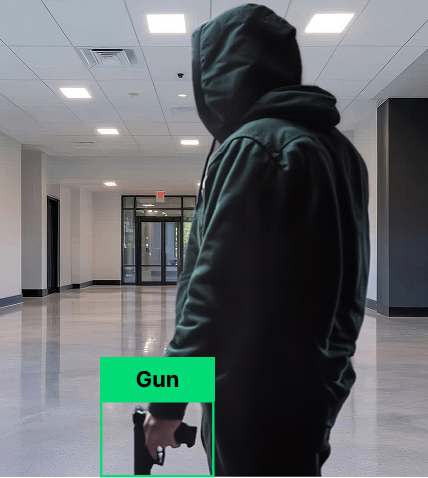
AI gun detection has moved from a theoretical video analytics feature to a critical operational layer for physical security, venue safety, incident prevention, and post-event investigation. As organizations look for faster ways to harden environments without disrupting daily life, the challenge is no longer whether Vision AI can identify a visible firearm. It is how accurately, responsibly, and reliably that capability performs in dynamic, real-world conditions.
This article starts with a short foundation on AI gun detection, then moves into expert Q&A with ROC’s research team on real-world performance, accuracy considerations, and deployment challenges. For a full overview of ROC capabilities and deployment options, visit our AI Gun Detection page.
AI Gun Detection: Quick Answers
What is Gun Detection?
Traditional surveillance still relies heavily on human operators noticing threats in real time and escalating them quickly. AI-assisted gun detection is a Vision AI capability that integrates into existing camera feeds and surveillance networks, automatically identifying visible firearms in images and video. By continuously analyzing camera feeds, it can alert security personnel to potential threats and support faster, more informed responses.
How Does AI Gun Detection Work?
AI gun detection uses computer vision to continuously analyze images and video for visible firearms. When a potential firearm is identified, the system generates an alert and routes it into a broader security workflow for review, escalation, or response. This workflow can be configured to suit each environment: detections may go first to a trained operator for review or trigger immediate escalation according to organizational policy.
How Accurate Is AI Gun Detection?
AI gun detection accuracy depends on the algorithm, camera resolution, lighting, distance, and visibility of the firearm. In controlled environments, firearms may be easier to identify, but real-world conditions introduce challenges such as occlusion, poor lighting, and limited image quality. Organizations should evaluate both detection accuracy and false-positive rates under their own operating conditions rather than relying on laboratory performance alone.
Is There a Standard Benchmark for Gun Detection?
Unlike some biometric technologies, AI gun detection does not have a single public leaderboard or official benchmark that buyers can use as a universal scorecard. Instead, buyers need to assess performance in their intended environment, considering both detection accuracy and false-positive rates, along with alert workflows and human review. That makes expert evaluation especially important for buyers assessing whether the technology will work within their existing security operations.
What Is Gun Detection Used For?
AI gun detection supports early threat detection and situational awareness in environments such as schools, public spaces, transportation hubs, government facilities, commercial buildings, and smart campuses. By proactively monitoring video from compatible camera networks and mobile tactical feeds, the technology can alert public safety, security, and tactical teams to visible firearms, helping them assess potential threats and respond more quickly.
Gun detection is not a one-size-fits-all deployment. Different sites, staffing models, and risk profiles require different thresholds for sensitivity, alerting, and response.
Expert Q&A: Gun Detection with Jordan Cheney

AI gun detection faces different challenges in controlled demonstrations and real-world security environments. Lighting, camera resolution, distance, occlusion, and workflow design can all affect detection performance. To better understand where the technology works, where it struggles, and how organizations should evaluate it, we spoke with Jordan Cheney, Director of Computer Vision at ROC.
How Does AI Use Pattern Recognition to Detect Firearms?
Guns are distinct, recognizable objects. As humans, we’re quite good at seeing individuals and identifying that they’re holding a gun. Gun detection works much the same way. Our models look at the raw pixels of images and video frames for patterns. Trained on millions of labeled images of firearms, our models have learned to recognize visual patterns associated with guns, including distinctive shapes, colors, and other characteristics. When the model identifies a likely firearm, it triggers an alert.
It is important to note that ROC’s model is trained on real-world brandished weapon scenarios rather than static firearm images. A weapon being drawn and presented is a critical operational threat moment. ROC’s models are specifically trained to detect this moment across varied poses, carry positions, and partial occlusion.
Gun Detection vs. Active Shooter Response?
Gun detection is a necessary first step in responding to an active shooter, although it has no response component on its own. As we know, AI gun detection continuously analyzes video feeds to support every stage of a threat — delivering proactive early warnings when a firearm is first brandished, live tracking during an incident, and rapid forensic review afterward.
- DETECT AND ALERT: Identify visible firearms and provide early warnings that could allow for intervention before shots are fired.
- TRACK AND RESPOND: During an active incident, multi-camera tracking can provide real-time situational awareness and response decisioning to tactical teams as the event unfolds.
- INVESTIGATE: After an incident, post-event video forensics accelerates investigations by automatically pinpointing key video frames, reconstructing timelines, and extracting evidence in minutes, reducing hours of manual video review.
Note that gun detection itself does not execute an active shooter response. We work directly with our customers to integrate alerts into their active shooter response plans, providing a proactive early warning when visible firearms are detected. ROC performs sub-second detection analysis, delivering alerts in near real time through email, SMS, MQTT, or REST API integrations.
For a related application, learn more about aerial threat detection and its role in identifying elevated sniper threats.
What Types of Firearms Can AI Detect?
Our visual AI system can detect all common types of firearms, including handguns, shotguns, rifles, and automatic rifles. In practice, detection depends on whether the firearm is visible to the camera and presented with enough image quality for the model to make a confident determination. The category of firearm matters less than the system’s ability to see enough of the object clearly, at the right distance, resolution, and angle.
Where Does Gun Detection Struggle in Operational Environments?
Gun detection systems are not magic and they will struggle in the same visual conditions in which a well-trained human would struggle. First off, the systems must see the gun in order to detect it. They will not alert on guns in backpacks or in a concealed holster. They also require a certain number of pixels across an object to make a confident determination, which necessitates well placed camera systems with reasonable quality. The difference between traditional security and gun detection systems is that our models can run 24/7/365 across thousands of cameras simultaneously, giving each frame equal attention and focus.
This is one of the most important expectations to set before deployment. AI gun detection cannot detect what the camera cannot see. Camera placement, field of view, distance, lighting, and scene complexity all affect performance. The goal is not to promise perfect detection in every possible scenario. The goal is to give security teams a persistent visual layer that can surface threats earlier than passive monitoring alone.
How Does the System Distinguish a Real Gun from a Phone, Wallet, or Umbrella?
We train our models specifically to distinguish between real guns and these distractor classes by showing them examples of both. We have millions of examples of real guns, phones, water bottles, wallets, vacuums, and more, each carefully reviewed and labelled by our team of human annotators. Over time, the models learn to distinguish between these classes, focusing on the key differences between real guns and challenging lookalikes.This is especially important in crowded, high-throughput environments where everyday objects may briefly resemble a firearm from certain angles. Strong gun detection requires more than recognizing the general shape of a weapon. It requires training against the false-positive cases that operators encounter in real camera footage.
What Camera Hardware, Resolution, and Frame Rates are Required for Reliable Detection?
Our algorithms are camera agnostic and will work across the vast majority of cameras. We recommend at least 32 pixels across an object to make an accurate determination of a gun. Cameras with lower resolution will require objects to be closer before they can make that determination. Conversely, cameras with higher resolution can do it from further away. You can improve your security posture in either case, and you should not disqualify yourself just because you have older hardware installed.
Gun detection is currently a more computationally intensive analytic. For context, detecting a visible firearm requires 4x the processing power of face recognition and 2x the power needed for person, vehicle, or license plate detection. Ongoing ROC optimizations aim to bring gun detection’s computational requirements more closely in line with these other detection modalities over time. Architecture, camera coverage, and deployment planning remain important considerations when scaling gun detection across large camera networks.
What are the Biggest Misconceptions about AI Gun Detection?
The biggest misconception is that it’s a lights-out, solved problem that can act without humans in the loop. Gun detection can make a meaningful difference with early warning and help localize active shooters within a building. AI does not replace security teams or make tactical decisions. It still needs a well trained human operator to review the alerts, highlight threats, and execute the appropriate response.
However, it does solve a massive human limitation: screen fatigue. Research suggests that operator attention can begin to decline after just 20 minutes of continuous video monitoring. No operator can watch every frame across every camera with equal attention, every second of the day. AI gun detection acts as a force multiplier by continuously scanning feeds and surfacing potential threats so trained people can focus on the moments that matter most.
How Should You Evaluate Gun Detection Vendors?
Organizations should evaluate gun detection vendors based on real-world performance, compatibility with existing camera infrastructure, and how effectively the technology integrates into their security workflows — not just a polished product demo. A controlled demonstration is a starting point, but the real test is how the system performs under actual operating conditions:
- Can the system work with existing cameras and video management systems without major hardware upgrades?
- Can the vendor demonstrate reliable detection under the actual lighting, angles, distances, and crowd conditions present at the site?
- What are the detection rates, missed-detection rates, and false-positive rates under comparable conditions? This is critical as gun detection doesn’t have a universal NIST-style benchmark.
- How quickly are alerts delivered, and can they be routed to the right people through the right channels?
- Does the workflow support human review before escalation when needed?
Beyond these operational questions, teams should also ask how the model was trained, what kinds of firearms and distractor objects it can distinguish, whether it can support multi-camera evironments, and how the vendor handles implementation, tuning, and support after deployment.
Ultimately, the best gun detection system is not simply the one that identifies visible weapons. It is the one that reliably delivers timely, actionable alerts to trained operators inside the customer’s live operating environment.
Similar to our age estimation, gun detection is most effective when it is treated as a decisioning signal, not a standalone answer. AI gun detection is a force multiplier, not a silver bullet. No technology can — or should — operate in a vacuum as a standalone solution, which is why human judgment remains at the heart of effective security. AI doesn’t replace security teams or make tactical decisions; instead, it solves the human limitation of screen fatigue by continuously scanning feeds and surfacing critical threats in sub-second time. By putting actionable intelligence directly into the hands of trained operators, gun detection transforms passive surveillance into a faster, smarter, and far more effective human-led response.
Future-ready insights.
Straight from the source.
Subscribe for Vision AI insights, product updates, and stories from the front lines of identity and intelligence.