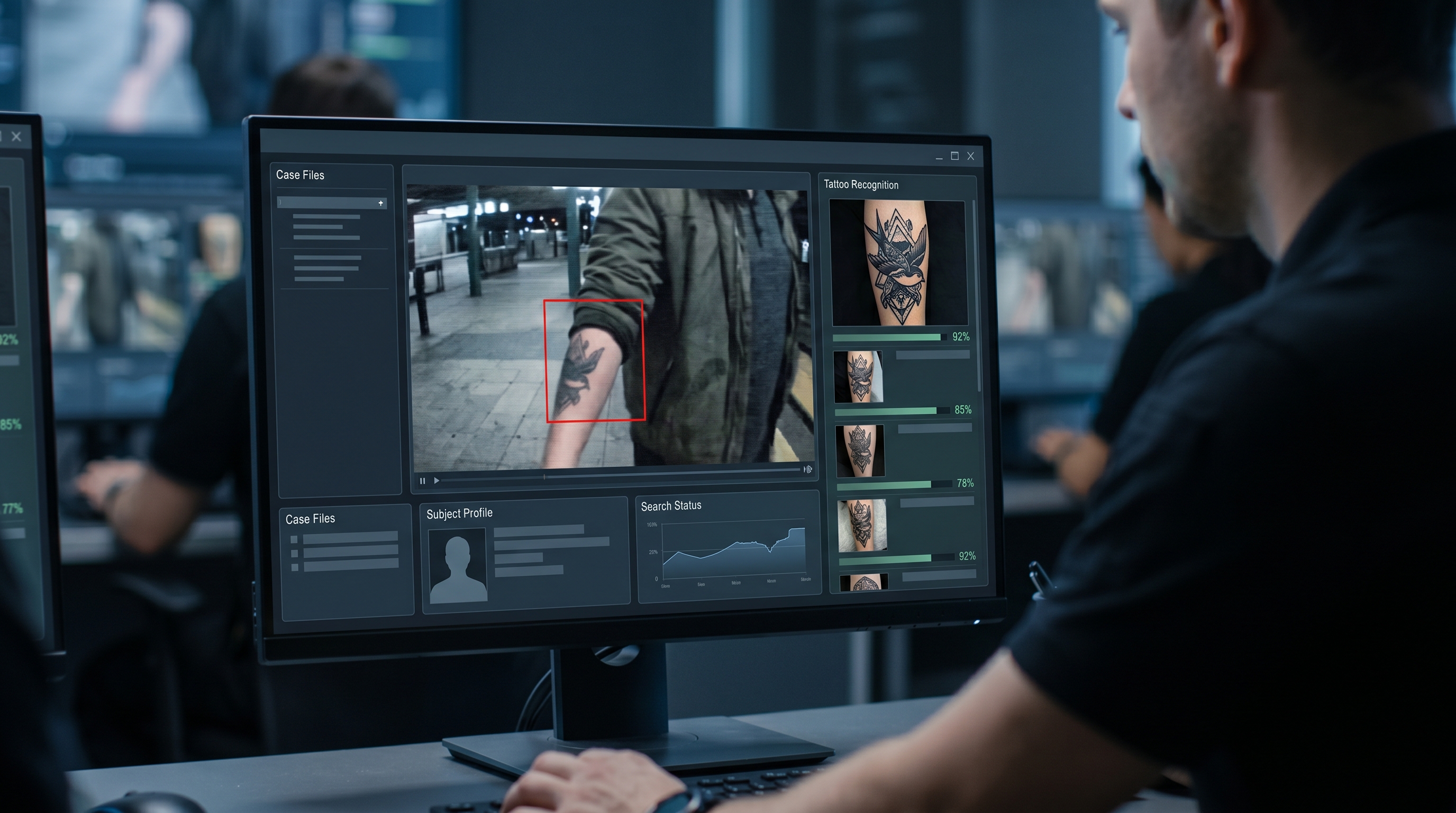


This article breaks down how the technology actually works, what it can and cannot do under real conditions, and how it fits into the broader biometric workflow that agencies already run.
Tattoos have become one of the most underused biometric signals in forensic work. Unlike fingerprints or DNA, they are often visible in security footage, witness photos, and social media posts, captured long before a suspect is in custody. Yet many agencies still rely on text-based gang databases and manual visual review to match them, a process that can take days and depends heavily on the memory of individual officers. AI-driven tattoo identification changes the economics of this work. It allows investigators to search millions of images in seconds, surface visually similar tattoos across jurisdictions, and connect cases that would otherwise stay disconnected.
Why Tattoos Matter as a Biometric Identifier
“Tattoos have been used for many years to assist law enforcement in investigations leading to the identification of criminals and victims.”
Tattoos sit in an unusual category. They are not strictly biometric in the traditional sense, since they are acquired rather than inherited, but they share many practical properties with biometrics. They are persistent, they are unique enough at the design level to differentiate individuals, and they can be captured passively from a distance.
For law enforcement, this combination is valuable in three specific situations.
When face capture fails. Hoods, masks, low-angle cameras, and poor lighting routinely defeat face recognition. A visible tattoo on the neck, hand, or forearm can survive conditions that destroy facial detail.
When identity is unknown. In cases involving unidentified remains, missing persons, or trafficking victims, tattoos often become the primary identifier. The FBI’s published guidance on tattoo classification was developed specifically because tattoos persist on bodies long after other features degrade.
When affiliation matters. Gang symbols, military insignia, and prison tattoos carry investigative meaning beyond identification. Recognizing them programmatically lets analysts cluster cases by affiliation rather than treating each as isolated.
The challenge has always been retrieval. An agency might hold hundreds of thousands of tattoo images across booking records, but without a way to search them visually, that archive is effectively read-only.
The Algorithmic Pipeline: Detection, Segmentation, Matching
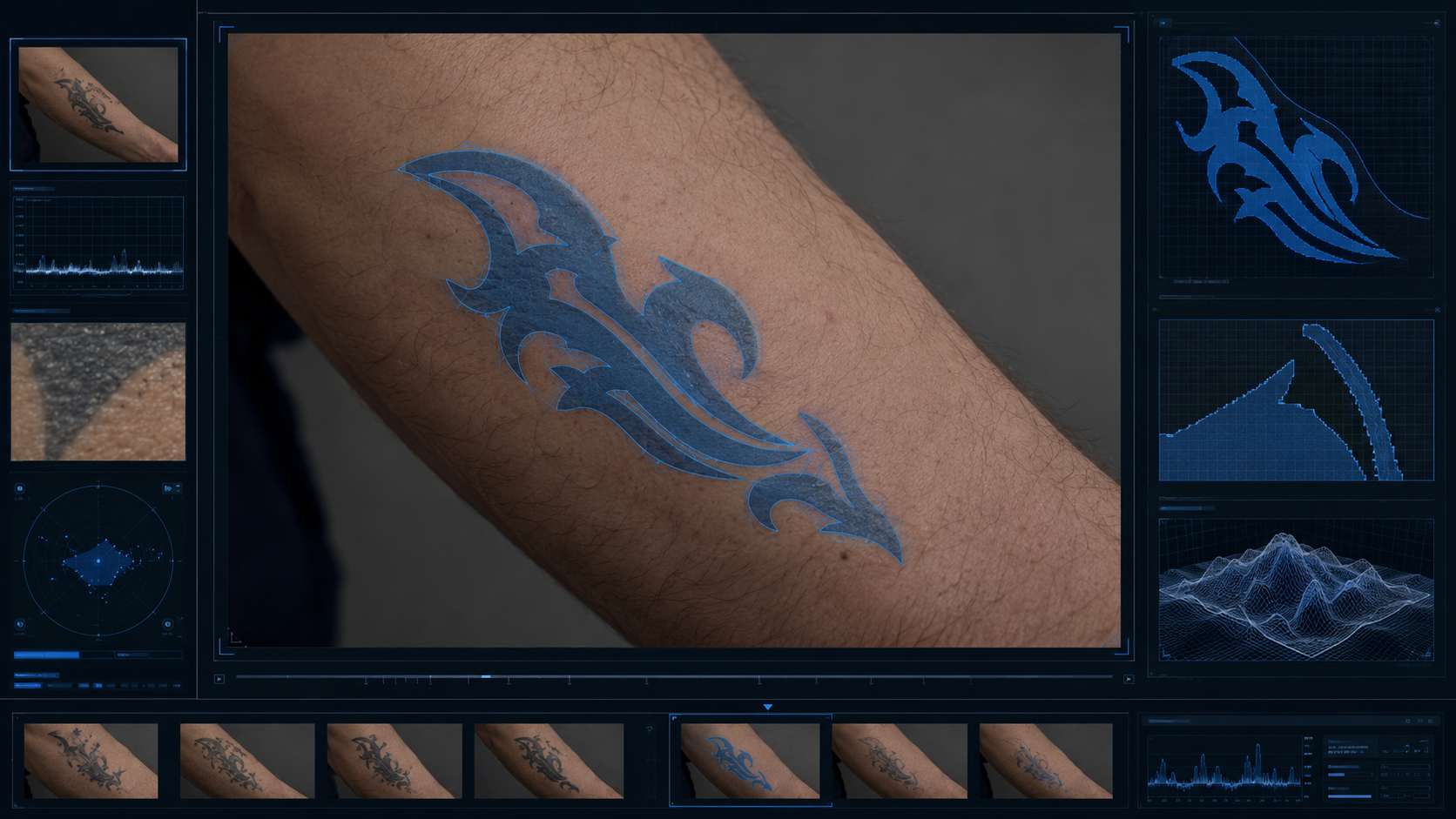
Modern tattoo recognition systems run a three-stage pipeline. Each stage uses deep learning, but the stages solve different problems and fail in different ways.
The three-stage tattoo recognition pipeline
| Stage | Function | Input | Output | Common failure mode |
|---|---|---|---|---|
| Detection | Locate tattoos within an image | Raw image (any source) | Bounding boxes with confidence scores | False positives on t-shirt graphics, henna, bruising |
| Segmentation | Isolate tattoo ink from skin | Detected region | Pixel-level mask of design | Incomplete masks on faded ink |
| Matching | Compare against the gallery | Segmented tattoo | Ranked similarity scores | Poor performance on probes unlike training data |
Stage 1: Detection
The system first has to locate tattoos within an image. This sounds trivial until you consider the inputs investigators actually work with: bodycam footage, mugshots taken under inconsistent lighting, photos pulled from phones, screenshots from social media. Tattoos can appear anywhere on the body, at any scale, partially occluded by clothing or other objects.
Detection models are trained on large, annotated datasets of tattooed skin versus everything else (untattooed skin, clothing patterns, background graffiti, printed designs on fabric). The output is a set of bounding boxes around regions the model believes contain tattoo content, each with a confidence score.
Detection is where most false positives originate. A model that has not seen enough variation will confuse printed t-shirt graphics, henna designs, or even bruising for tattoos. Production-grade systems aggressively filter at this stage rather than passing weak detections downstream.
Stage 2: Segmentation
Once a tattoo region is detected, segmentation refines the boundary. Instead of a rectangular box, the system produces a pixel-level mask that separates tattoo ink from surrounding skin. This matters for two reasons.
First, accurate segmentation lets the matching stage focus on the tattoo’s actual content rather than its background. Skin tone, lighting, and surrounding body parts vary enormously between images of the same tattoo, and including that variation degrades match quality.
Second, segmentation handles partial visibility. A tattoo photographed from an angle, or one that extends under a sleeve, will only be partially captured. A segmentation mask records exactly which portion of the design is available, which the matcher can then weigh appropriately.
Stage 3: Matching
The matching stage converts the segmented tattoo into a numerical representation, called a feature vector or embedding, that captures its visual content in a compact form. Two tattoos that look similar to a human produce similar vectors. Two that look different produce dissimilar vectors.
Identification then becomes a nearest-neighbor search. Given a probe image, the system computes its embedding and compares it against the embeddings of every tattoo in the gallery, returning the closest matches ranked by similarity score.
The quality of this stage depends almost entirely on how the embedding model was trained. Models trained only on high-quality, well-lit gallery images perform poorly on the noisy, real-world probes that investigators actually submit. Robust systems are trained explicitly on probe-gallery pairs that include the degradations the model will encounter in production: motion blur, low resolution, partial occlusion, color shifts, and aging.
Benchmarking Against Tatt-C
“On a gallery size of 4,375, the top performing algorithm reported a rank 10 hit rate of 99.4%.”
Anyone evaluating a tattoo recognition system should understand the NIST Tattoo Recognition Technology Challenge (Tatt-C), the reference benchmark in this field. Tatt-C, developed in coordination with the FBI’s Biometric Center of Excellence, defines a set of standardized use cases that mirror real investigative work.
The five core tasks are:
Tattoo identification. Given a probe image of a tattoo, find the same tattoo in a gallery, even if the gallery image was captured years earlier under different conditions.
Region of interest. Given a probe showing only part of a tattoo, find the complete tattoo in the gallery.
Mixed media. Match a tattoo photograph against a sketch or rendering of the same design, useful when only a witness description exists.
Tattoo similarity. Find visually similar tattoos across different individuals, supporting affiliation and pattern analysis.
Tattoo detection. Given an image that may or may not contain a tattoo, decide whether one is present.
Tatt-C benchmark tasks and operational meaning
| Tatt-C Task | What it measures | Real-world investigative use |
|---|---|---|
| Tattoo Identification | Match the same tattoo across captures over time | Identifying a suspect from booking history |
| Region of Interest | Match a partial probe to a full gallery image | Working from surveillance stills showing partial tattoos |
| Mixed Media | Match photographs to sketches or renderings | Witness-described tattoos with no photo available |
| Tattoo Similarity | Cluster visually related tattoos | Gang affiliation, organized crime analysis |
| Tattoo Detection | Determine whether an image contains a tattoo | Triaging large image batches before manual review |
Vendors that publish Tatt-C results give agencies a defensible basis for comparison. Vendors that do not are essentially asking for trust on faith. For procurement teams, the absence of independent benchmark performance is a meaningful signal.
How Systems Handle Blurry, Partial, and Aged Tattoos
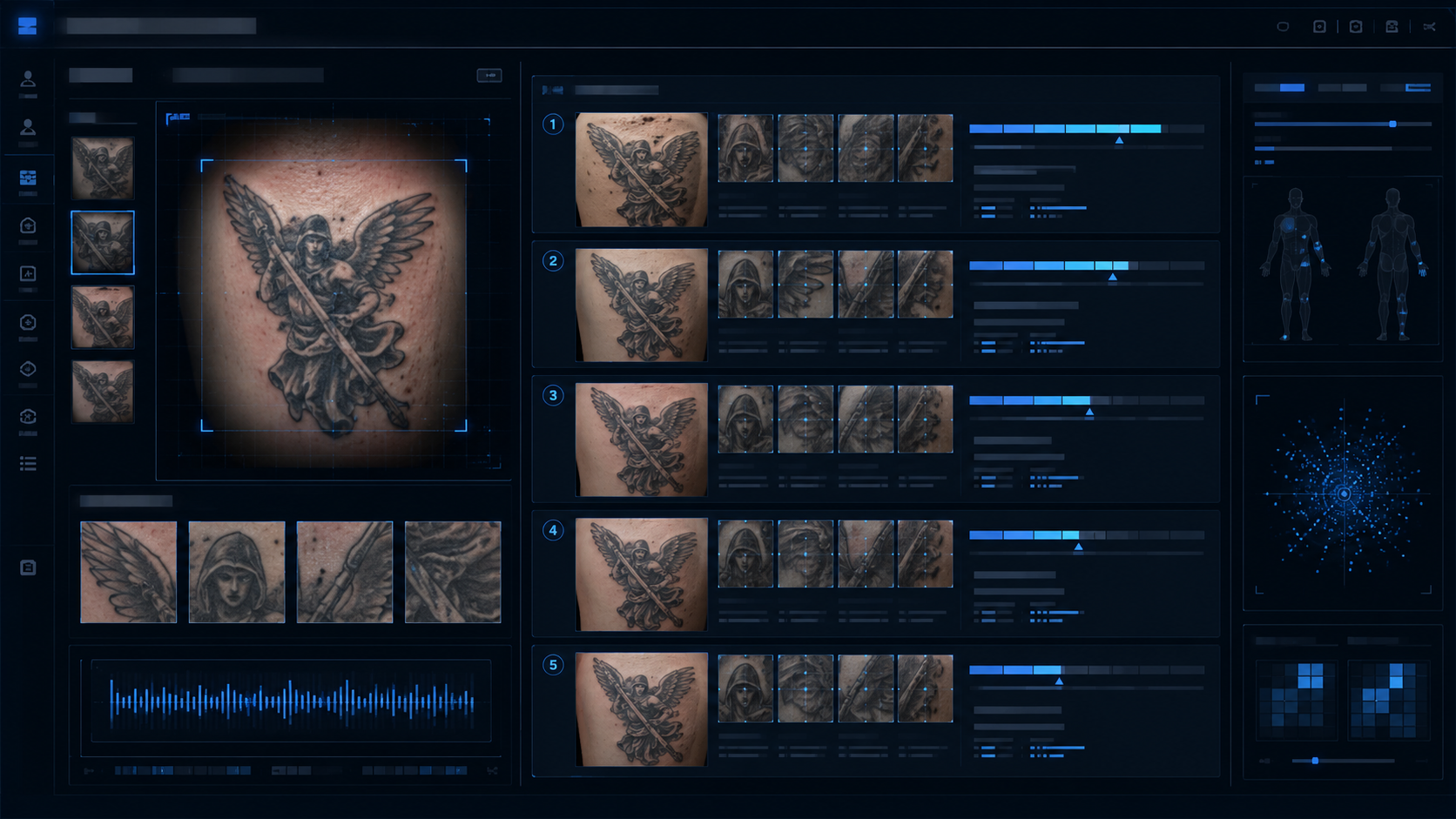
The hardest part of tattoo recognition is not matching clean gallery images to each other. It is matching the imperfect images that investigators actually have.
Blurry images come from motion, focus failure, or aggressive digital zoom. Modern systems mitigate this through training data augmentation: during model training, sharp images are deliberately degraded with synthetic blur so the embedding model learns to recognize the same tattoo across multiple quality levels.
Partial views are addressed at both the segmentation and matching stages. Segmentation records which portion of the design is visible. The matcher then uses local feature matching, comparing distinctive sub-regions of the tattoo rather than requiring the entire design to be present. A tattoo that is 40 percent visible can still produce a usable match if the visible portion contains discriminative content.
Aged or faded tattoos present a different challenge. Tattoos lose contrast over time, ink migrates, and lines soften. Skin trauma, weight change, and sun exposure further alter appearance. Systems trained only on recent booking photos will fail on cold cases. Systems trained on longitudinal data, where the same tattoo is captured across years, learn to abstract beyond surface appearance and match on design content rather than current ink condition.
The honest assessment is that no system handles all three degradations equally well. Investigators should expect strong performance on moderate quality probes and treat extreme cases (heavy blur combined with partial occlusion combined with age) as edge conditions where human review remains essential.
Where Tattoo Recognition Fits in the ABIS Workflow
Tattoo recognition is most useful when it operates as one signal inside a broader biometric workflow, not as a standalone tool. This is where integration with an Automated Biometric Identification System (ABIS) matters.
In a typical investigative flow, an analyst submits a probe image, sometimes a single still from surveillance, sometimes a packet of photos from a phone. The ABIS performs face recognition where a face is visible, tattoo recognition on any visible tattoos, and fingerprint matching if latent prints are also part of the case. Results from each modality are returned with similarity scores and gallery references.
The investigative value comes from correlation. A face match alone might return ten candidates. A tattoo match alone might return twenty. The intersection of the two often returns one. When fingerprint or iris evidence is also available, confidence rises further, and the system can rank candidates by combined multimodal score rather than by any single biometric.
This multimodal approach also handles the failure modes of each individual signal. Faces fail under occlusion. Tattoos fail when not visible. Fingerprints require physical contact with a surface. No single modality is reliable across all cases, but the combination produces a system that degrades gracefully rather than failing outright.
For agencies replacing legacy systems, the practical question is whether their current ABIS supports tattoo as a first-class modality or treats it as a bolt-on. Bolt-on integrations tend to create parallel workflows, separate databases, and inconsistent audit trails. First-class integration means tattoo results appear in the same case file, with the same provenance and chain-of-custody as face and fingerprint results.
Practical Recommendations for Agencies Evaluating Tattoo Recognition
For agencies considering deployment or upgrade, a few practical points consistently separate successful programs from stalled ones.
Audit your existing tattoo image archive before procurement. The value of any system depends on the gallery you can give it. Booking photos, intake records, and case files often contain tattoo images that have never been catalogued. Knowing what you actually have, and in what condition, determines what kind of system you need.
Require published Tatt-C performance. Standardized benchmark results are the only way to compare vendors honestly. Internal marketing numbers are not a substitute.
Pilot with degraded probes, not clean ones. Many systems demo well on high-quality images and fail on real surveillance frames. Insist on testing with the kinds of images your investigators actually submit.
Plan for multimodal integration from the start. Tattoo recognition deployed in isolation rarely justifies its cost. Tattoo recognition integrated into a unified ABIS workflow consistently does.
Verify ethical AI and bias documentation. Tattoo distributions vary across demographic groups, and systems trained on narrow data can produce biased results. Vendors should be able to document training data composition and demographic performance.
How ROC Approaches Tattoo Recognition
ROC’s tattoo recognition is built into the same multimodal SDK that powers its face, fingerprint, and iris algorithms, all of which hold top-tier rankings in NIST evaluations. This matters because it removes the integration tax that agencies typically pay when combining biometric modalities from different vendors.
Within the ROC ABIS, tattoo searches run against the same case database used for face and fingerprint, with results merged into a single multimodal ranking. Investigators see one candidate list, scored across every available modality, rather than separate result sets that have to be cross-referenced manually. For agencies replacing legacy systems, this consolidation often reduces investigative time on identity cases by a significant margin.
ROC is also one of the few biometric vendors built entirely on American-made, ethically developed AI, with documented bias performance across demographic groups, a factor that has become non-negotiable for federal procurement.
Conclusion
Tattoo recognition is no longer an experimental capability. It is a production-grade investigative tool, validated against published benchmarks, and most valuable when it operates as part of a unified biometric workflow rather than a standalone search. Agencies that integrate it thoughtfully, with attention to data quality, multimodal correlation, and ethical performance, recover investigative value that was previously locked in their own archives.
The technology will not replace investigators. It will give them a way to search evidence they already have, faster and more consistently than manual review allows.
Learn More
If your agency is evaluating tattoo recognition as part of a broader biometric modernization, explore ROC’s tattoo recognition capabilities or get in touch to discuss how multimodal identification fits into your existing investigative workflow.
Future-ready insights.
Straight from the source.
Subscribe for Vision AI insights, product updates, and stories from the front lines of identity and intelligence.
Frequently Asked Questions
What is tattoo recognition and how does it work?
Tattoo recognition is a biometric technology that uses AI to detect, segment, and match tattoo images across large databases. It operates in three stages: detection locates tattoos in an image, segmentation isolates the design from surrounding skin, and matching compares the tattoo against gallery records using deep learning embeddings. The result is a ranked list of visually similar tattoos, scored by similarity.
Accuracy depends on image quality, gallery size, and the conditions the model was trained on. Production-grade systems benchmarked against the NIST Tattoo Recognition Technology Challenge (Tatt-C) deliver high match rates on clean probes and meaningful performance on degraded inputs. Tattoos that are blurry, partially occluded, or significantly aged remain harder cases and typically require human review of top candidates.
Yes, with limitations. Modern systems use local feature matching, which compares distinctive sub-regions of a tattoo rather than requiring the entire design to be visible. A tattoo that is 40 to 50 percent visible can still produce a usable match if the visible portion contains discriminative content. Heavily faded or aged tattoos perform better when the underlying model was trained on longitudinal data showing the same tattoos across years.
The two are complementary, not competitive. Face recognition fails when faces are occluded, turned away, or captured in low light. Tattoo recognition works when faces are not visible, but tattoos are. In multimodal investigative workflows, combining face, tattoo, and fingerprint matching narrows candidate lists dramatically compared to any single modality used in isolation.
The NIST Tattoo Recognition Technology Challenge (Tatt-C), developed with the FBI’s Biometric Center of Excellence, is the reference benchmark for tattoo recognition systems. It evaluates five use cases: tattoo identification, region of interest matching, mixed media matching (photo against sketch), tattoo similarity for affiliation analysis, and tattoo detection. Vendors that publish Tatt-C results give agencies a defensible basis for comparison.
Yes. Beyond matching one specific tattoo to its owner, similarity search can cluster visually related designs across individuals, surfacing patterns that indicate gang membership, military service, or other affiliations. This is one of the Tatt-C standard tasks and is widely used in gang intelligence and threat assessment work.
In a properly integrated Automated Biometric Identification System, tattoo recognition runs as a first-class modality alongside face, fingerprint, and iris matching. A single probe submission returns merged, multimodal results within one case file, rather than separate searches that have to be cross-referenced manually. ROC ABIS is built this way from the ground up.
Tattoo recognition is generally used as an investigative lead, not as standalone courtroom evidence. Like other AI-driven biometric tools, it points investigators toward candidates for human review. Final identification typically rests on corroborating evidence, expert testimony, and documented chain of custody. Agencies should consult their legal counsel on jurisdiction-specific admissibility standards.
Higher resolution and good lighting always improve results, but production systems are designed to operate on real-world inputs: surveillance stills, bodycam footage, phone photos, and social media images. Minimum useful resolution varies by tattoo size and complexity, but most systems can produce candidate matches from images where a human reviewer can recognize the tattoo as a tattoo.
Yes. ROC’s tattoo recognition is built into the same multimodal SDK that powers its NIST-ranked face, fingerprint, and iris algorithms. It is available as a standalone capability or integrated into ROC ABIS for unified multimodal investigations, with full documentation of bias performance and ethical AI compliance.