



ROC’s move from U.S. leader to global leader in NIST testing marks a new milestone in facial age estimation. This greater precision gives organizations a stronger foundation for age assurance, supporting more informed access decisions and smoother user experiences across digital onboarding, age-restricted commerce, and child online safety.
Three Datasets. Three Global #1 Results.
ROC leads the global field in facial age estimation with the lowest Mean Absolute Error (MAE) on the Visa, Application, and Mugshot datasets in the NIST Face Analysis Technology Evaluation for Age Estimation and Verification (FATE AEV). MAE measures the average difference between an estimated age and a person’s actual age, expressed in years. The lower the score, the closer the age estimate.
ROC’s latest submission, ROC-003, ranked first on three of the four datasets in NIST’s primary MAE comparison. These results cover adults ages 18–30 across distinct types of imagery, from visa photographs to standardized law enforcement portraits.
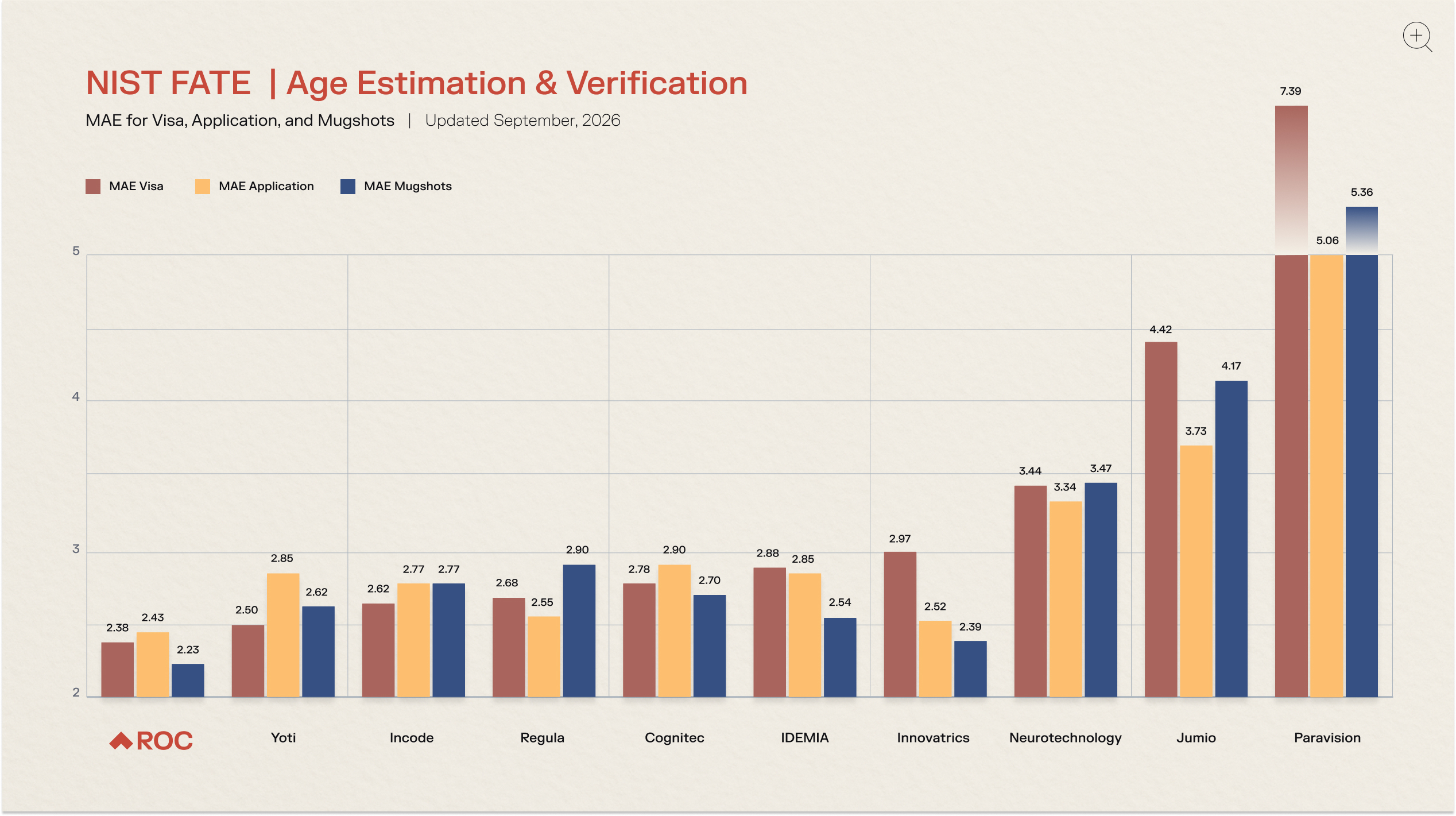
Mean Absolute Error (MAE) in years for selected vendors on NIST’s Visa, Application, and Mugshots datasets. Lower is better. Based on vendors’ latest submissions, listed by NIST as of September, 2026. NIST FATE AEV
#1 Global Age Estimation Provider on Visa Dataset
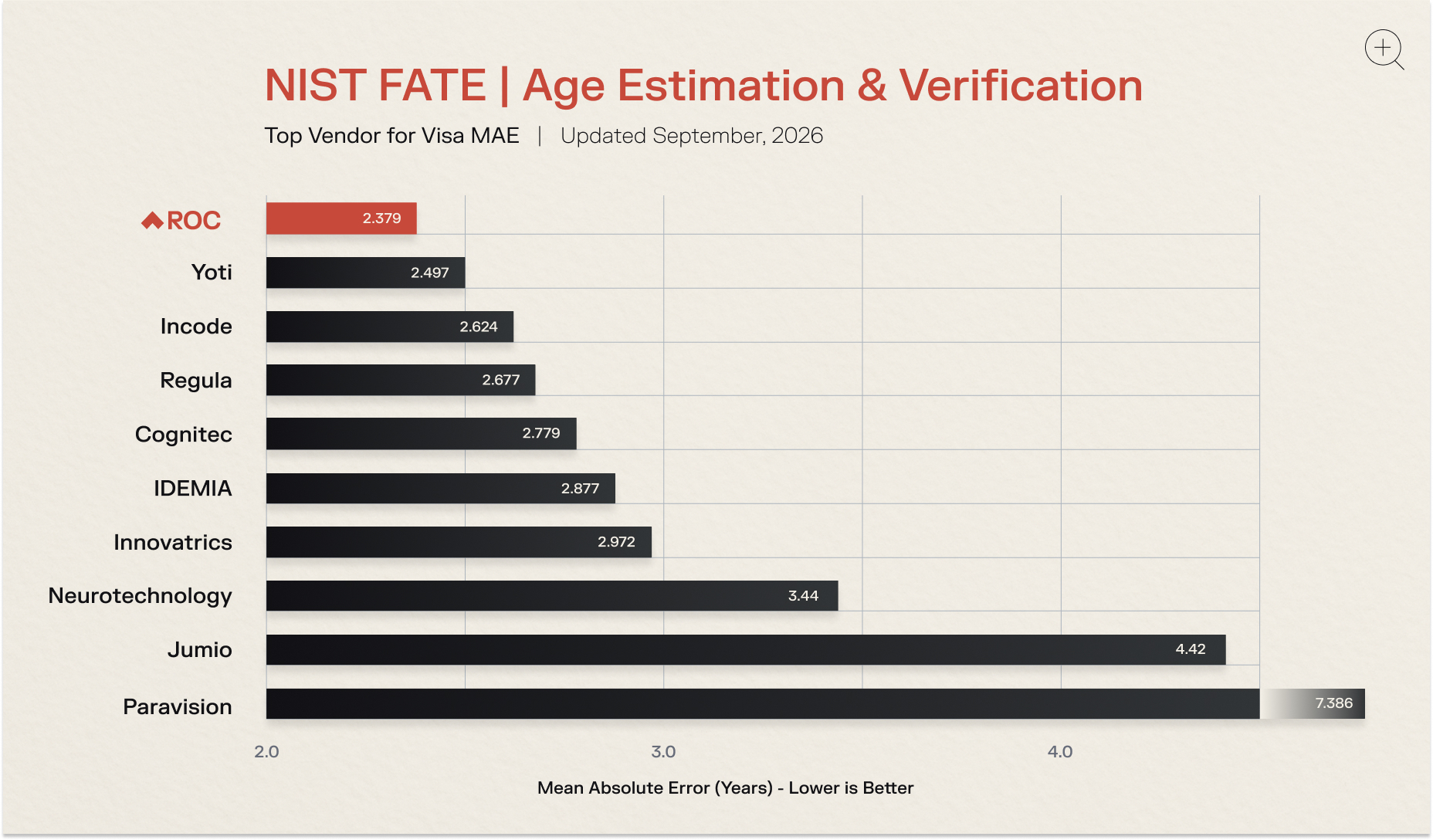
Mean Absolute Error (MAE) in years on NIST’s Visa dataset, ages 18–30. Lower is better. Based on vendors’ latest submissions (ROC-003, September, 2026). NIST FATE AEV
ROC-003 ranked first on NIST’s Visa dataset with an MAE of 2.379 years. This comparison uses frontal visa photographs without glasses. The result improves on ROC’s previous submission and establishes a new global lead in this category.
#1 Global Age Estimation Provider on Application Dataset
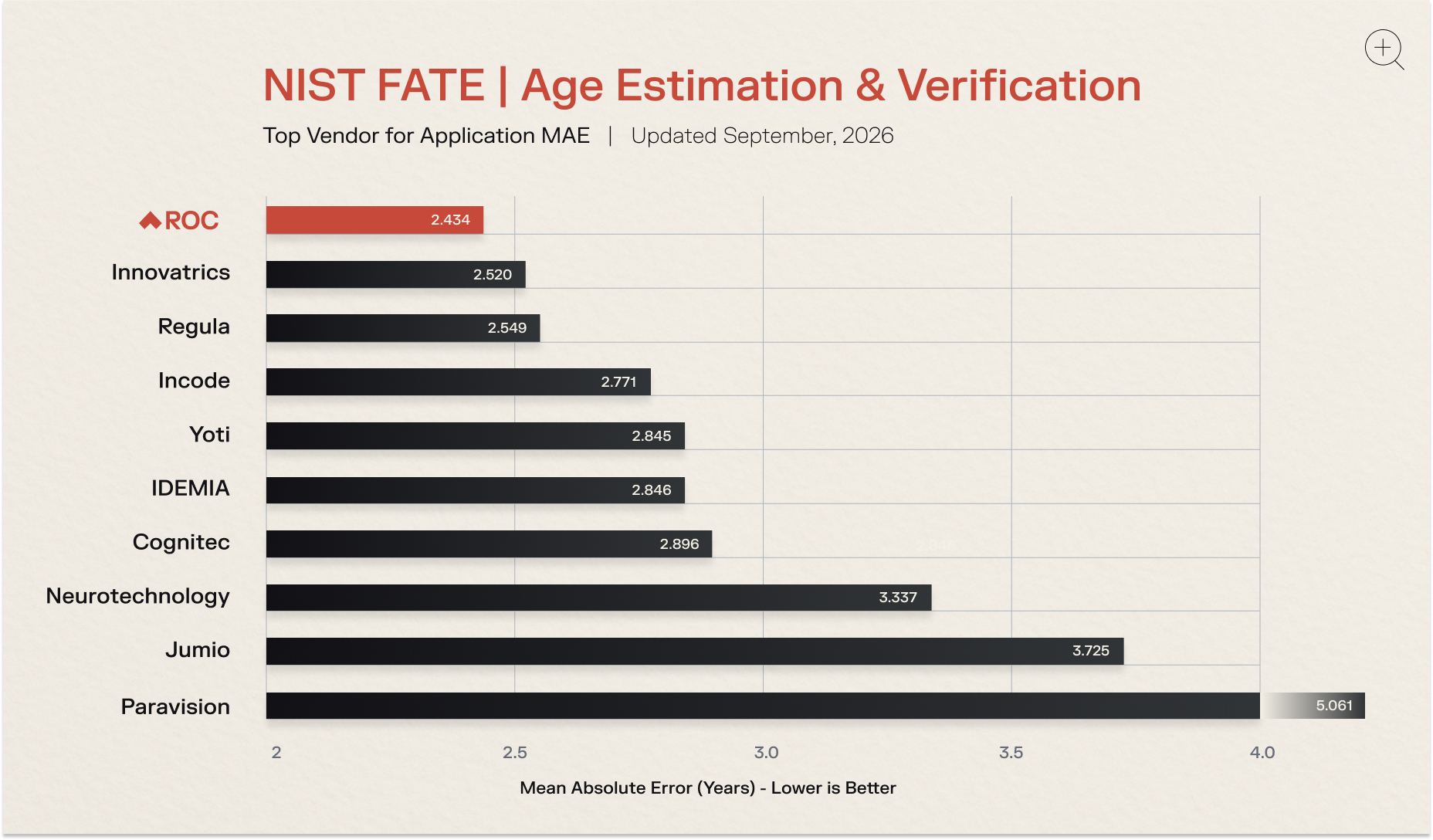
Mean Absolute Error (MAE) in years on NIST’s Application dataset, ages 18–30. Lower is better. Based on vendors’ latest submissions (ROC-003, September, 2026). NIST FATE AEV
ROC-003 also ranked first on the Application dataset with an MAE of 2.434 years. The dataset comprises of immigration application photographs captured during attended interviews at U.S. immigration offices, with candidates from 34 countries represented across six regions. Leading both the Application and Visa datasets demonstrates ROC’s accuracy across two distinct sources of identity imagery.
#1 Global Age Estimation Provider on Mugshots Dataset
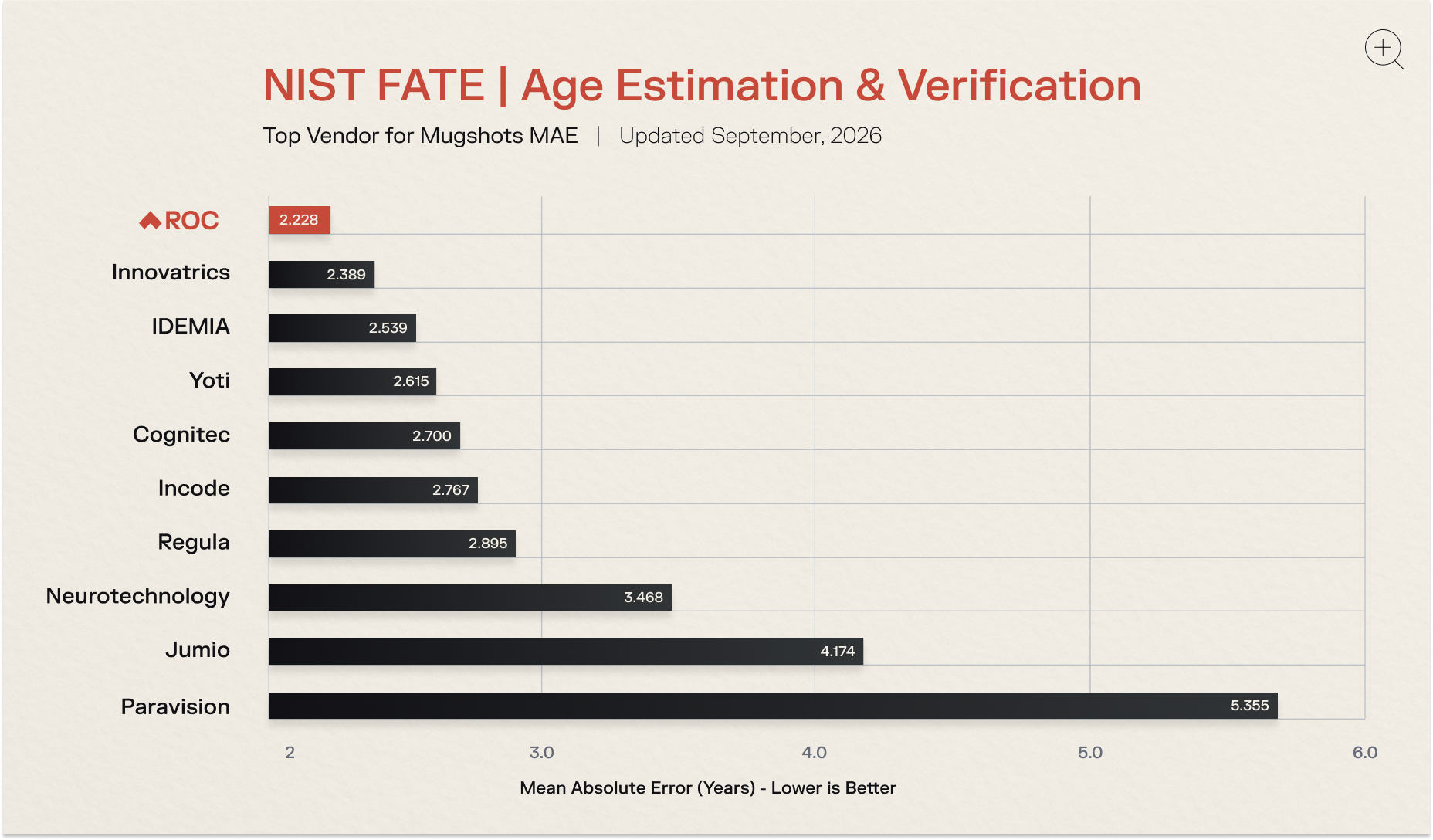
Mean Absolute Error (MAE) in years on NIST’s Mugshots dataset, ages 18–30. Lower is better. Based on vendors’ latest submissions (ROC-003, September, 2026). NIST FATE AEV
On the Mugshots dataset, ROC-003 delivered the lowest MAE at 2.228 years, improving on its previous submission’s result of 2.353 years. This dataset uses standardized law enforcement portraits. ROC’s latest result extends its existing global lead, with its two most recent submissions now occupying the first and second positions in Mugshot MAE.
“Six months ago, ROC landed the top spot among U.S. age estimation vendors in NIST FATE testing. Today, our ROC-003 algorithm ranks #1 globally in MAE on three of NIST’s four primary datasets. This progress reflects the skill and persistence of the team behind our algorithms as we continue to push the science forward.”

Still Leading in Child Online Safety
ROC also retains the top spot in Child Online Safety MAE for ages 13–16. Its two most recent submissions hold the top two positions:
- ROC-002: #1 globally, with an MAE of 1.6479 years.
- ROC-003: #2 globally, with an MAE of 1.9447 years.
For platforms serving younger users, a few years can change a person’s online experience: what content they see, which features they can use, and what protections apply. ROC’s top two submissions for ages 13–16 give platforms a strong age signal to guide access and safety decisions, and identify when additional verification is needed. These results build on our previous NIST update: continued leadership in this critical youth age range, alongside broader gains across NIST’s primary adult datasets.
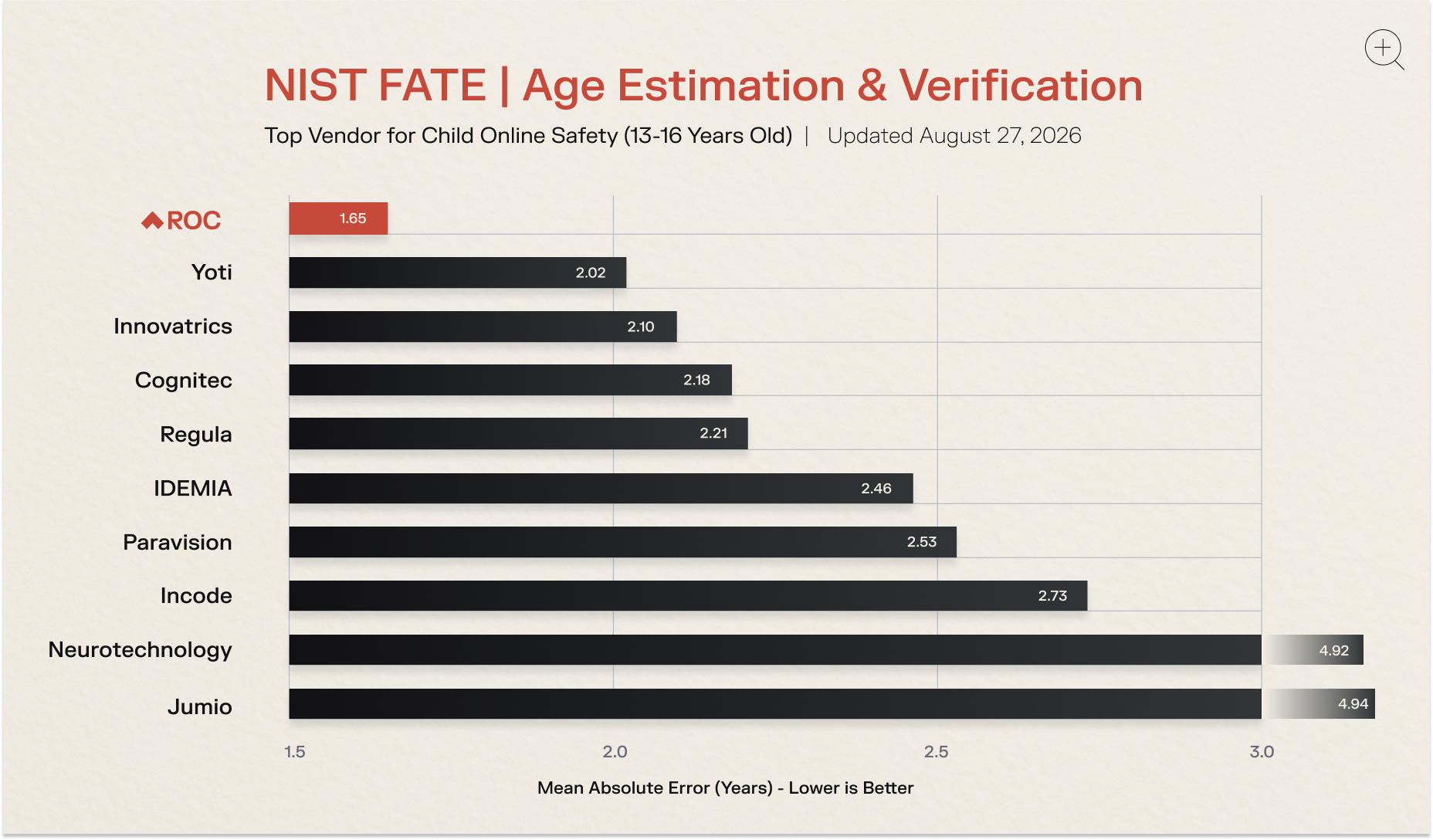
ROC is the #1 global age estimation vendor for Child Online Safety. Mean Absolute Error (MAE) in years in NIST’s Child Online Safety scenario, ages 13-16. Lower is better. Based on vendors’ latest submissions, listed by NIST as of September, 2026. NIST FATE AEV
“Age estimation is ready to play a bigger role in age assurance. Our goal is to give organizations a precise, low-friction signal they can use to shape an experience, apply protections, or determine when additional verification is needed. ROC’s latest NIST results demonstrate the accuracy this technology can achieve and its potential to support high-impact missions like child online safety.”

From U.S. Leader to Global Leader
ROC’s earlier results established it as the top U.S. age estimation provider, with global first-place finishes in Child Online Safety and Mugshots. Its latest submission expands that lead to Visa and Application MAE as well.
For organizations comparing age estimation companies, independent testing provides evidence to guide technology selection. The next step is putting that capability to work in experiences that balance protection, access, and ease of use:
- Digital Onboarding: Add age intelligence to registration and identity workflows without requiring an identity document from every user. Use an age estimate to guide the next step, whether that means continuing onboarding, applying age-appropriate settings, or requesting additional verification.
- Age-Restricted Commerce: Support eligibility decisions for restricted products and services with age checks built into the customer journey. Apply thresholds tailored to the offering and route users near those thresholds to additional verification, helping balance access requirements with a smoother purchasing experience.
- Child Online Safety: Help platforms tailor access, features, and protections to a user’s estimated age. Age intelligence can inform content filtering, privacy defaults, and communication controls, while identifying when additional age assurance is needed to support safer experiences for younger users.
Gaming & Gambling: Support age-aware onboarding, access to games and features, and age-appropriate community experiences. Use age estimates to inform access decisions, support responsible gambling controls, or route users to additional verification when needed. - Age-Gated Digital Content: Help services make age-aware access decisions for restricted content. Use an age estimate to inform the next step in the assurance process, based on the service and its requirements.
Accuracy Gains Across NIST Datasets
Compared with ROC-002, ROC-003 lowered Mean Absolute Error (MAE) across NIST’s primary datasets:
- Visa: 2.640 to 2.379 years — 9.9% lower MAE
- Application: 2.666 to 2.434 years — 8.7% lower MAE
- Border: 3.141 to 2.845 years — 9.4% lower MAE
- Mugshots: 2.353 to 2.228 years — 5.3% lower MAE
Performance Across Interocular Distance
In NIST’s mugshot analysis by interocular distance (IOD), ROC-003 ranked in the top two across five of six ranges:
- 15–79 IOD: MAE 1.80 — Rank #1
- 80–119 IOD: MAE 1.73 — Rank #1
- 120–199 IOD: MAE 1.79 — Rank #2; ROC-002 ranked #1
- 200–299 IOD: MAE 1.81 — Rank #2; ROC-002 ranked #1
- 300–499 IOD: MAE 1.72 — Rank #2; ROC-002 ranked #1
- 500–955 IOD: MAE 1.70 — Rank #3
NIST’s IOD analysis uses mugshots of white males ages 18–30 collected at multiple U.S. venues. The images use a standard photographic setup, with variation in cameras and client software.
Robustness to Head Rotation
NIST’s sin (Yaw) measure estimates how much age-estimation error increases with 90° of head rotation; lower values indicate less sensitivity to pose. Among the five highest-ranked algorithms for MAE, ROC-003 had the lowest dependence score of 2.44, indicating less sensitivity to head rotation.
Understanding NIST FATE AEV
NIST’s Face Analysis Technology Evaluation for Age Estimation and Verification is an ongoing evaluation open to developers worldwide. It measures algorithms that estimate age from facial images and publishes results on accuracy and computational efficiency. NIST FATE AEV is one of the strongest ways to independently assess algorithm performance across a range of age-assurance use cases.
NIST evaluations do not constitute endorsement of any vendor, product, or technology.
Future-ready insights.
Straight from the source.
Subscribe for Vision AI insights, product updates, and stories from the front lines of identity and intelligence.