

The next generation of physical security ecosystems like ROC Access connects identity, access, and real-time threat awareness to extend existing physical access control systems without replacing them.
Access Control Has Outgrown the Credential
For decades, access control has centered on one basic premise: was a credential presented?
This model still defines the market, but it is no longer enough. Although credentials remain an important part of access security, they cannot always confirm that the person presenting them is the authorized user. Badges, PINs, and mobile credentials can be lost, stolen, shared, or used fraudulently.
Today’s access points are operational decision points sitting at the intersection of identity, activity, and risk. For organizations operating in high-security, high-throughput, or high-consequence environments, the challenge at the door is therefore no longer limited to validating a credential.
Physical access control is evolving beyond static credential checks toward a more intelligent model — one that can verify the person requesting entry, adapt to different security conditions, and contribute to broader situational awareness.
Biometrics provides stronger identity assurance. Video analytics adds context. Together, they allow an access point to function as part of the wider security environment rather than as a standalone reader.
“Access control is no longer just about opening doors. It is about the intelligence layer behind it: customers want to know who is actually there, what risk is present, and how to make faster, smarter decisions. We’ve seen strong demand for a solution that improves access assurance without forcing customers into a rip-and-replace project. ROC Access brings this all together in a way the market has been missing.”

ROC Access: Biometric Access Control Beyond the Badge
ROC Access is an intelligent biometric access control system that combines real-time face recognition, AI-powered video analytics, and flexible access workflows to help organizations make stronger access decisions based on who is present and what is happening at the point of entry.
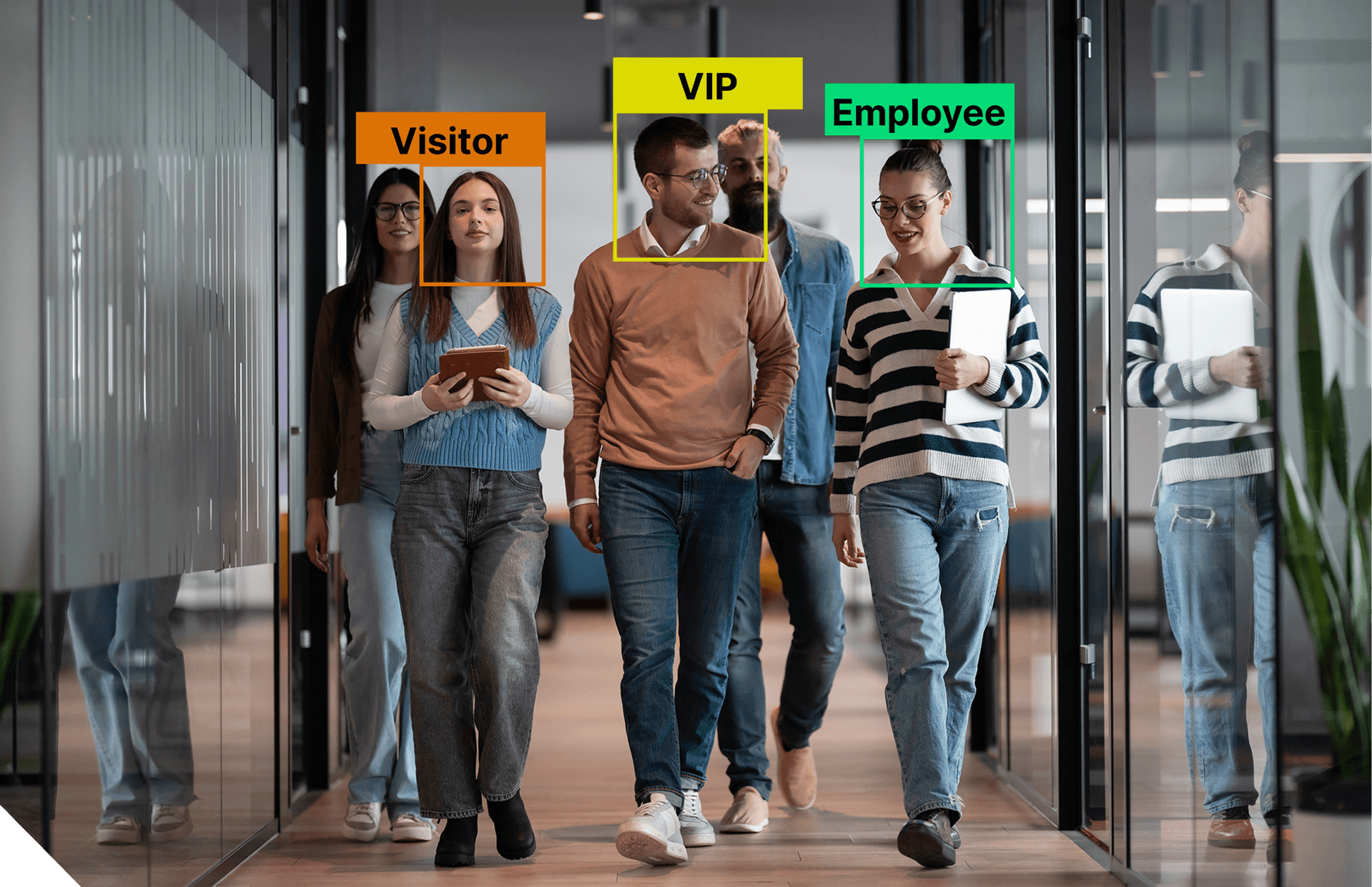
Unlike conventional biometric readers that focus narrowly on the person directly in front of the device, ROC Access can evaluate multiple people and signals in parallel. It can authenticate an authorized employee while simultaneously screening someone in the background against a watchlist and analyzing the surrounding scene for visible firearms or other configured threats.
ROC Access can support environments ranging from frictionless, high-throughput crowd-based entry to more controlled, single-user high-security applications. Organizations can tailor identity verification and access rules to the requirements of a particular door, facility, or security posture.
Just as importantly, ROC Access is designed to work with the physical access control systems organizations already use. Existing PACS infrastructure continues managing doors, zones, permissions, and access rights while ROC adds real-time biometric identity and scene intelligence around each access event.
Organizations can also deploy the optional ROC Access Face1 biometric reader to provide stronger identity assurance at the entry point. Unlike traditional biometric readers which process images and generate templates on the non-secure side, ROC Access Face1 keeps image processing, template generation, and biometric matching on the secure side, with ROC Watch handling biometric processing, while the existing access control system continues to control the door.
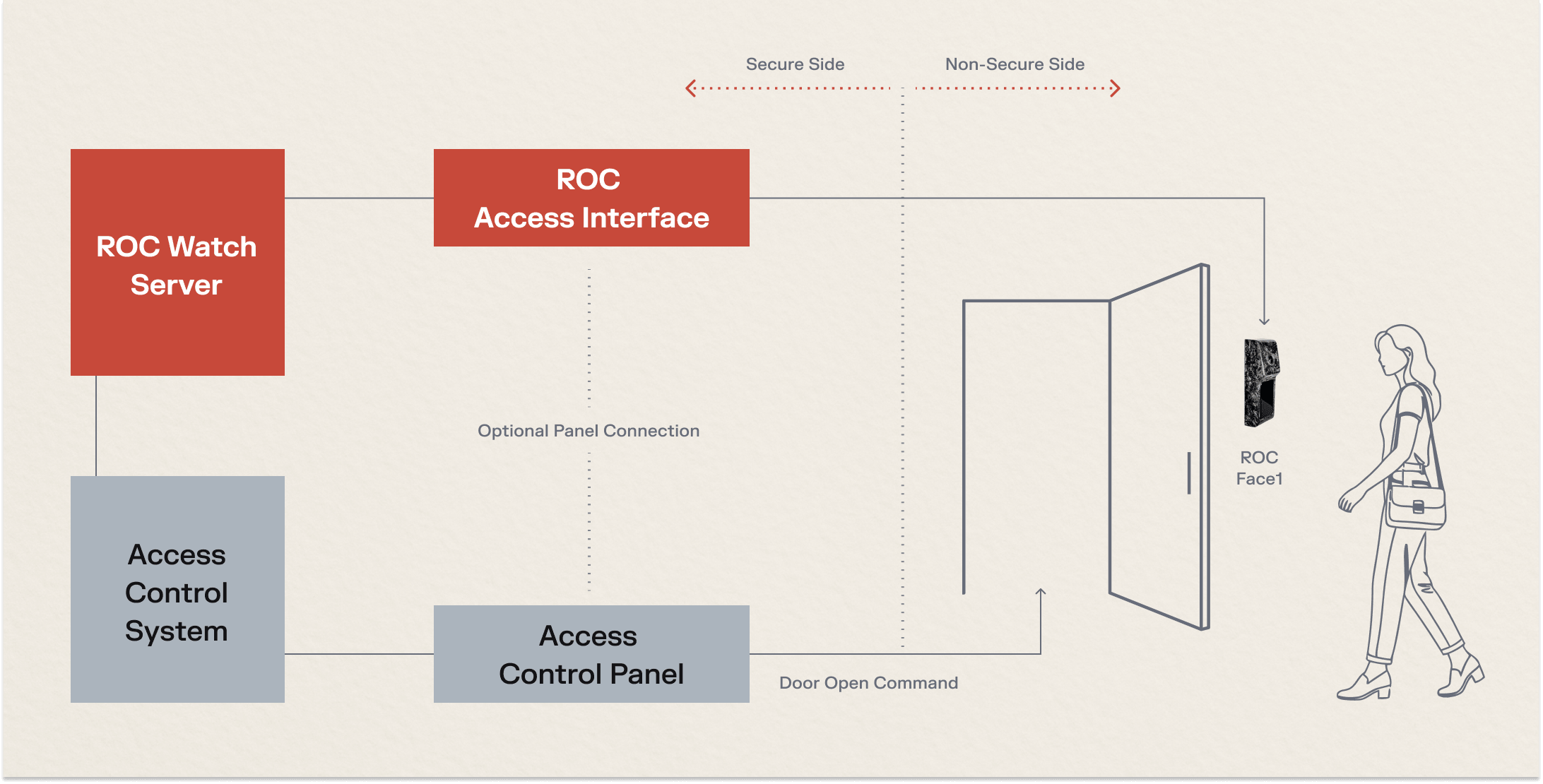
Secure-side processing architecture for ROC Access Face1, an ultra compact transparent mode face biometric reader with parallel intelligence features.
Explore ROC Access
ROC Watch: One View for Access Control and Video Analytics
ROC Access is powered by ROC Watch, ROC’s unified video analytics platform. Together, they connect biometric identity, live threat detection and alerting, and investigative search across access points and surrounding camera networks.
ROC Watch analyzes live and recorded video to help authorized teams identify people and vehicles of interest, detect configured threats, generate alerts, and investigate activity and support operational decision-making across the wider security environment. This extends awareness beyond the person immediately in front of the reader and connects what happens at the door with activity across the surrounding facility.
Instead of ending with a single access decision, each interaction can become part of a continuous operational picture that security teams can monitor, review, search, and investigate. The same platform can support post-event video forensics, pattern-of-life analysis, and event reconstruction when teams need to understand what occurred before, during, or after an access event.

ROC Watch capabilities include:
- Access assurance
- Watchlist alerting
- Gun detection
- Badgeless visitor management
- Perimeter protection
- Automated license plate recognition (ALPR)
- Active incident response
- Video forensics
Explore ROC Watch video analytics
“An access control reader should provide value 24/7, not just for the brief moments when users request access. Integrated weapon detection, watchlisting and a host of configurable analytic features set a new standard for the biometric terminals market. This helps customers secure entry points with greater confidence and greater awareness of the broader security environment.”

Built on Independently Evaluated ROC Biometrics
Effective biometric access control requires reliable performance beyond controlled laboratory conditions. Real deployments must account for changing lighting, variable camera angles, different traffic patterns, and people moving naturally through the environment.
ROC Access is backed by the biometric and Vision AI capabilities ROC has already brought to market across defense, public safety, and digital identity environments. The platform builds on ROC’s NIST-ranked face recognition technology, advanced face analytics, single-frame passive liveness, and iBeta Level 2 presentation attack detection. These independently evaluated technologies provide a strong foundation for identity decisions across a range of real-world access environments.
By combining biometric matching with live scene analysis, ROC Access strengthens the connection between the identity being evaluated and the person physically requesting entry — not simply the credential being presented.
Modernize Physical Access Control Without Replacing Your PACS
One of the most important ideas behind ROC Access is simple: customers should not have to rip out working systems to modernize access control. Built on an open, vendor-agnostic architecture, ROC Access is designed to complement existing physical access control systems, VMS platforms, and camera infrastructure, including mixed-vendor environments. Current PACS deployments continue managing doors, zones, permissions, and access rights. ROC simply enhances that environment by feeding it more intelligent inputs and richer alerts.
This integration-first approach protects prior investment, reduces deployment friction, and allows organizations to introduce new capabilities at the pace their facilities and security requirements demand. It also helps customers draw more value from existing camera infrastructure, supporting biometric access, threat alerting, watchlist screening, and post-event investigation without creating another isolated security workflow.
Redefining Security Through Connected Intelligence
Physical access control should do more than validate a credential and open a door. The next generation of access will be defined by the connection between identity, activity, and action. Discover how ROC Access achieves this seamlessly, empowering security teams to unlock new capabilities without requiring a wholesale rebuild of their existing technology infrastructure.
Learn more about ROC Access biometric access control
Future-ready insights.
Straight from the source.
Subscribe for Vision AI insights, product updates, and stories from the front lines of identity and intelligence.