



In the latest NIST Evaluation of Latent Fingerprint Technologies (ELFT), ROC achieved the lowest False Negative Identification Rate (FNIR) at Rank-1 on the largest dataset in the benchmark, the U.S. Department of Defense (DoD) latent fingerprint dataset. With the fastest search speeds and materially smaller template sizes, ROC enables law enforcement, intelligence, and ABIS operators to scale latent search operations efficiently — returning high-confidence matches faster while reducing infrastructure demands and total cost of ownership.
#1 Global Rank-1 Accuracy and Fastest Search Speed for DoD Dataset
ROC placed 1 of 22 for lowest FNIR at Rank-1 in the DoD dataset, the largest latent fingerprint test in the ELFT evaluation, comprising 5,259 probes. This combination of Rank-1 accuracy and search efficiency reflects the architectural focus of ROC’s fingerprint platform: next-generation performance that holds under operational load.
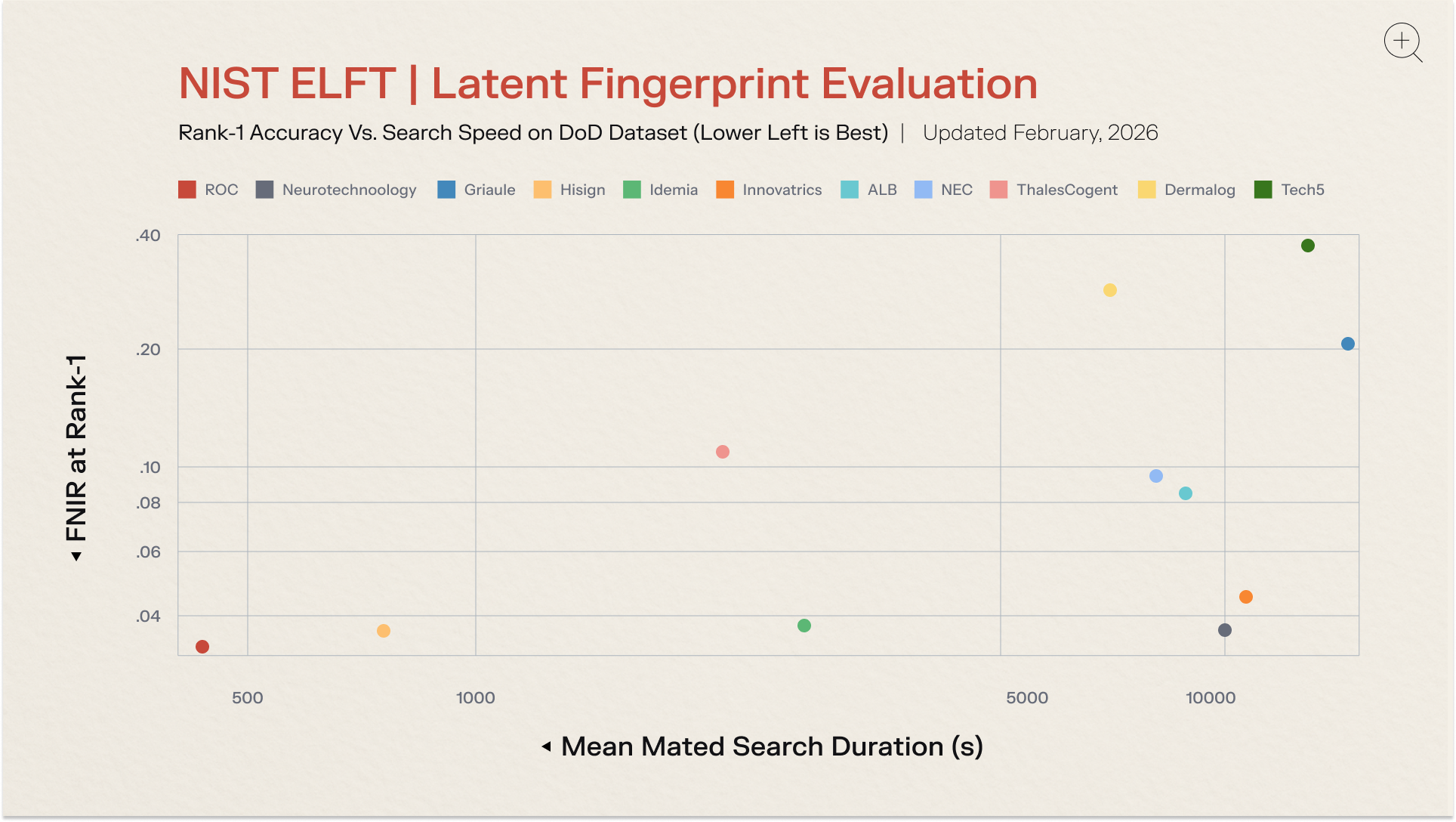
This chart plots FNIR at Rank-1 on the DoD dataset against Mean Mated Search Duration for all global vendors in the NIST ELFT benchmark, illustrating how systems balance accuracy and efficiency at scale.
Performance at this scale is a meaningful indicator of how algorithms behave under real-world workload conditions, where even fractional differences in FNIR can translate into measurable changes in investigative workload and result confidence.
Rank-1 performance is especially relevant in operational workflows, where analysts rely on high-confidence candidates appearing at or near the top of the list. At this scale, small improvements compound quickly, reducing review time and accelerating case progression.
“Latent fingerprint identification is one of the most challenging problems in biometrics. Achieving the lowest FNIR at Rank-1 on the largest dataset in ELFT reflects years of focused algorithmic innovation. Our goal is not just to perform well in controlled settings, but to deliver consistent, high-confidence matching under real operational conditions.”
Read the official press release
Speed, Accuracy, and Architectural Efficiency
Latent fingerprint search is not just about accuracy. It is about how quickly a system can return high-confidence candidates without increasing analyst burden. A system that is accurate but slow creates backlog, while a system that is fast but inaccurate increases review workload. Real-world operational environments require both. In this ELFT submission, ROC delivered:
Fastest Search Speeds
- 6.26x faster than Idemia
- 18.45x faster than NEC
- 4.92x faster than Thales
ROC returns latent search results in approximately seven minutes, compared to an evaluation-wide average of 1.8 hours, a difference that directly impacts investigative timelines and system throughput.
Smallest Template Size
- 22.3x smaller template size than Idemia
- 3.69x smaller than NEC
- 1.42x smaller than Thales
ROC’s mean latent template size is 9.7 kB, versus an evaluation-wide average of 21.7 kB, reducing storage requirements by almost 55%. At national scale, where galleries contain tens of millions of records, that efficiency translates directly into lower infrastructure costs and improved system scalability.
“Performance at scale demands more than just accuracy; it requires a critical balance of precision and efficiency. Our algorithms are optimized to deliver consistent, low-latency performance even across millions of records.”
Learn more about ROC fingerprint recognition
Consistent Performance Across Datasets
While no single vendor dominated every dataset in this ELFT cycle, a reality given the variability of latent fingerprint quality and capture conditions, ROC demonstrated competitive performance across multiple datasets, with particular strength at scale and mid-rank retrieval.
DoD-Provided Dataset (5,259 probes)
Ranked #1 at FNIR Rank-1
FBI-Provided Solved Dataset (516 probes)
Ranked #2 at FNIR Rank-5
Across all datasets, ROC’s submission improved error rates by approximately 1.25–1.45x relative to prior internal benchmarks.

Latent prints are often partial, low-quality impressions lifted from crime scenes, among the most difficult forms of biometric evidence to analyze. In many cases, a successful latent match is the only physical link between a suspect and a scene, and can mean the difference between stalled leads and actionable intelligence.
NIST ELFT: The Gold Standard for Independent Latent Fingerprint Evaluation
The NIST Latent Fingerprint Evaluation (ELFT) is the authoritative one-to-many benchmark run by the National Institute of Standards and Technology (NIST). It measures how effectively automated latent fingerprint systems perform, using challenging, partial, and unmarked images as probes against large reference databases. Importantly, ELFT compares “image-only” searches with systems that also use examiner-marked features, helping agencies understand the added value of expert markups in improving accuracy. The program is widely regarded as the most trusted and rigorous benchmark for latent fingerprint matching, providing transparent performance evaluation across both accuracy and speed. Learn more at www.nist.gov
Future-ready insights.
Straight from the source.
Subscribe for Vision AI insights, product updates, and stories from the front lines of identity and antelligence.