


Age estimation is increasingly foundational to how digital systems manage access and risk. As youth protection laws evolve, digital platforms deploy age assurance controls, and financial institutions strengthen identity verification at onboarding, the requirement is clear: estimate age precisely, across demographics, in real-world conditions.
Leading Where It Counts
ROC was previously recognized as the top-ranked U.S. company in age estimation. The latest age estimation results from the NIST Face Analysis Technology Evaluation (FATE) extend that position with category-leading performance in two of the most operationally important datasets.
“Age assurance is becoming foundational to digital trust, especially when it comes to protecting minors. These NIST FATE results validate ROC’s focus on accuracy at the boundaries that matter, helping partners meet evolving youth protection requirements while minimizing friction for legitimate users. Our goal is simple: make age assurance more precise, and the digital world safer for young users.”
#1 Global Provider in Child Online Safety (Ages 13-16)
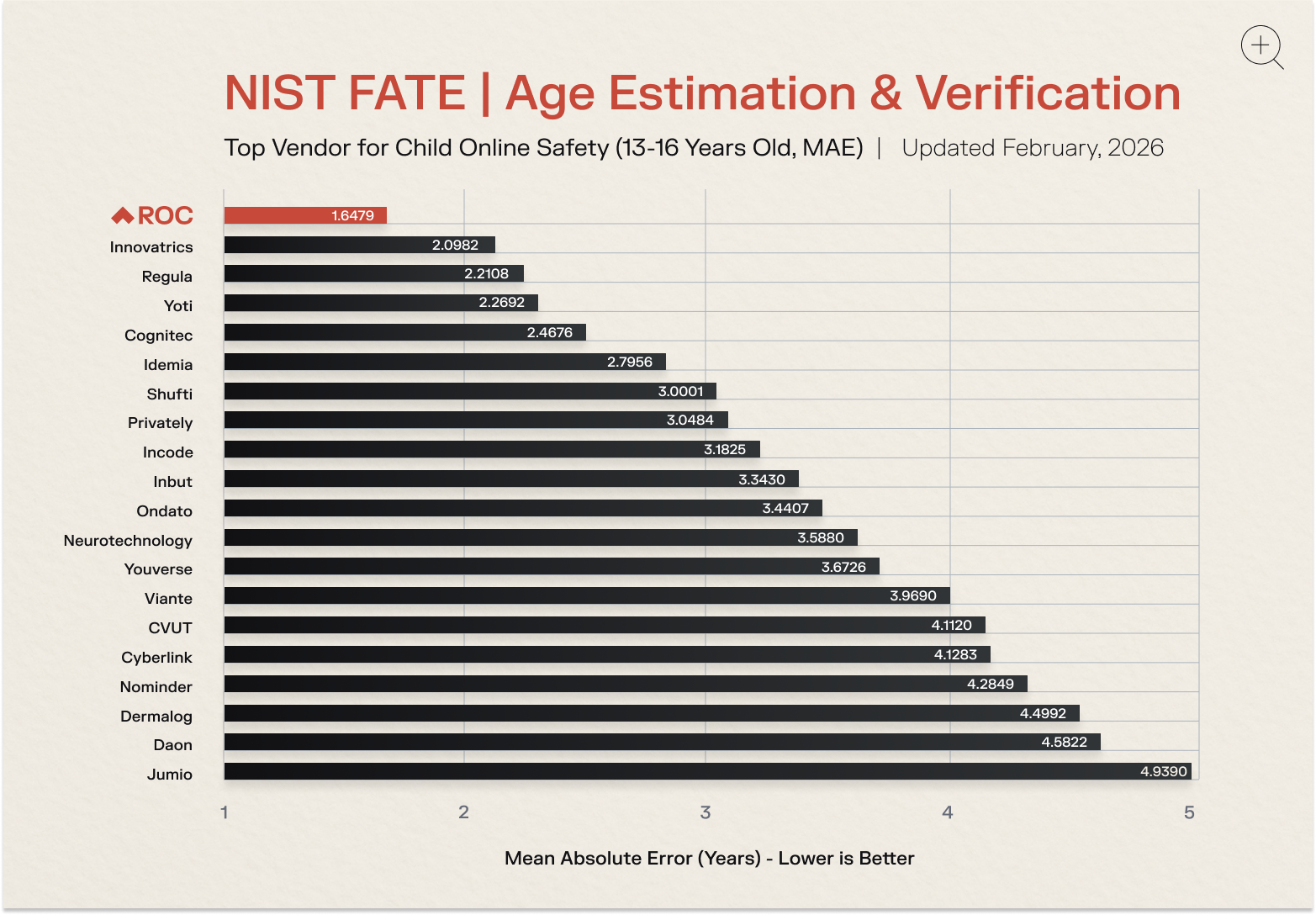
Mean Absolute Error (MAE) for age estimation on the Child Online Safety (ages 13–16) dataset, based on vendors’ latest submissions (ROC-002, Feb 6, 2026). NIST FATE (AEV)
ROC ranked #1 in Mean Absolute Error on the Child Online Safety dataset. This cohort represents one of the most sensitive thresholds in age assurance. The distinction between 13, 16, and 18 carries regulatory, platform policy, and risk implications. Accuracy at this boundary directly impacts youth protection controls, access decisions, and compliance enforcement. ROC delivered the lowest MAE in this category, leading the field where youth protection requirements are most exacting. This capability sits at the center of:
- Online safety compliance
- Youth access controls
- Platform risk management
- Financial onboarding safeguards
“The latest NIST FATE results reinforce what we strive for every day at ROC: setting the global standard for biometric precision. Achieving the lowest Mean Absolute Error in NIST’s rigorous Child Online Safety evaluation is more than a technical milestone, it reflects our commitment to building technology that makes the digital world safer. We deliver industry-leading accuracy so our partners can lead with absolute trust.”
#1 Global Provider for Age Estimation in Mugshot Dataset
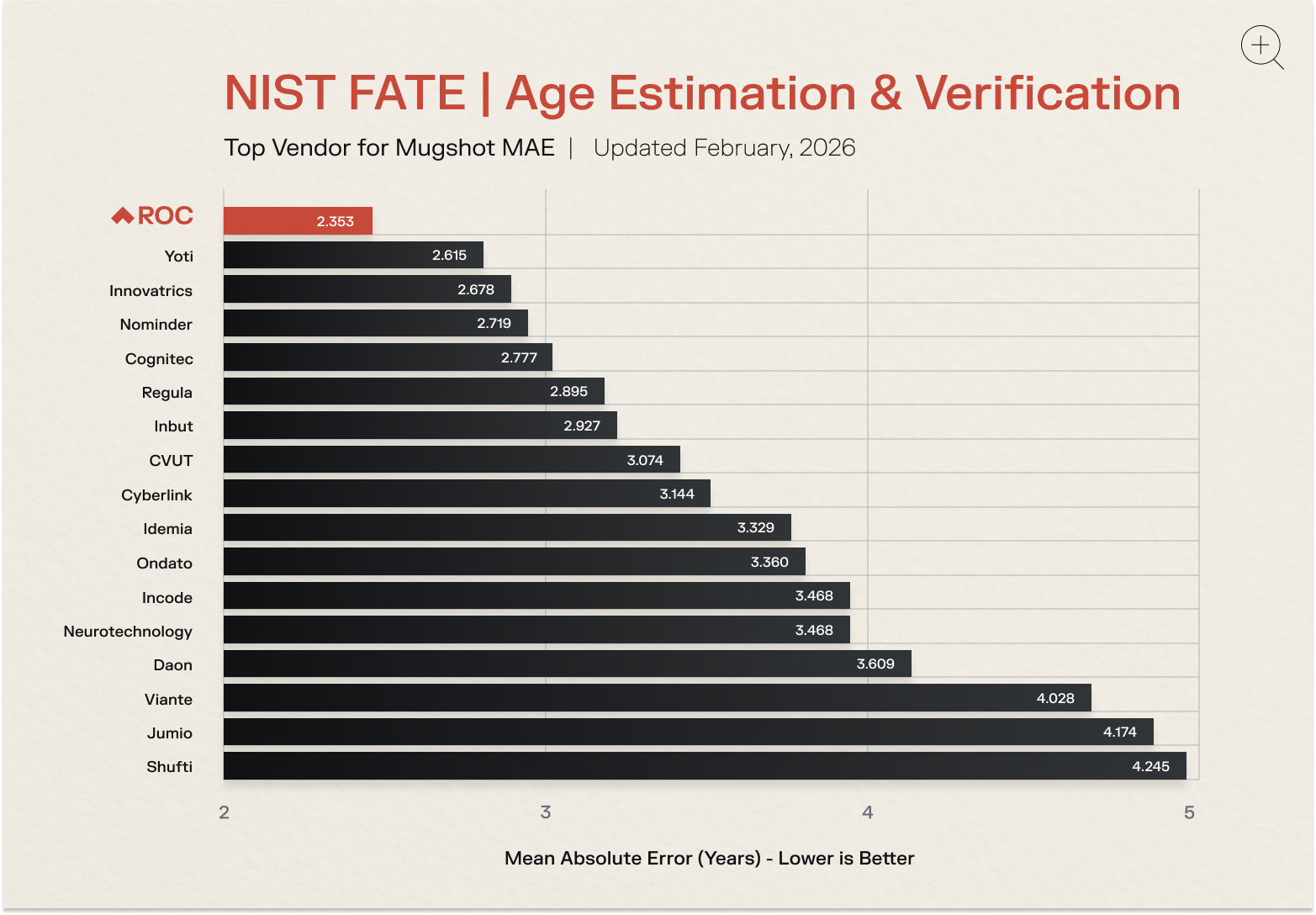
Mean Absolute Error (MAE) for age estimation on the Mugshot dataset, based on vendors’ latest submissions (ROC-002, Feb 6, 2026). NIST FATE (AEV)
ROC also ranked #1 in Mean Absolute Error (MAE) on the NIST FATE Mugshot dataset. Performance in this dataset demonstrates algorithmic strength in controlled identity environments, where consistency and repeatability are critical. Achieving the lowest MAE reinforces ROC’s ability to estimate age accurately across standardized imagery, supporting:
- Real-world booking conditions
- Structured identity verification workflows
- Digital evidence, video forensics, and investigative search
- Systems that depend on repeatable, controlled capture conditions
Consistency Across Demographics
Age estimation must remain consistent across populations to enable reliable performance at scale in diverse, real-world environments. In this evaluation, ROC ranked #1 in MAE across multiple geographic origin breakouts, including:
- South Asian Female (2.5 MAE +/- 0.08)
- West African Female (2.9 MAE +/- 0.2)
- West African Male (2.5 MAE +/- 0.2)
Real-World Robustness: Sunglasses and Occlusion
Operational environments introduce friction: sunglasses, partial occlusions, and inconsistent capture conditions. These are common failure modes for age estimation models. Within the latest NIST FATE results, ROC demonstrated robust performance against sunglasses, supporting accurate age estimation even when the face is partially obscured.
In today’s world, age estimation is increasingly interwoven into digital trust. Within ROC’s unified Vision AI platform, age signals can strengthen biometric identity workflows and support fraud prevention, digital onboarding, and industries where access and risk intersect. As regulatory frameworks tighten globally and organizations raise the bar for age assurance, accuracy is pivotal.
Learn more about ROC Age Estimation
Understanding NIST FATE: Age Estimation and Verification
The NIST Face Analysis Technology Evaluation (FATE) is a government-run benchmarking program for face analysis tasks beyond recognition. For age estimation, the FATE Age Estimation & Verification (AEV) track is an ongoing evaluation of software algorithms that inspect face photos and produce an age estimate. NIST publishes results on accuracy and computational efficiency, and notes that facial age verification has been mandated in legislation in a number of jurisdictions, typically to protect minors. The AEV track is open to a worldwide community of developers under a standardized submission process. Learn more at www.nist.gov
Future-ready insights.
Straight from the source.
Subscribe for Vision AI insights, product updates, and stories from the front lines of identity and antelligence.