

For decades, large-scale U.S. biometric identity systems have relied heavily on foreign fingerprint providers. ROC’s performance in the NIST FRIF TE E1N evaluation, including #1 global ranking in Class B slap fingerprints, a critical capture format for high-scale civil and government identity programs, proves that American technology can now lead at the highest levels of global biometric performance.
Top-Tier Performance Across Every Accuracy Benchmark
The NIST Friction Ridge Image and Features Technology Evaluation Exemplar One-to-Many evaluation, known as NIST FRIF TE E1N, evaluates one-to-many fingerprint identification at massive scale, testing how accurately algorithms can identify a subject from large enrollment repositories. Across the evaluation, ROC delivered top-tier performance in every category tested, including Class A, Class B, and Class C. The results position ROC among the strongest global performers in advanced fingerprint recognition and establish a new benchmark for American-made biometrics technology.
ROC’s most significant milestone came in Class B slap fingerprints. This performance is especially important for high-scale ABIS environments, including national ID programs, border management, civil enrollment, and high-stakes criminal justice workflows, where handling immense scale without sacrificing accuracy is mandatory.
#1 Global Ranking in Slap Fingerprints
Class B evaluates slap fingerprint accuracy using simultaneous multi-finger impressions from 4-4-2 captures, including left slap, right slap, and both thumbs. In this highly competitive category, ROC emerged as the #1 globally ranked vendor, reinforcing its capability to support mission-critical identity programs at national scale.
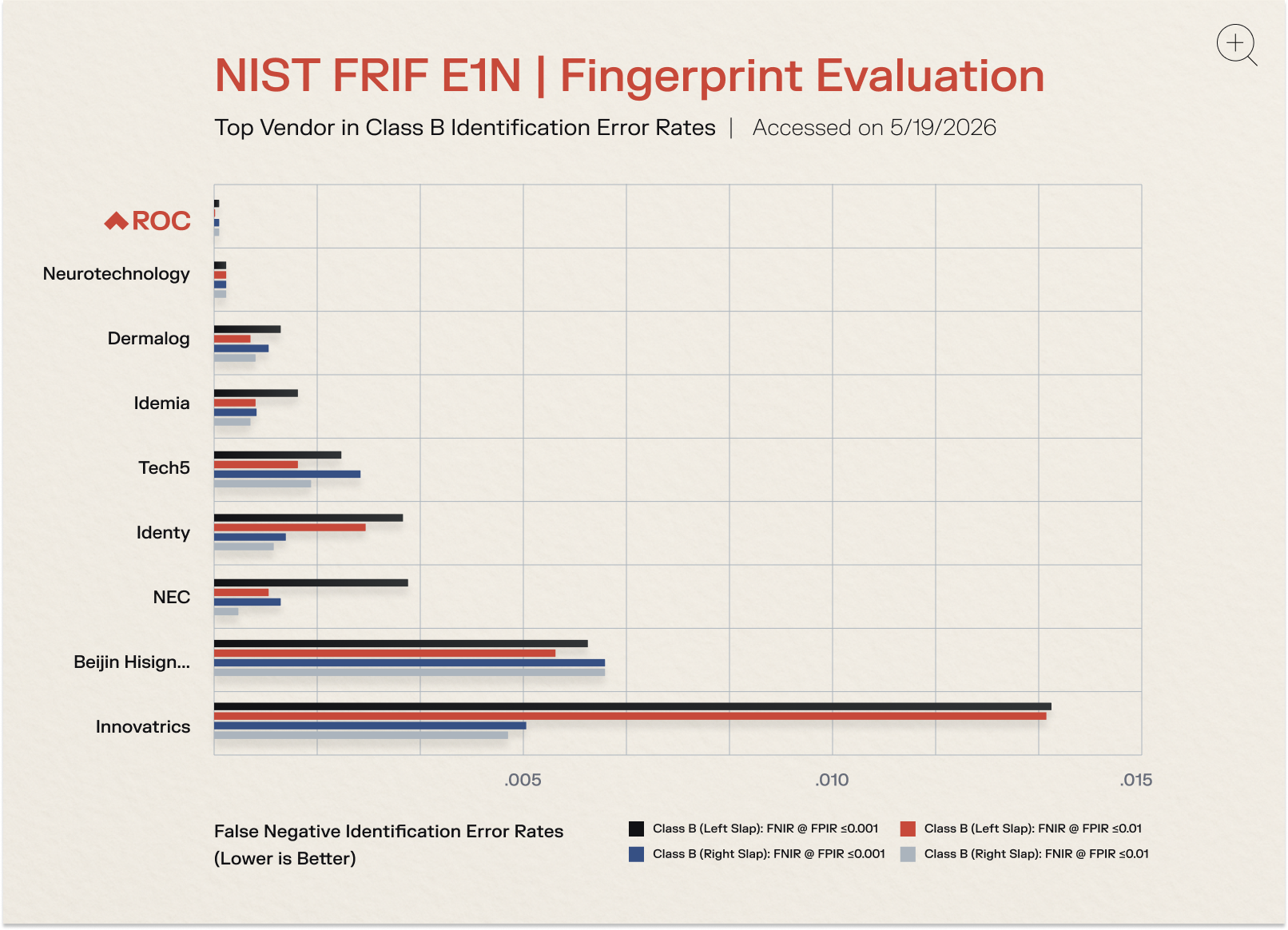
NIST FRIF TE E1N is a large-scale open-set 1:N fingerprint evaluation that tests core ABIS algorithms for feature extraction, template creation, and candidate search across databases of millions of subjects. Class B is the slap fingerprint category, evaluating simultaneous multi-finger impressions from 4-4-2 captures, including left slap, right slap, combined left-and-right slap, and full tenprints.
Rather than just taking a narrow win, ROC achieved the lowest error rate across all 28 Class B identification metrics reported by NIST, delivering a clean sweep across both high-scale identification and investigative search scenarios. Together, these results establish ROC as the global accuracy leader for Class B slap fingerprint identification.
Statistical Operating Thresholds
False Negative Identification Error rates at False Positive Identification Error rates of 0.001, 0.005, and 0.01.
Hand Configurations
The full Class B aggregate configurations, including Left Hand Slap, Right Hand Slap, and combined Left+Right Hand Slap.
Rank-1 Retrieval Error Rates
Rank-1 performance measures whether the correct candidate appears first in the returned results. In operational workflows, this helps analysts move faster, reduce review time, and advance cases with greater confidence at national scale.
All 28 Class B Metrics Where ROC Ranked #1 Globally
- Class B (Left Slap): FNIR @ FPIR ≤0.001
- Class B (Left Slap): FNIR @ FPIR ≤0.005
- Class B (Left Slap): FNIR @ FPIR ≤0.01
- Class B (Right Slap): FNIR @ FPIR ≤0.001
- Class B (Right Slap): FNIR @ FPIR ≤0.005
- Class B (Right Slap): FNIR @ FPIR ≤0.01
- Class B (Left and Right Slap): FNIR @ FPIR ≤0.001
- Class B (Left and Right Slap): FNIR @ FPIR ≤0.005
- Class B (Left and Right Slap): FNIR @ FPIR ≤0.01
- Class B: FNIR @ FPIR ≤0.001
- Class B: FNIR @ FPIR ≤0.005
- Class B: FNIR @ FPIR ≤0.01
- Class B (Left Slap): FNIR @ Rank ≤1
- Class B (Left Slap): FNIR @ Rank ≤2
- Class B (Left Slap): FNIR @ Rank ≤5
- Class B (Left Slap): FNIR @ Rank ≤10
- Class B (Right Slap): FNIR @ Rank ≤1
- Class B (Right Slap): FNIR @ Rank ≤2
- Class B (Right Slap): FNIR @ Rank ≤5
- Class B (Right Slap): FNIR @ Rank ≤10
- Class B (Left and Right Slap): FNIR @ Rank ≤1
- Class B (Left and Right Slap): FNIR @ Rank ≤2
- Class B (Left and Right Slap): FNIR @ Rank ≤5
- Class B (Left and Right Slap): FNIR @ Rank ≤10
- Class B: FNIR @ Rank ≤1
- Class B: FNIR @ Rank ≤2
- Class B: FNIR @ Rank ≤5
- Class B: FNIR @ Rank ≤10
View the NIST FRIF TE E1N results
Strengthening America’s Identity Infrastructure
Beyond the numbers, this is about more than algorithm performance. ROC’s results change the procurement equation for national security, public safety, and civil identity systems, while advancing the domestic AI industrial base. As agencies modernize, ROC gives them something long needed: an affordable, high-performing American solution.
“For years, the United States has maintained a dangerous overreliance on foreign AI for our most critical identity and biometric screening systems. Nearly every large-scale government deployment depends on overseas technology. ROC’s historic performance in the NIST fingerprint evaluation proves America now has a world-class domestic alternative — one that is more accurate, more efficient, and built here at home.”
“For decades, billions of dollars supporting critical U.S. identity infrastructure flowed overseas instead of strengthening America’s own industrial base. That changes today. National security systems should be powered by technology that is accurate, scalable, cost-effective, and aligned with American interests. We look forward to partnering with agencies across the FBI, DHS, and DoD to strengthen America’s technological independence and restore U.S. leadership in biometric and identity technologies.”

Performance Built in Record Time for Global Scale
Historically, achieving elite tier accuracy required massive hardware overhead and crushing infrastructure footprints. ROC’s algorithms break this mold. By optimizing for both extreme speed and absolute precision, ROC enables federal, state, and local agencies to deploy the world’s most accurate fingerprint technology while simultaneously modernizing their stacks, stripping out infrastructure complexity, and driving down long-term operational costs.
“In just four months, ROC went from a strong first submission in FRIF E1N to the best in the world across substantial portions of the evaluation. This directly contrasts competitors who have been submitting against these same datasets for over a decade. The collaboration across our data engineering, research, and engineering teams during this sprint has been hard to overstate. This is only our second submission, and as a highly focused American biometrics company, ROC still has a lot of gas left in the tank for what comes next.”

Learn more about ROC fingerprint recognition
Why the NIST FRIF Evaluation Matters
The FRIF TE E1N is widely regarded as one of the most comprehensive benchmarks in the biometrics industry. It establishes the standard for large-scale Automated Biometric Identification Systems (ABIS) used by governments and enterprises worldwide. Unlike evaluations that only test isolated software components, FRIF assesses the entire end-to-end pipeline, from processing raw fingerprint images to extracting features and executing massive one-to-many (1:N) searches. It evaluates processing power to ensure systems can handle peak-volume operations without creating bottlenecks at places like airports or border control where time and accuracy matter most. Because it utilizes operationally realistic datasets, a top ranking like what ROC just achieved, proves an algorithm can handle the messy, real-world data faced daily by law enforcement and national security agencies.
Future-ready insights.
Straight from the source.
Subscribe for Vision AI insights, product updates, and stories from the front lines of identity and antelligence.