



For agencies working against investigative backlogs and time-sensitive forensic demands, search speed is not a convenience metric. ROC’s latest NIST ELFT submission, combining the world’s fastest latent fingerprint search with top-tier accuracy across key FBI and DoD datasets, shows that American-made technology can lead where agencies need it most: faster searches, stronger candidate returns, and a shorter path from latent print to investigative lead.
Speed and Accuracy in Real-World Investigations
In operational forensic workflows, speed and accuracy have to work together. Latent fingerprint systems must do more than produce accurate candidate lists. They must also return results fast enough to support real investigative timelines, reduce examiner burden, and help agencies move from evidence to leads faster. In its latest NIST ELFT submission, ROC delivered the fastest latent fingerprint search speed in the evaluation along with multiple #1 Rank-1 accuracy results across key FBI and DoD datasets.
Fastest Global Search Speed with Top-Tier Rank-1 Accuracy in FBI Dataset
In the FBI-Provided Solved Dataset #1, ROC achieved a 102-second mean mated search duration, making it the fastest latent fingerprint algorithm in NIST ELFT. This was approximately 64x faster than the mean of the top five vendors evaluated in the benchmark, whose average search duration was nearly 109 minutes. Just as importantly, ROC delivered this speed without sacrificing accuracy. On the same dataset, ROC returned 0.0194 FNIR at Rank 1 and 0.0717 FNIR at FPIR = 0.01, showing that agencies do not have to choose between faster searches and stronger candidate returns.
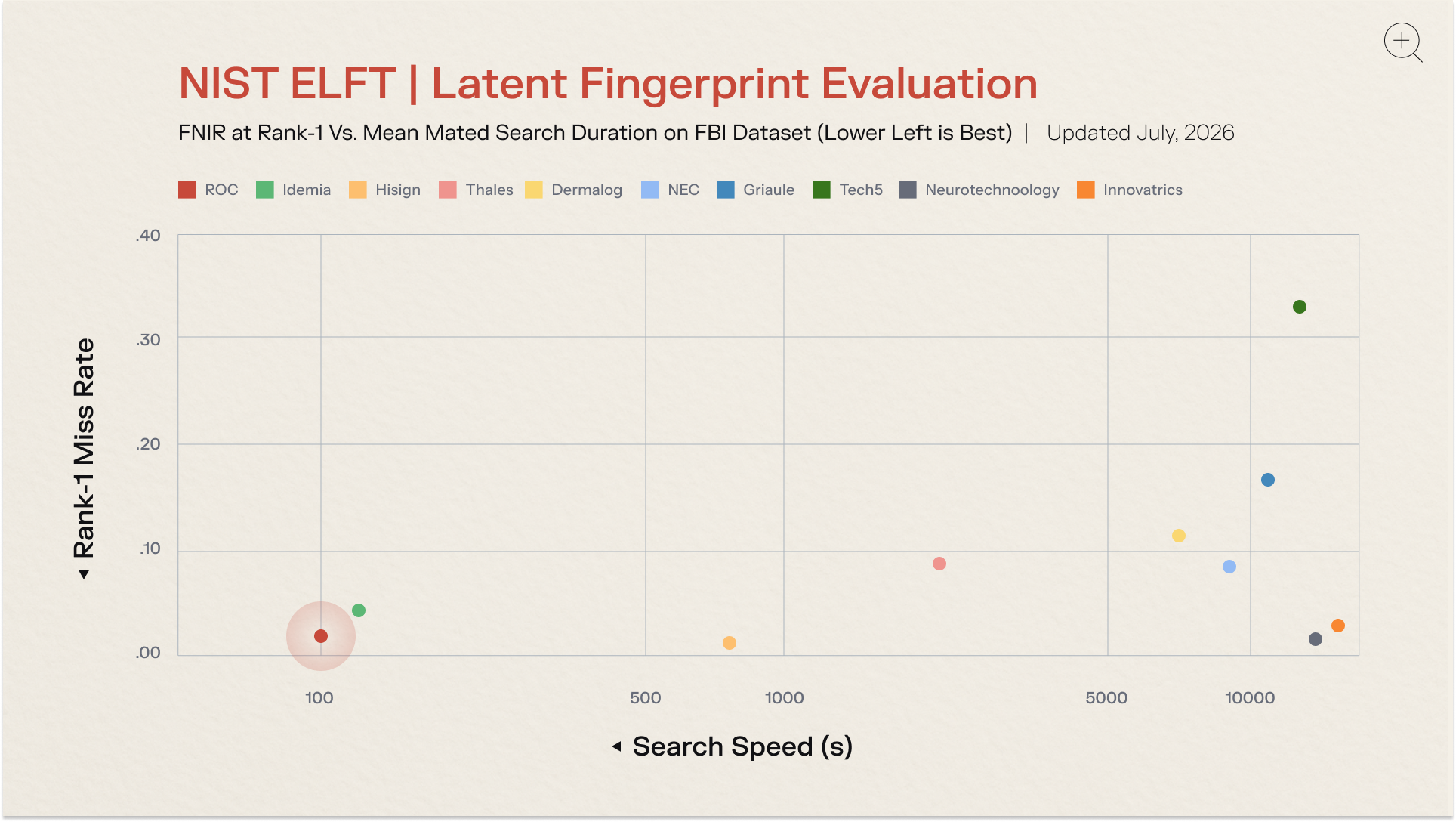
This chart plots results from the FBI-Provided Solved Dataset #1: FNIR at Rank 1 versus mean mated search duration, illustrating how systems balance accuracy and efficiency at scale. ROC combines the fastest search speed in the comparison with top-tier Rank 1 accuracy in NIST ELFT.
“What stands out in this ELFT submission is ROC’s optimization of both accuracy and throughput. The low error rates across multiple benchmark conditions, combined with the fastest search speed, shows continued leadership and progress on the two outcomes that materially affect large-scale latent search: candidate quality and system throughput. These gains are especially meaningful in large-scale deployments, where performance, compute, and total cost of ownership must be considered together.”

Major Accuracy Gains Across FBI and DoD Datasets
ROC’s latest ELFT submission delivered notable Rank-1 results alongside meaningful error-rate reduction across multiple benchmark conditions, demonstrating significant progress beyond search speed alone.
Rank-1 Accuracy Results
- #1 global Rank-1 accuracy on the EFS subset of the FBI-Provided Solved Dataset
- Tied for #1 among Western providers in Rank-1 accuracy on the FBI Laboratory Dataset
- Tied for #1 global Rank-1 accuracy on the FBI Laboratory Dataset using Image + EFS
Accuracy Improvements
Compared to ROC’s prior submission, the latest results delivered:
- 1.4x lower error rate on the FBI-Provided Solved Dataset #1 for FNIR at Rank 1
- 1.67x lower error rate on the FBI Laboratory Dataset for FNIR at Rank 1
- 2x lower error rate on the FBI Laboratory Dataset for FNIR at FPIR = 0.1
- 1.12x lower error rate on the DoD dataset for FNIR at FPIR = 0.01
For agencies, these gains matter because latent fingerprint performance is not measured in a single condition. Algorithms must perform across different datasets, operating points, and investigative scenarios. ROC’s latest results show continued improvement where forensic teams need it most: faster searches, lower miss rates, and more confident candidate lists for examiner review.
“Latent fingerprint recognition is one of the most difficult challenges in biometrics. These latest NIST ELFT results show that ROC is delivering the speed, accuracy, and scalability agencies need to move investigations forward faster. They also reinforce a broader point: American-made biometrics can lead globally in the technologies that support public safety, national security, and the critical identity infrastructure America depends on.”

ELFT Accuracy Results by Dataset
ROC’s latest ELFT identifier, roc+0018, achieved the following results across key NIST ELFT datasets:
FBI Laboratory
- 0.0408 FNIR at FPIR = 0.1
- 0.0612 FNIR at Rank 1
FBI-Provided Solved Dataset #1
- 0.0717 FNIR at FPIR = 0.01
- 0.0194 FNIR at Rank 1
DoD-Provided Dataset #1
- 0.0749 FNIR at FPIR = 0.01
- 0.0331 FNIR at Rank 1
- 0.0289 FNIR at Rank ?5
IARPA N2N Sequestered
- 0.3371 FNIR at Rank 1
View the NIST ELFT results

Built for the Realities of Latent Fingerprint Investigation
Latent fingerprint recognition is one of the most technically demanding areas of biometrics. Unlike controlled fingerprint capture, latent prints are often partial, distorted, smudged, or recovered from difficult surfaces. In many cases, it may be one of the only physical links between a person and an event. This makes search performance operationally important. Faster search speeds can help agencies reduce delays, manage backlogs, and move from latent print to investigative lead more quickly, while stronger candidate returns help examiners focus attention on the most promising results.
Explore ROC fingerprint recognition
About NIST ELFT
The NIST Evaluation of Latent Fingerprint Technologies (ELFT) is an independent benchmark for measuring the performance of automated latent fingerprint matching algorithms. For agencies evaluating latent fingerprint capabilities, NIST ELFT provides a common framework for understanding how algorithms perform across challenging forensic search scenarios, helping them assess accuracy, speed, and operational fit before making technology decisions.
NIST evaluations do not constitute endorsement of any vendor, product, or technology.
Future-ready insights.
Straight from the source.
Subscribe for Vision AI insights, product updates, and stories from the front lines of identity and intelligence.