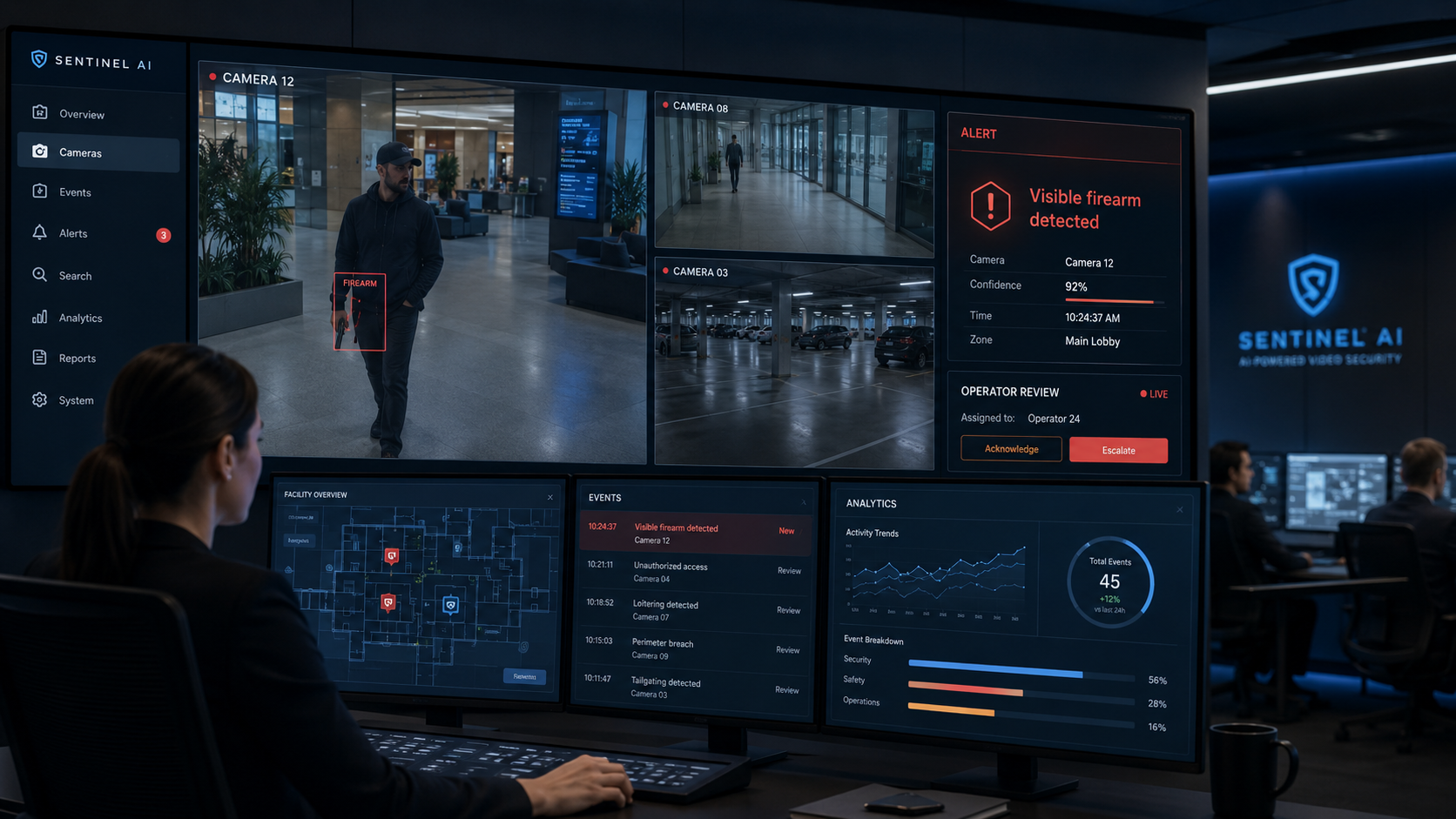


AI gun detection is designed to help security teams identify visible firearms sooner by turning existing camera networks into a proactive layer of awareness. Here’s how the technology works, from video analysis and detection to alerting and human review, and what teams should consider when evaluating it.
“The FBI defines an ‘active shooter’ as one or more armed individuals actively engaged in shooting or attempting to shoot people in a populated area.”
In most of these events, a firearm is visible before it is fired. That interval, the seconds between when a weapon is drawn and when it is used, creates a narrow window where a security team may be able to act. The problem is that traditional surveillance rarely uses it. Cameras record, but no one is watching every feed at every moment, and by the time a human notices a weapon on a monitor, the opportunity to intervene is often gone.
AI gun detection is built to close that gap. It is a Vision AI capability that analyzes live video and flags a visible firearm the moment it appears, turning passive recording into an active layer of detection and response. This article breaks down how the technology actually works, from the camera to the alert, what it can and cannot do under real conditions, how it should be evaluated in the absence of a formal benchmark, and where it fits inside a broader security workflow.
Why Visual Gun Detection Is a Priority
The case for proactive detection is a case about time. In its 2024 report, the FBI designated 24 active shooter incidents, part of 223 incidents recorded between 2020 and 2024 across 43 states and the District of Columbia. The defining operational fact of these events is their speed: the majority end within a few minutes, and roughly three in four are over before law enforcement arrives on scene. In education settings, the average incident in the FBI’s data lasted only a few minutes.
When a response window is measured in minutes, the value of any security tool is measured in how early it can generate awareness. A system that shaves a minute off the time between a weapon appearing and a team responding is not a marginal improvement; it is operating inside the exact interval where outcomes are decided. This is the gap visual gun detection is designed to fill, and it is why the capability has moved from novelty to procurement priority across schools, transit systems, venues, and public safety agencies.
The limits of human monitoring compound the problem. A single operator cannot watch dozens or hundreds of feeds with sustained attention; vigilance degrades over time, and the feed showing a threat is rarely the one being watched at the decisive moment. AI does not fatigue and applies identical scrutiny to every camera simultaneously, which is why it functions as a force multiplier for public safety and school safety teams rather than a replacement for them.
Gun Detection Is Not One Technology
Before tracing the pipeline, it is worth separating three technologies that procurement conversations routinely conflate. They answer different questions at different moments, and understanding the distinction is the first step to evaluating any of them.
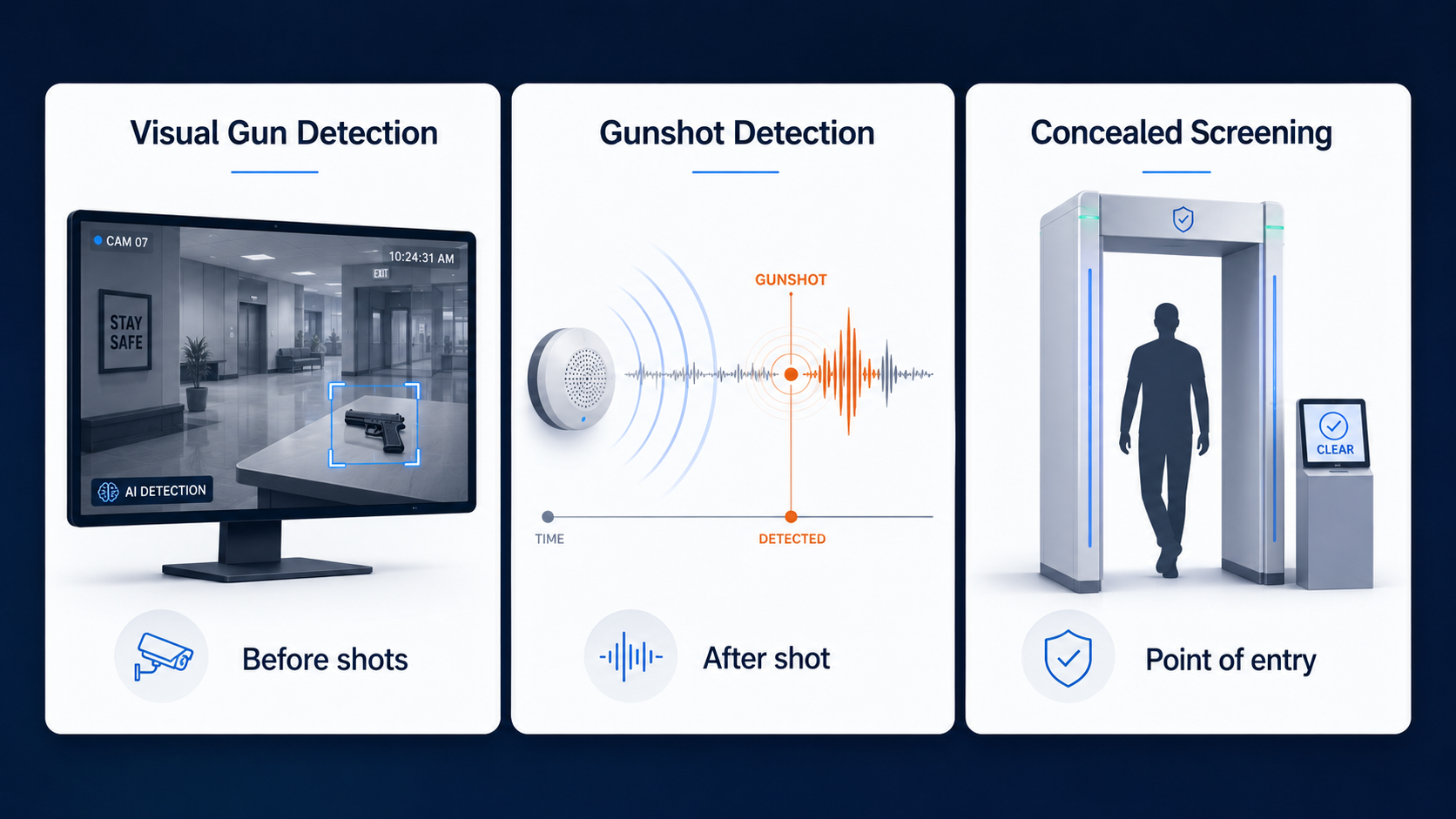
They answer different questions at different moments, and understanding the distinction is the first step to evaluating any of them.
| Approach | How it senses | Timing | Coverage | Question it answers |
|---|---|---|---|---|
| Visual gun detection | Vision AI on camera video | Proactive, before shots | Entire camera network | Is a firearm visible right now? |
| Gunshot detection | Acoustic sensors | Reactive, after a shot | Sensor coverage area | Was a shot fired, and where? |
| Concealed weapon screening | Dedicated sensors at a checkpoint | At point of entry | Single controlled entry point | Is someone carrying a hidden weapon? |
None of these is strictly superior. Gunshot detection confirms an event after it begins. Concealed screening inspects a single doorway. Visual gun detection watches an entire network continuously and aims to flag a weapon before it is used. The strongest security postures layer them rather than choosing one. The remainder of this article focuses on the visual approach.
The AI Gun Detection Pipeline: A Step-by-Step Guide
A production gun detection system is a chain of stages, each with a distinct job and a distinct way of failing. “The AI sees a gun” compresses five separate operations into one phrase. Pulling them apart is the best way to understand both the capability and its limits.
| Stage | Function | Input | Output | Common failure mode |
|---|---|---|---|---|
| Ingestion | Pull live video from cameras | RTSP / IP streams | Decoded frames | Dropped or low-bitrate streams |
| Detection | Locate visible firearms | Video frames | Bounding boxes with class | Missed small or occluded guns |
| Confidence scoring | Score and threshold detections | Raw detections | Filtered candidates | Too loose: false alarms; too tight: misses |
| Alerting | Generate and route the alert | Passed detections | Alert via email/SMS/API | Alert fatigue, integration gaps |
| Adjudication | Validate and decide response | Alert plus video | Confirmed action | Slow review, undefined protocol |
Stage 1: Ingestion from Existing Cameras
The pipeline starts with video the organization already produces. Modern gun detection software is hardware-agnostic: it connects to existing IP cameras over standard RTSP streams, and legacy analog CCTV can be brought in through encoders. In many environments, this eliminates the need for rip-and-replace infrastructure, new cabling, or proprietary cameras. This matters operationally, because it collapses the cost and timeline of deployment, and it means the quality of the feed, resolution, frame rate, camera angle, becomes a variable the system has to tolerate rather than one it can dictate.
Stage 2: Detection of Visible Firearms
Once frames are flowing, deep-learning models analyze them to locate visible firearms in context. Detection is genuinely hard, and the research literature is blunt about why. As the authors of the CCTV-Gun benchmark put it, firearms are “typically very small in size, non-salient in appearance, and often severely occluded or indistinguishable from other small objects.” A robust model is trained to recognize handguns and long guns across challenging poses, brandished, depressed, or partially visible, and to hold up in the crowded, uncontrolled scenes where real threats occur.
Firearms, especially handguns, are typically very small in size, non-salient in appearance, and often severely occluded or indistinguishable from other small objects.
Stage 3: Confidence Scoring and Threshold Tuning
Every detection carries a confidence score, and this is where a system stops being one-size-fits-all. Different sites, staffing models, and risk profiles demand different thresholds. A high-traffic downtown corridor and a quiet school perimeter should not be tuned identically. Set the threshold too low and operators drown in false positives on phones, tools, and look-alike objects; set it too high and real threats slip through. Getting this balance right, and giving teams control over it, is what separates a credible deployment from a demo.
Stage 4: Alerting and Routing
When a detection clears its threshold, the system generates an alert in near real time and routes it intelligently. Alerts can be delivered through email, SMS, MQTT, or REST API integrations, so detections flow into existing security workflows and third-party systems rather than sitting in a silo. In a school, that same alert can help trigger lockdown protocols, notify school resource officers, and speed law enforcement dispatch. The routing model, who gets the alert and how, is a design decision as important as the detection itself.
Stage 5: Human Adjudication
The final stage is a person. Some organizations want automated escalation the instant a detection occurs; others route detections first to a trained operator in a security operations center for adjudication before any action is taken. Human review validates detections, reduces unnecessary escalation, and ensures the response matches the context. The purpose of gun detection is not to remove human judgment but to focus it, directing operators to the small fraction of video that actually warrants attention.
How Systems Handle Real-World Conditions
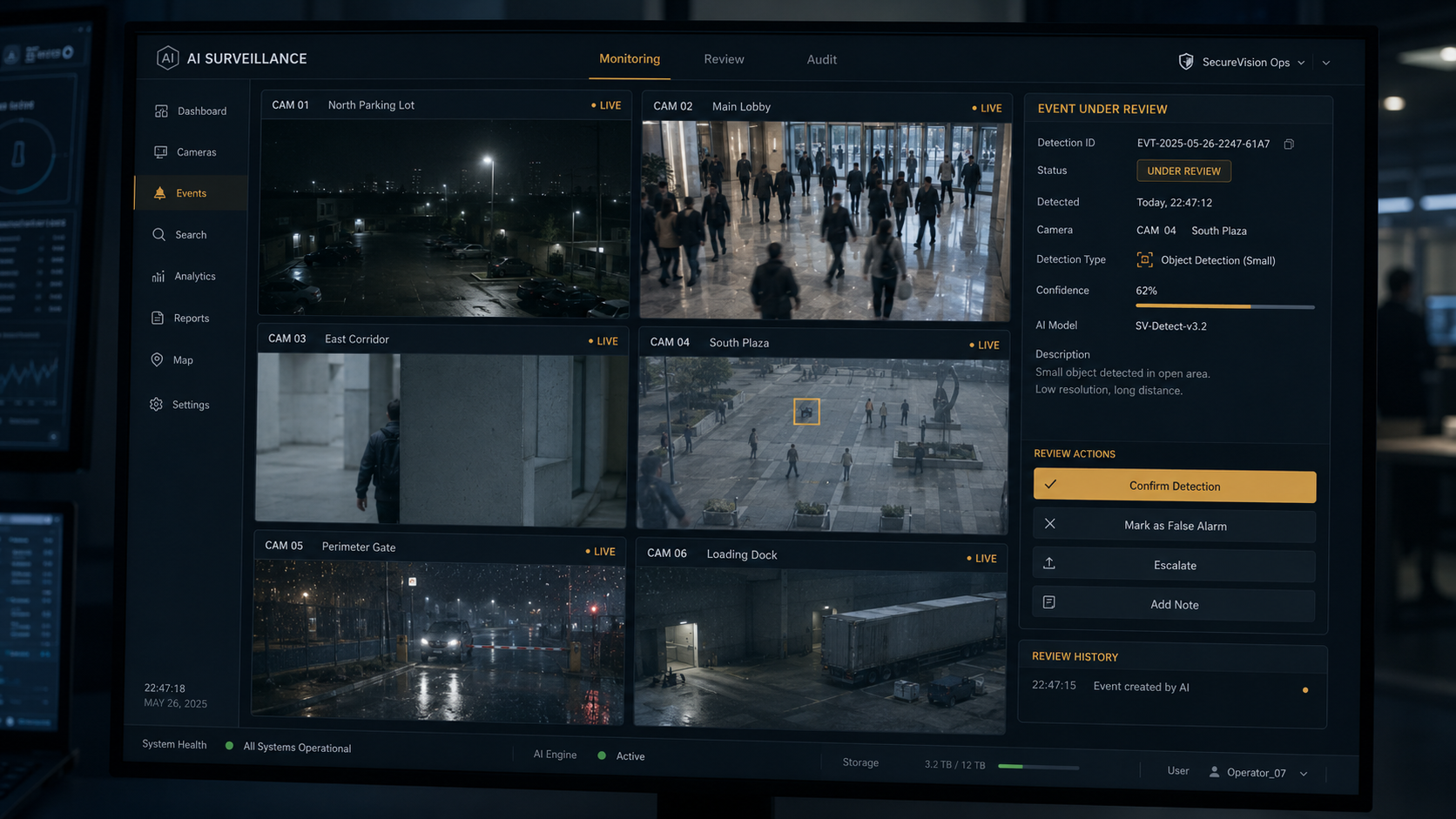
The hard part of gun detection is not the clean demo frame. It is the imperfect video that operators actually work with: low light, adverse weather, motion, partial occlusion, and high-throughput scenes where a firearm never presents itself cleanly. Systems built for these conditions are trained on real-world, brandished-weapon scenarios rather than catalog images of firearms on white backgrounds, because a weapon being drawn and presented is the operational threat moment, and it looks nothing like a product photo.
The honest assessment is that no system performs equally well across every degradation. Detection is strong on reasonably visible weapons and degrades as size, occlusion, and image quality worsen, exactly the pattern the benchmark literature documents. This is why mature deployments treat the model as the first filter and human adjudication as the safeguard, rather than expecting the algorithm to be right in every frame. Vendor claims of flawless detection across all conditions should therefore be treated with skepticism.
The Benchmark Problem: Evaluating Without a NIST Standard
Buyers of biometric technology are used to leaning on independent benchmarks. Face recognition has the NIST Face Recognition Technology Evaluation; fingerprint has NIST PFT and ELFT; tattoo recognition has the NIST Tatt-C challenge. Visual gun detection has no equivalent official government benchmark. Evaluation lives largely in academic datasets such as CCTV-Gun and other published firearm-detection sets, which are valuable but not a standardized procurement yardstick.
This absence has a direct consequence for procurement. Without a public leaderboard to point to, vendor accuracy claims cannot be taken at face value, and internal marketing numbers are not a substitute for evidence. Teams evaluating gun detection should shift their scrutiny toward operational proof: how the system performs on the buyer’s own cameras, in the buyer’s own conditions, and whether it is genuinely deployed and used in comparable live environments rather than only demonstrated. The right question is not “What is your published score?” but “Show me detection on footage that looks like mine.”
Where Gun Detection Fits in a Multimodal Workflow
Gun detection delivers the most value as one signal inside a broader video-intelligence system, not as an isolated alert. Deployed inside ROC Watch, a detection is paired with intelligent tracking across camera feeds and sits in the same pane of glass as face recognition, watchlisting, and license plate recognition. Operators can follow a flagged individual as they move through an environment instead of working from a single frozen frame, and correlate the weapon with a vehicle, face, or watchlist entry.
For teams building detection into their own products or command-and-control systems, the same algorithm is available through the ROC SDK, which maintains feature parity across seven languages (C++, Java, Python, C#, Go, Node.js, and Rust) with native support for Windows, macOS, Linux, iOS, and Android, and deploys to cloud, on-prem, hybrid, and edge, including air-gapped and tactical environments. Gun detection is one capability within ROC’s wider object detection stack, which is how a single alert becomes part of a fuller operational picture.
Practical Recommendations for Teams Evaluating Gun Detection
A few points consistently separate successful gun detection programs from stalled ones.
- Test on your own cameras. Because the system depends on your feeds, evaluate it over your real RTSP streams and camera angles, not a vendor’s reference setup.
- Demand real-world validation, not lab numbers. With no NIST benchmark to cite, insist on evidence of live operational deployment in environments comparable to yours.
- Pilot with degraded footage. Many systems demo well on clean frames and fail on real surveillance video. Test with low light, distance, and occlusion.
- Define alert routing and review up front. Decide before deployment who receives alerts, how, and whether a human adjudicates first. The workflow matters as much as the model.
- Verify deployment sovereignty. Confirm on-prem, edge, and offline options if your environment requires them, and understand where video is processed and stored.
- Require ethical AI documentation. Ask for a published code of ethics and a clear position on human oversight, privacy, and accountability.
How ROC Approaches Gun Detection
ROC Vision AI technology supports U.S. law enforcement and military missions, including publicly disclosed deployments with the Department of Defense, U.S. Navy, U.S. Marshals Service, and FBI.
Our Gun Detection capability is trained on real-world, brandished-weapon scenarios, and analyzes live video with sub-second detection latency, integrates with existing IP camera infrastructure, and delivers alerts through email, SMS, MQTT, or REST API. It runs on-prem, in the cloud, or at the edge, including fully disconnected and tactical deployments.
It is also built on the same ROC SDK that powers ROC’s NIST top-ranked face, fingerprint, and iris algorithms, so gun detection inherits the same engineering foundation and the same multimodal integration path rather than arriving as a bolt-on. And because ROC is a proudly American-made company that develops under a strict Code of Ethics, the capability is designed to support public safety while respecting privacy, human oversight, and operational accountability, factors that have become non-negotiable in government and enterprise procurement.
Conclusion
AI gun detection is no longer experimental. It is a production-grade capability that turns the cameras an organization already owns into a proactive layer of awareness, operating inside the narrow window where response time determines outcomes. It is not magic, and it is not a NIST-benchmarked commodity; it is a pipeline of imperfect stages that, tuned well and paired with human judgment, gives security teams earlier visibility than passive surveillance ever could.
The technology will not replace operators or first responders. It will give them the one thing an active-threat scenario rarely provides enough of: time.
Learn More
If your organization is evaluating gun detection as part of broader security infrastructure modernization, explore ROC’s AI gun detection capabilities or get in touch to see how visual firearm detection fits into your existing camera network and response workflow.
Future-ready insights.
Straight from the source.
Subscribe for Vision AI insights, product updates, and stories from the front lines of identity and intelligence.
Frequently Asked Questions
Does AI weapon detection actually work for guns?
Yes, within defined limits. Visual gun detection reliably flags firearms that are reasonably visible to a camera, and performance degrades as weapons become smaller, more occluded, or harder to see, which is consistent with the published research. It works best as a first-filter that surfaces likely threats for human confirmation, not as an infallible standalone judge. Real-world validation on footage similar to your own environment is the honest way to confirm it works for your deployment.
It runs a five-stage pipeline: it ingests live video from existing cameras, analyzes frames with deep-learning models to locate visible firearms, scores each detection against a tunable confidence threshold, generates and routes an alert in near real time, and surfaces that alert to a human for adjudication and response. Each stage is configurable to the environment it protects.
Gunshot detection is reactive and acoustic; it confirms that a weapon has been fired. Visual gun detection is proactive; it identifies a visible, brandished firearm before it is used, aiming to buy the critical seconds needed to respond. Many strong deployments combine both.
Yes. Modern gun detection software is hardware-agnostic and integrates with almost any existing IP camera over standard RTSP streams, with legacy analog CCTV supported through encoders. No rip-and-replace hardware overhaul is required.
No, and that is by design. Visual gun detection identifies firearms that are visible to a camera. Detecting hidden weapons requires dedicated concealed-weapon screening sensors at a checkpoint. The two are complementary layers, not substitutes.
Systems built for operational use are trained on real-world, degraded imagery rather than clean stock photos, so they maintain useful accuracy in low light, weather, and crowded scenes. Performance still declines in extreme cases, which is why human review remains part of the workflow.
Unlike face, fingerprint, and tattoo recognition, visual gun detection has no official NIST evaluation. Assessment relies on academic datasets such as CCTV-Gun. In the absence of a standardized benchmark, buyers should weigh operational deployment evidence and testing on their own footage over vendor accuracy claims.
ROC Gun Detection performs sub-second analysis and delivers alerts in near real time through email, SMS, MQTT, or REST API integrations, so detections can be surfaced and escalated within existing security workflows almost immediately.
That is configurable. Alerts can be routed directly to facility personnel for immediate action or sent first to a security operations center for human adjudication, matching your staffing model and risk tolerance.
ROC offers on-prem, cloud, or edge deployment, and as a 100% American-made company it keeps its code sovereign. For tactical teams, it can run in fully disconnected or offline environments, keeping sensitive video under the operator’s control.