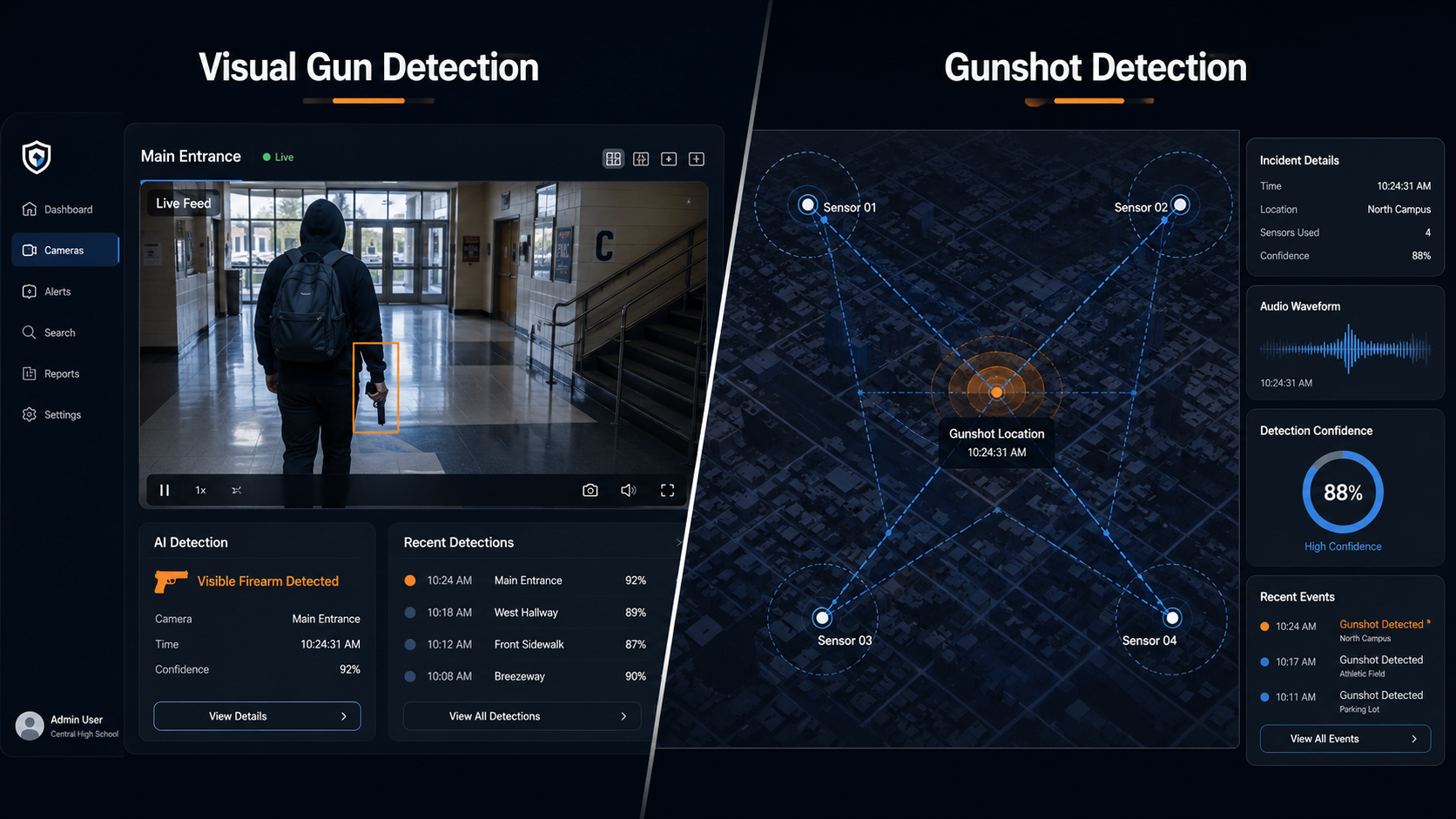


Security teams often evaluate gun detection and gunshot detection side by side, but each serves a distinct role in a layered security strategy. This guide compares their timing, coverage, infrastructure requirements, and practical use cases – helping teams make informed procurement decisions and determing the right fit for their environment.
The FBI defines an ‘active shooter’ as one or more armed individuals actively engaged in shooting or attempting to shoot people in a populated area.
Two very different technologies are routinely confused in security procurement: gun detection and gunshot detection. The names are nearly identical, the marketing overlaps, and buyers frequently assume they are competing versions of the same thing. They are not. One listens for the sound of a shot that has already been fired; the other watches for a weapon before it is used. The distinction is not academic. It determines whether a system helps you respond after an incident begins or gives you a chance to intervene before it does.
This article explains how each technology works, compares them honestly across accuracy, timing, coverage, and cost, and lays out when each is the right choice, and why the strongest deployments often use both. Throughout, the focus is on visible-firearm gun detection versus acoustic gunshot detection, the two systems most often weighed against each other.
How Gunshot Detection Works
Acoustic gunshot detection systems, of which ShotSpotter, now part of SoundThinking, is the best known, use networks of audio sensors mounted across a coverage area, typically outdoors in urban neighborhoods. When several sensors capture a loud, impulsive sound, the system uses the differences in arrival time to triangulate a location. Machine-learning algorithms filter out sounds that are clearly not gunfire, and a human-staffed incident review center confirms the event before an alert is dispatched to police, typically within a provider’s stated response window.
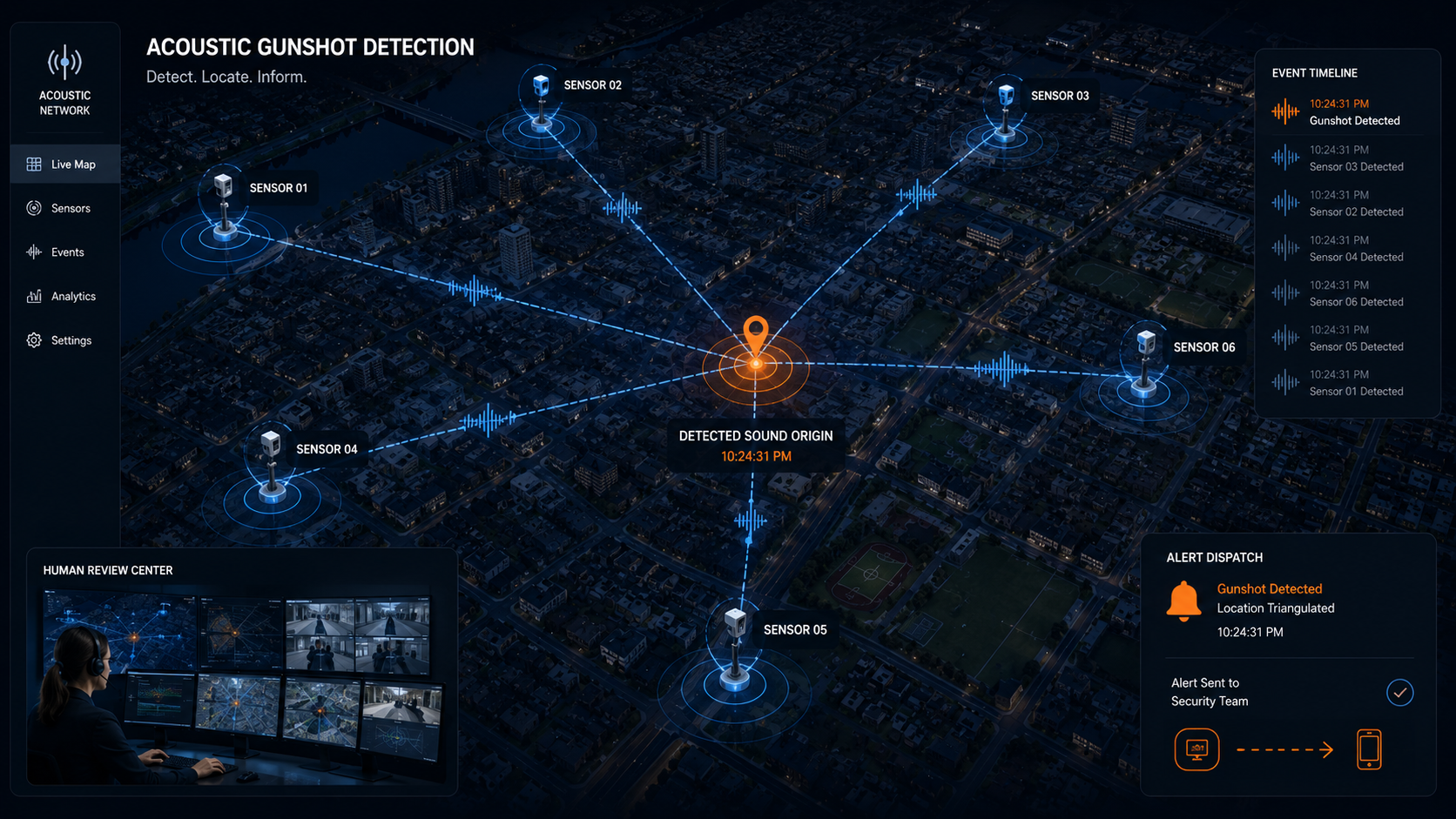
The defining characteristic is timing: gunshot detection is reactive. It cannot flag a weapon that has not yet been fired. Its value is in localizing gunfire quickly, especially in outdoor environments where no one calls 911, so officers can be directed to a precise location. It answers the question, “Was a shot fired, and where?”
How Visual Gun Detection Works
Visual gun detection takes the opposite approach. It is a Vision AI capability that analyzes live camera video frame by frame and can flag a visible firearm, a brandished handgun or long gun, within a connected camera’s field of view. It runs on existing IP cameras, generates an alert in near real time, and routes it into a configurable security workflow for review and response.
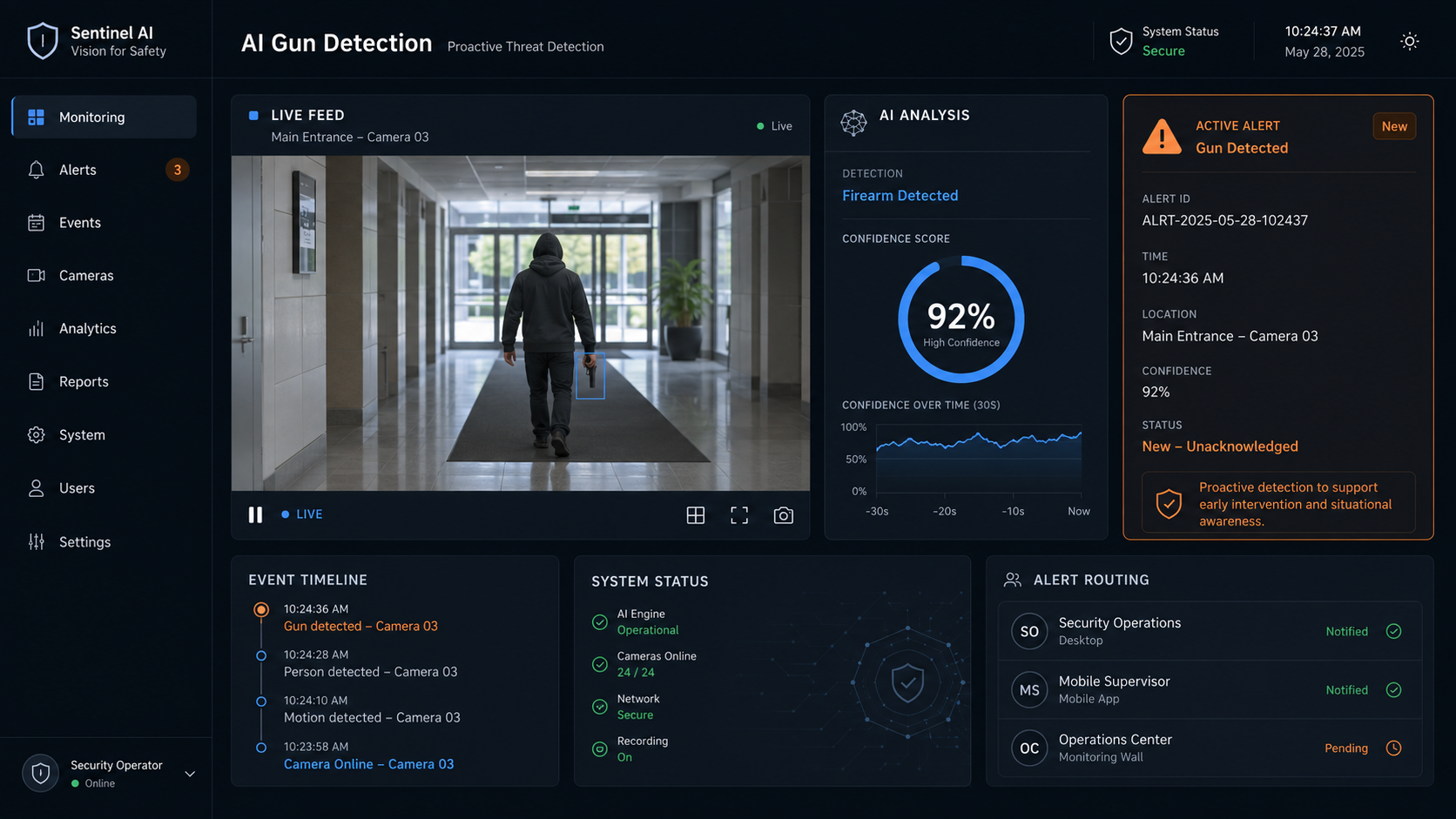
By analyzing a visible weapon before a shot is fired, it supports a more proactive approach to threat awareness and answers a different question: “Is a firearm visible right now?” As covered in our guide to how AI gun detection works, achieving accurate detections in real-world video is technically challenging – a limitation widely documented in research literature.
Head to Head
| Dimension | Visual gun detection | Acoustic gunshot detection |
|---|---|---|
| Sensor | Cameras (video) | Audio sensors |
| Timing | Proactive, before a shot | Reactive, after a shot |
| Trigger | A visible, brandished firearm | The sound of gunfire |
| Best coverage | Anywhere cameras exist, indoor or outdoor | Outdoor areas with sensor coverage |
| Infrastructure | Reuses existing IP cameras | Requires dedicated sensor network |
| Core value | A chance to intervene pre-incident | Fast localization of gunfire |
| Key limitation | Weapon must be visible to a camera | Only detects shots already fired |
The Accuracy Debate
Neither technology should be bought on a headline accuracy number, and buyers deserve the full picture. On the acoustic side, SoundThinking states that ShotSpotter is roughly 97 percent accurate with a false-positive rate near 0.5 percent, and an independent audit by Edgeworth Economics reported a 97.69 percent accuracy rate for detecting and publishing gunfire incidents from 2019 to 2021. At the same time, independent researchers and oversight bodies have raised pointed concerns: a MacArthur Justice Center analysis found that in Chicago, roughly 88.7 percent of ShotSpotter alerts led police to find no gun-related incident, a New York City Comptroller audit reached similar conclusions, and civil-liberties groups have questioned both the deployment patterns and the lack of independent, peer-reviewed validation. Some cities have discontinued their acoustic systems amid this debate.
Visual gun detection faces a different accountability gap. Unlike face and fingerprint recognition, it has no official NIST benchmark; evaluation lives in academic datasets such as CCTV-Gun. That absence means visual-detection accuracy claims also cannot be taken at face value, and buyers should demand evidence of real-world operational deployment rather than a marketing figure. The honest conclusion for both technologies is the same: scrutinize the methodology behind any accuracy claim, and weight demonstrated performance in conditions like yours over a single advertised percentage.
Timing Is the Real Distinction
If you strip away the marketing, the fundamental difference is when each system acts. In the FBI’s 2024 data, active shooter incidents frequently unfold within a few minutes, and the majority conclude before law enforcement arrives. Against that timeline, a reactive acoustic system confirms and locates an event that is already underway, while a proactive visual system aims to generate awareness in the interval between when a firearm first enters camera view and when a first shot is fired. Both compress response time, but they do so at opposite ends of the incident timeline. That is why framing them as competitors is a mistake.
Coverage and Cost
The practical trade-offs follow from the sensors each uses. Acoustic systems require a dedicated network of audio sensors and are typically deployed across outdoor urban areas as a subscription service; their coverage is defined by where sensors are installed, and they add little value indoors. Visual detection can often reuse whatever IP cameras an organization already owns, so its coverage maps to existing camera placement, indoors and out, and its main cost is software rather than new sensor hardware. For a school, venue, corporate campus, or access-control setting where cameras already exist, visual detection usually offers a faster and lower-infrastructure path; for wide outdoor areas with sparse camera coverage but a gunfire problem, acoustic sensors fill a gap cameras cannot.
When to Use Each
The decision comes down to environment and goal.
- Choose visual gun detection for schools, venues, transit, corporate campuses, and access-control points, anywhere you have cameras and want a chance to act before a weapon is fired.
- Choose acoustic gunshot detection for wide outdoor areas, such as urban neighborhoods, where rapid localization of gunfire is the goal and camera coverage is limited.
- Combine both in large, complex environments: cameras provide proactive, pre-incident awareness where they can see, and acoustic sensors cover the outdoor gaps, giving security teams both early warning and fast localization.
How ROC Approaches Gun Detection
ROC focuses on the proactive side of the equation. ROC Gun Detection analyzes live video with sub-second processing latency to flag visible, brandished firearms on existing IP cameras, and delivers alerts through email, SMS, MQTT, or REST API. Inside ROC Watch, a detection sits alongside face recognition, watchlisting, and license plate recognition in a unified, evolving timeline, and can be paired with intelligent tracking so operators follow a threat as it moves rather than working from one frozen frame.
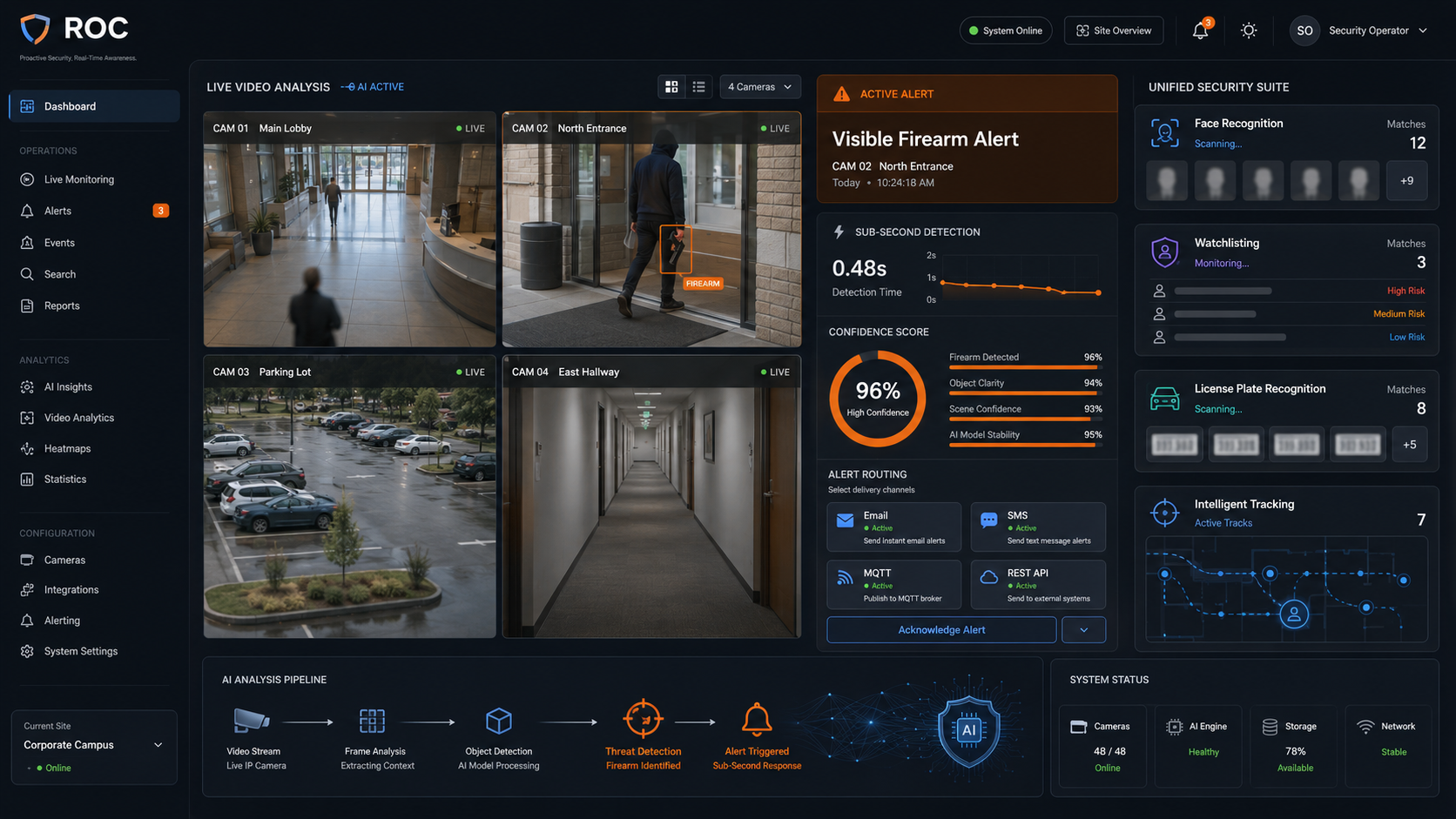
It runs on-prem, in the cloud, or at the edge, including disconnected and tactical environments, and is developed under a strict Code of Ethics by a proudly American-made company. Because it is built on the same ROC SDK as ROC’s NIST top-ranked biometric algorithms, visual gun detection can also be embedded directly into an organization’s own systems.
Conclusion
Gun detection and gunshot detection are not rival products; they are answers to different questions asked at different moments. Acoustic systems tell you when a shot was fired and where. Visual systems try to tell you a weapon is present, potentially before a shot is fired at all. Understanding that distinction, and evaluating both with a skeptical eye toward accuracy claims, is what lets a security team build the right layered posture rather than buying a name.
In most indoor and access-controlled environments, the proactive, camera-based approach offers the earlier warning that matters most. In wide outdoor spaces, acoustic sensors cover ground cameras cannot. The strongest programs stop treating them as either-or.
Learn More
To see how proactive, camera-based detection fits your environment, explore ROC’s AI gun detection capabilities or get in touch to discuss the right layered approach for your facilities.
Future-ready insights.
Straight from the source.
Subscribe for Vision AI insights, product updates, and stories from the front lines of identity and intelligence.
Frequently Asked Questions
What is the difference between gun detection and gunshot detection?
Gun detection is visual and proactive: it uses AI on camera video to flag a visible, brandished firearm, with the aim of providing awareness before a shot is fired. . Gunshot detection is acoustic and reactive: it uses audio sensors to detect and locate a shot after it has been fired. One aims to help you intervene pre-incident; the other helps you respond to an event already underway.
Networks of audio sensors capture loud impulsive sounds, and the system triangulates a location from the differences in arrival time. Machine-learning algorithms filter out non-gunfire, and a human review center confirms the event before alerting police, typically within under a minute.
Vision AI analyzes live camera video frame by frame, locates a visible firearm, scores the detection against a confidence threshold, and routes an alert to security staff in near real time. It runs on existing IP cameras and is designed to act before a shot is fired.
Both carry accuracy debates. Vendors report high acoustic accuracy (around 97%), while independent analyses have found large shares of alerts with no gun found in some cities. Visual detection has no official NIST benchmark, so its claims also require scrutiny. Judge either by real-world deployment evidence in conditions like yours, not a single advertised number.
Not the same sensor, but a security program can deploy both: cameras for proactive, pre-incident detection where they can see, and acoustic sensors for outdoor areas with limited camera coverage. They complement each other across the incident timeline.
Generally little. Acoustic systems are designed for wide outdoor areas. Indoors and at access points, visual gun detection on existing cameras is usually the more relevant approach.
No. It is hardware-agnostic and works with existing IP cameras over standard RTSP streams, with legacy analog CCTV supported through encoders.
Because they address different moments and environments. Cameras give early, pre-shot warning where they have a line of sight; acoustic sensors localize gunfire across outdoor spaces cameras miss. Together they provide both early warning and fast localization.