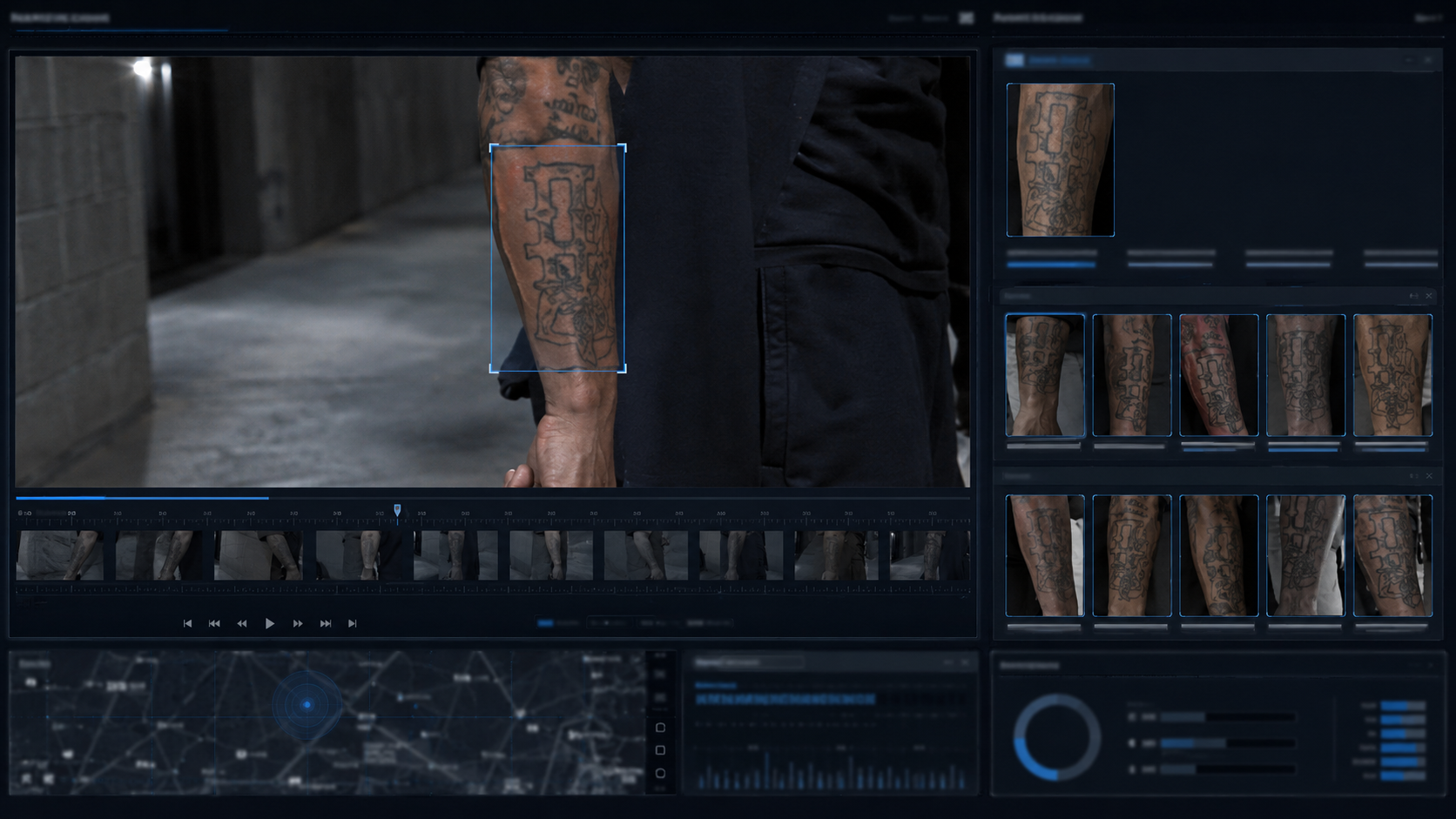


Gang tattoo identification connects suspects to organizations, links cases across jurisdictions, and identifies victims who otherwise have no documentation.
For decades, recognizing these signals depended on the institutional memory of gang unit officers, hand-compiled binders, and intelligence shared informally between agencies. When that knowledge walked out the door with a retiring detective, it often did not come back.
The investigative cost has been real. Manual recognition can do this work, but only at the pace of human review, and only within the patterns each analyst happens to know. AI-driven tattoo recognition does not replace that expertise. It scales it, making it possible to search image databases the way investigators have always searched fingerprint records: in seconds, against everything available, with consistent ranking. For law enforcement workflows handling high case volumes, this difference is operationally meaningful.
“A natural extension would be to focus on specific classes of tattoos, for example, gang tattoos.”
This article looks at how modern systems support gang identification, specifically, where they fit in active investigations, and where they have become essential for cases involving mass casualty events and human trafficking.
What Makes Gang Tattoo Identification Different
Generic tattoo recognition asks one question: Is this the same tattoo as one in the gallery? Gang tattoo identification asks a different question: Does this tattoo belong to a known pattern, family, or affiliation?
The distinction matters because gang tattoos are designed to be readable. They are signaling systems, intended to communicate membership, rank, history of violence, and territorial claims to anyone who knows the code. That means they cluster into recognizable visual families rather than appearing as one-off designs.
MS-13 imagery includes specific gothic lettering styles, devil horns, and the numerical references “13” or “MS.” Sureno-aligned tattoos cluster around the number 13 in different stylizations, three-dot triangles, and southern California iconography. Norteno tattoos use 14, four-dot patterns, and Huelga bird symbols. Eastern European organized crime, Russian prison tattoos, and Asian gang imagery each carry distinct visual vocabularies that have evolved over decades and remain remarkably consistent within their traditions.
Table 1. Common gang tattoo visual vocabularies
| Affiliation | Numerical references | Visual elements | Typical placements |
|---|---|---|---|
| MS-13 | “13”, “MS” | Gothic lettering, devil horns | Face, neck, chest, hands |
| Sureno-aligned | “13”, “X3”, “Sur” | Three-dot triangle, Aztec imagery | Forearms, hands, neck |
| Norteno-aligned | “14”, “X4”, “N” | Four dots, Huelga bird, “Norte” | Forearms, chest, back |
| Russian organized crime | Varies by rank | Stars on shoulders or knees, cathedral domes | Shoulders, knees, chest |
| Outlaw motorcycle clubs | “1%”, “13” | Club colors, skulls, wings | Back, chest, arms |
Sources: DOJ National Gang Center publications; FBI Gang Threat Assessment; academic literature on gang iconography.
For an identification system, this consistency is both an advantage and a trap. The advantage is that pattern recognition genuinely works: a model trained on enough labeled examples can recognize MS-13 stylistics across photos taken in different conditions, on different body locations, with significant variation in execution quality. The trap is that gang tattoos are not exclusive identifiers. Civilians get tattoos that look like gang imagery, sometimes deliberately, sometimes by accident. A system that flags affiliation with high confidence on the basis of imagery alone produces false positives that have real consequences for innocent people.
Production systems handle this by returning ranked similarity, not categorical labels. The system tells an analyst: “This tattoo is visually similar to images in our MS-13 reference set, with the following confidence.” The analyst then evaluates the result in context: other tattoos on the same person, location of the tattoo, accompanying evidence, and known intelligence on the subject. The AI does the retrieval. The human does the interpretation.
Why Public Tattoo Charts Fail in Real Investigations
A common starting point for investigators new to gang identification is the printable chart: a one-page reference showing which tattoos mean what. These charts are widely available, often shared between agencies, and they have real value as training material for officers who have never worked gang cases.
In active investigations, however, they fail in three predictable ways.
First, charts are static. Gang iconography evolves. MS-13 imagery in 2026 includes elements that did not exist when most reference charts were compiled. New cliques add new symbols. Older designs fall out of use. Charts that were accurate five years ago routinely mislead investigators today.
Second, charts cannot match. They tell an analyst what a clean reference image of a symbol looks like. They cannot tell the analyst whether the faded, partially visible mark on a bodycam still is the same symbol. That work requires image-to-image comparison, which only computational matching provides.
Third, charts cannot search backward. An analyst with a chart can ask, “What does this symbol mean?” They cannot ask, “Where else has this specific tattoo appeared in our records?” The reverse query, finding every prior case involving the same or visually similar tattoo, is often what closes investigations. It is also what only a database-backed recognition system can do.
Table 2. Static charts versus AI-driven recognition
| Capability | Static charts | AI-driven recognition |
|---|---|---|
| Currency of reference data | Frozen at publication date | Updates as the gallery is expanded |
| Image-to-image matching | Not possible | Core function |
| Reverse search across case history | Not possible | Standard query type |
| Handles degraded probes | No, requires a clean reference | Trained explicitly on degraded data |
| Audit trail for decisions | None | Logged in to case management |
| Best use | Officer training, orientation | Active investigations, casework |
This is why modern agencies treat charts as orientation material and AI-driven recognition as operational tooling. The two are not in conflict, but they answer different questions.
Integration with Criminal Databases
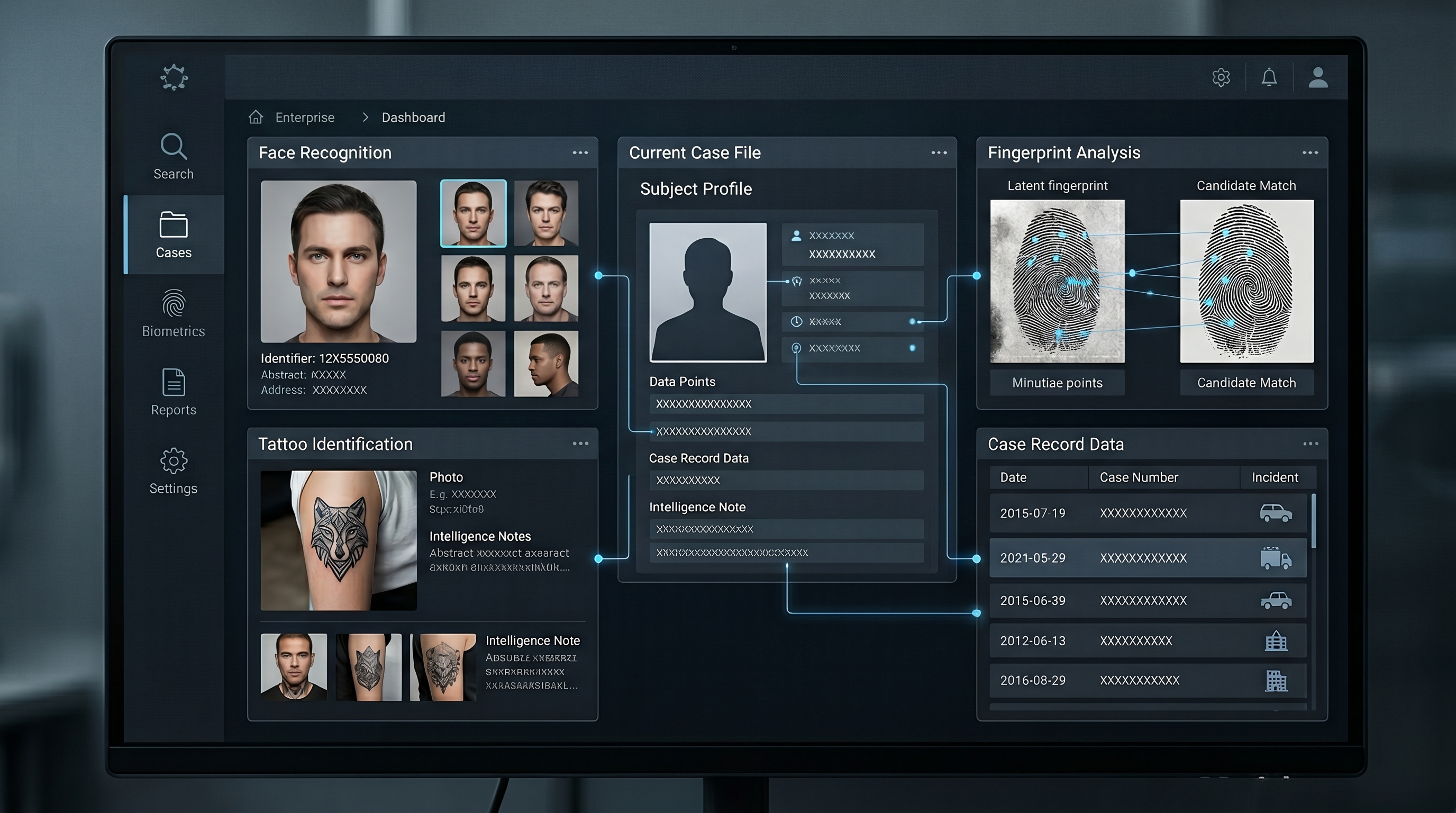
A tattoo recognition system has investigative value only in proportion to the gallery behind it. Algorithms run on the data they are given.
In practice, this means integration with the existing criminal records infrastructure. Booking systems capture tattoo photographs during intake. Corrections databases hold longitudinal records of inmates whose tattoos may have changed during incarceration. State and federal repositories aggregate records across jurisdictions. A tattoo recognition system that cannot ingest from these sources, or cannot push results back into them, becomes a separate tool that investigators have to consult in parallel, which in practice, means it gets consulted rarely.
Proper integration looks like this. When a new probe image arrives, whether from a current case, an intake photograph, or a digital evidence submission, it runs against the full integrated gallery without manual export or re-upload. Results appear in the same case management system the investigator is already using. Tattoo matches link to the underlying records, including booking date, location, charges, and other biometric data on file. This is the operational logic behind a modern criminal justice ABIS.
“The NGI system will include automated matching of scars, marks, and tattoos.”
This is also where standards compliance matters. Federal law enforcement and most state agencies operate within data-sharing frameworks that specify how biometric data is captured, stored, and exchanged. The American National Standards Institute and the National Institute of Standards and Technology jointly publish the ANSI/NIST-ITL standard, which defines the format for biometric data transmission, including tattoo records. Systems that conform to ANSI/NIST-ITL can exchange data with other compliant systems without custom integration work. Systems that are not functionally isolated, regardless of how good their internal matching is.
Victim Identification in Mass Casualty Events
The hardest cases in identification are those where the subject cannot speak for themselves. Mass casualty events, whether from natural disaster, transportation accident, or violent incident, produce remains that often cannot be identified through standard means. Faces may be unrecognizable. Documents are frequently lost or destroyed. Family members, if they exist and can be located, may not have current photographs.
Tattoos persist. Skin and ink degrade more slowly than facial features, and tattoos are typically known to family members in detail, unlike birthmarks or scars are not. After major incidents, medical examiners and disaster victim identification teams routinely catalog visible tattoos as part of the post-mortem record.
The matching problem is the inverse of investigative tattoo recognition. Instead of taking a tattoo of unknown ownership and finding matches in a criminal database, victim identification takes a post-mortem tattoo image and tries to match it against records the deceased generated during life: phone photos, social media posts, prior medical records, and missing persons reports. The same algorithmic pipeline works, but the gallery and the workflow are different.
This is where multimodal capability becomes important. Family members submitting missing persons reports may not have isolated photographs of tattoos. They have group photos, vacation pictures, and profile photos from social media. A system that can detect tattoos within larger images, segment them automatically, and match against post-mortem records dramatically increases the pool of useful reference data. Identification that would once have required matching a single submitted tattoo photo against a single post-mortem photo can now use any image in which the tattoo appears, from any source.
For agencies coordinating with families, medical examiners, and federal partners in the aftermath of mass casualty events, this expansion of usable evidence has a measurable impact on identification timelines.
Support for Human Trafficking Investigations
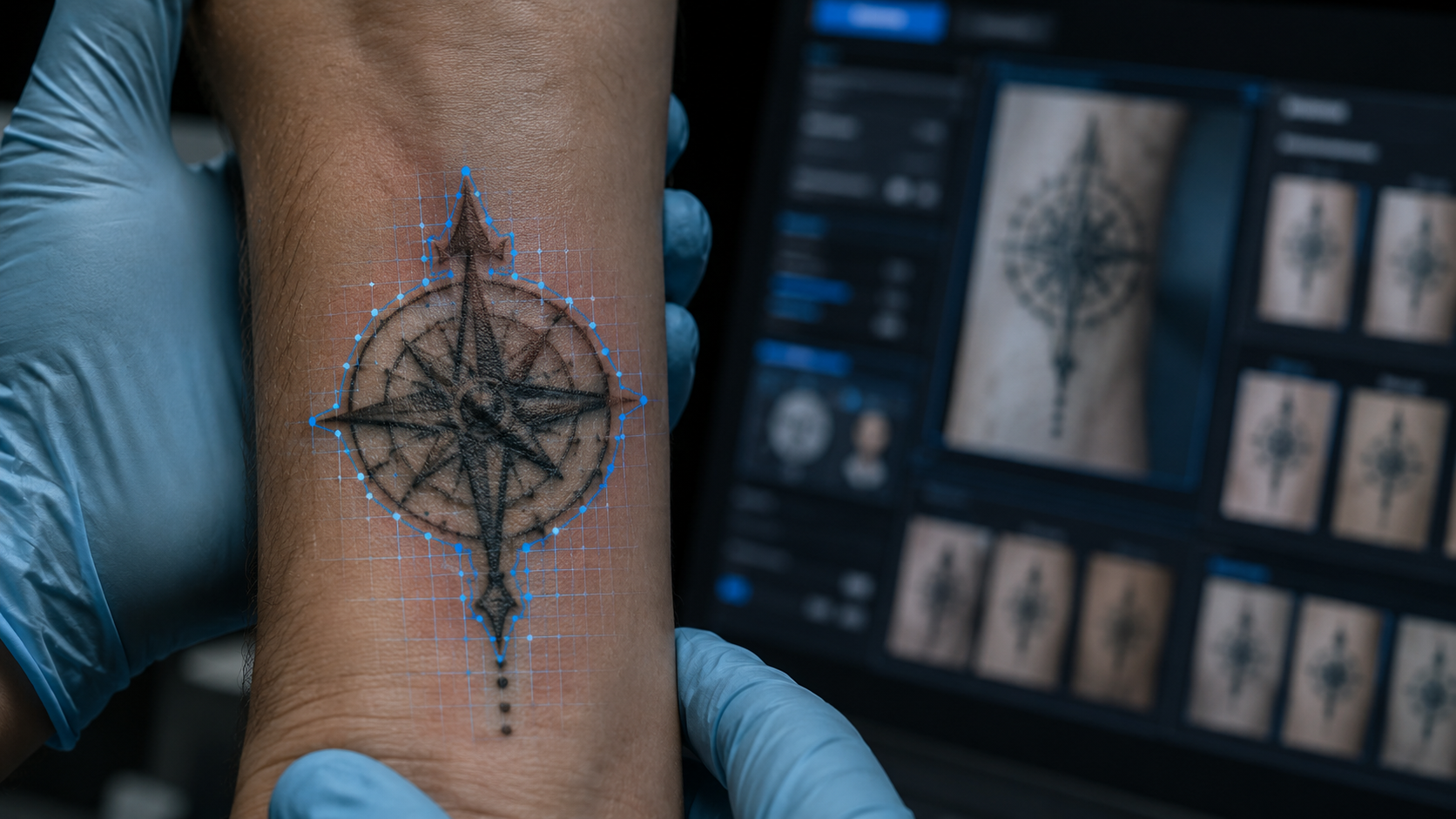
Human trafficking cases share a structural problem with mass casualty work: victims often cannot self-identify, or are not in a position to do so safely. Traffickers also use tattoos as branding, marking individuals under their control with insignia that identify ownership.
“Tattoos, branding, rashes, and bruising are typically seen in victims of sex trafficking.”
These branding tattoos are an investigative signal in two directions. First, they identify the trafficker or organization, since branding patterns recur across victims controlled by the same network. Second, they identify the victims themselves, since photographs of branding tattoos are sometimes the only consistent record across recovery operations in different cities.
Tattoo recognition supports this work in ways that face recognition often cannot. Trafficking victims are commonly photographed in conditions that defeat face matching: poor lighting, partial visibility, and intentional obscuring. Tattoos, particularly on the neck, wrists, or other consistently exposed areas, are more frequently captured and more durable across the chaos of these cases.
Federal task forces working trafficking cases use tattoo identification to link victims to known traffickers, to connect cases that local jurisdictions had handled as isolated incidents, and to support family reunification when recovered victims cannot or will not identify themselves. The work is sensitive, the standards for victim privacy are strict, and the value of accurate retrieval is direct.
Table 3. Investigative scenarios where tattoo recognition is uniquely valuable
| Scenario | Primary obstacle to ID | Why tattoo recognition helps |
|---|---|---|
| Mass casualty events | Faces unrecognizable, documents lost | Tattoos persist longer than facial features |
| Human trafficking recovery | Victims cannot or will not self-identify | Branding tattoos are consistent across recovery operations |
| Cold case review | Original suspects aged or appearance changed | Tattoo design content remains discriminative over decades |
| Cross-jurisdictional gang cases | Records held separately by each agency | Multi-jurisdictional gallery search via ANSI/NIST-ITL |
| Surveillance with no face capture | Subject masked, turned away, or distant | Visible tattoos on arms or neck can survive capture conditions |
Practical Recommendations for Agencies
For agencies building or expanding gang tattoo identification capability, several practical points consistently matter.
Catalog before you procure. Existing booking and intake photographs are the foundation of any deployment. Many agencies discover during procurement that their existing tattoo image holdings are uncatalogued, inconsistently photographed, or stored in formats that cannot be ingested directly. Resolving this before vendor selection saves significant deployment time.
Insist on ANSI/NIST-ITL compliance. Standards conformance determines whether your system can exchange data with federal partners, state repositories, and other agencies. Systems that match well internally but cannot share results are limited in their investigative value.
Train analysts on interpretation, not just operation. The most common failure mode is treating AI similarity scores as conclusions rather than leads. Analyst training should explicitly cover when high similarity is meaningful, when it is not, and how to evaluate matches alongside other case evidence.
Document review workflows for sensitive cases. Gang affiliation classification, trafficking victim identification, and mass casualty work all involve high-stakes consequences. Written procedures for how AI results enter the case record, who reviews them, and what corroboration is required protect both subjects and agencies.
Plan for multimodal use from the start. Tattoo recognition deployed alongside face recognition, fingerprint matching, and iris recognition produces investigative value that any single modality cannot. The architectural decision to support multimodal workflows is harder to retrofit than to design in initially.
How ROC Supports Gang Tattoo Identification
ROC’s tattoo recognition runs as part of a unified multimodal SDK that also covers face, fingerprint, iris, and object detection, all built on NIST-evaluated algorithms with documented bias performance. For gang identification specifically, this matters in three ways.
The first is gallery integration. ROC ABIS ingests existing booking, intake, and case records through ANSI/NIST-ITL compliant interfaces, which means agencies do not have to rebuild their image holdings to deploy the system. Existing tattoo records become searchable through the same case management workflows analysts already use.
The second is multimodal correlation. When a probe image contains both a face and a visible tattoo, ROC runs both matches in the same query and returns a combined ranking. Investigators do not have to perform two separate searches and reconcile the results manually.
The third is ethical AI provenance. ROC is built entirely in the United States, on training data and algorithms that have been independently evaluated for bias across demographic groups. For agencies whose procurement processes require documented responsible AI compliance, particularly federal task forces and partners working on trafficking and gang cases, this provenance is increasingly non-negotiable.
Conclusion
Gang tattoo identification has moved from institutional memory to operational capability. The technology supports work that investigators have always done, faster and at a greater scale than manual review allows, and extends into adjacent investigative areas, including victim identification and trafficking case work, where the alternatives are limited or absent. The systems do not produce conclusions. They produce ranked leads, and the quality of those leads depends on the gallery behind them, the standards they conform to, and the integration with the workflows analysts actually use.
For agencies evaluating capability in this area, the technical questions matter less than the operational ones. A system that matches accurately but cannot share data with federal partners, or that runs in isolation from case management, will be used rarely regardless of its benchmark performance. A system built for integration, with documented bias performance and proper multimodal support, becomes part of how investigations get done.
Learn More
If your agency is building or modernizing gang tattoo identification capability, explore ROC’s tattoo recognition platform or get in touch to discuss how multimodal biometric identification fits into your investigative workflow.
Future-ready insights.
Straight from the source.
Subscribe for Vision AI insights, product updates, and stories from the front lines of identity and intelligence.