
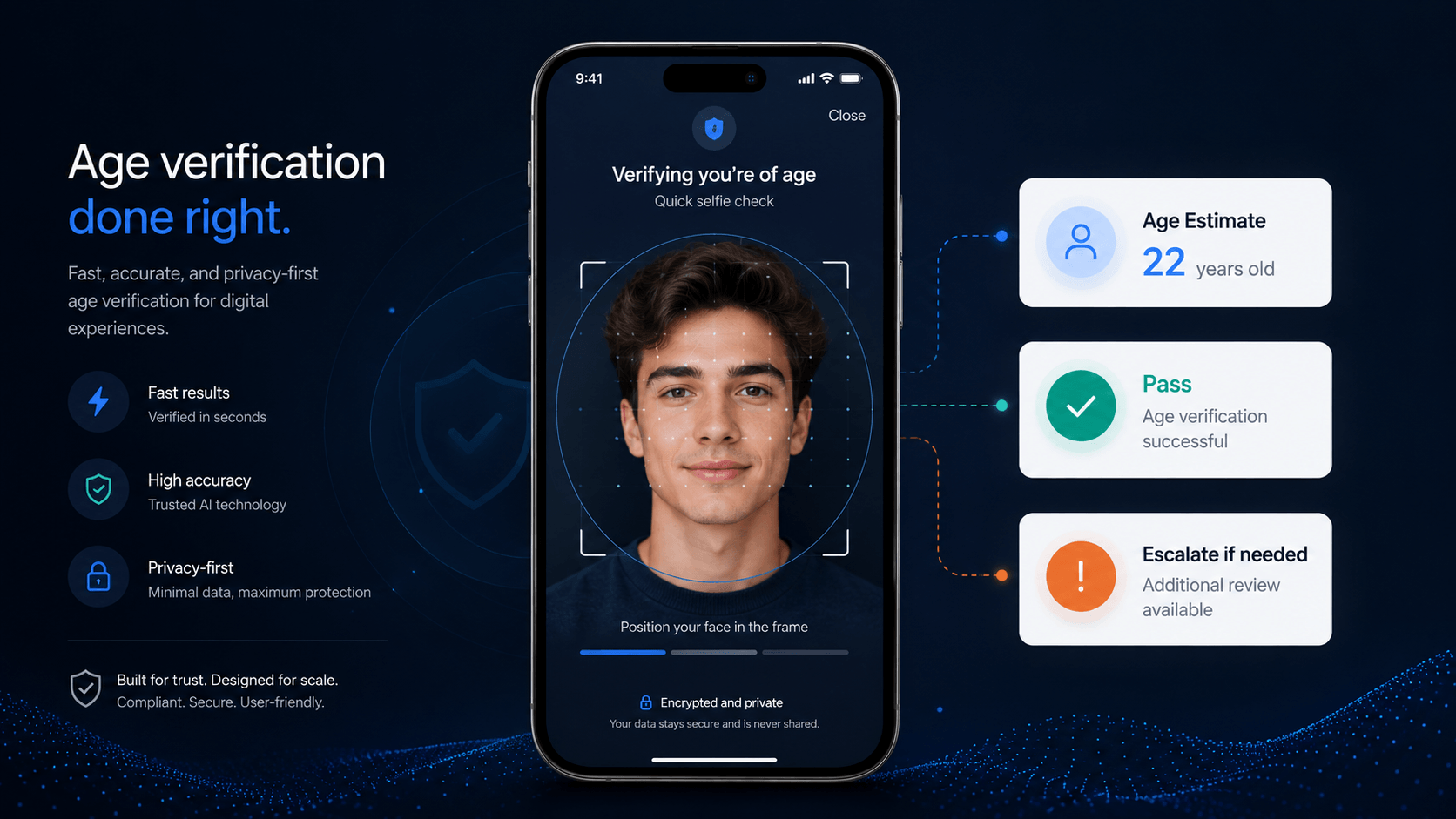


AEV software might be used as a gatekeeper for activities that have an age restriction, such as purchasing alcohol or accessing mature content online.
For most of the internet’s history, age checking was a checkbox that asked users to confirm they were over 18. That era is ending. A wave of regulation, from federal children’s-privacy rules to state age-verification statutes to European platform obligations, is turning age assurance from an optional courtesy into a compliance requirement, and the honor-system checkbox no longer satisfies regulators or auditors. Platforms and regulated businesses now need a way to make age-aware decisions that is accurate, defensible, and low-friction enough that it does not destroy conversion.
This guide explains the technology behind modern age verification software, the crucial distinction between age verification and age estimation, the regulations driving adoption, how facial age estimation actually works, how to read the NIST benchmark that now scores it, and how to evaluate a vendor. It is written for the product, compliance, and trust-and-safety teams who have to choose a system and defend that choice.
Age Verification vs. Age Estimation: A Critical Distinction
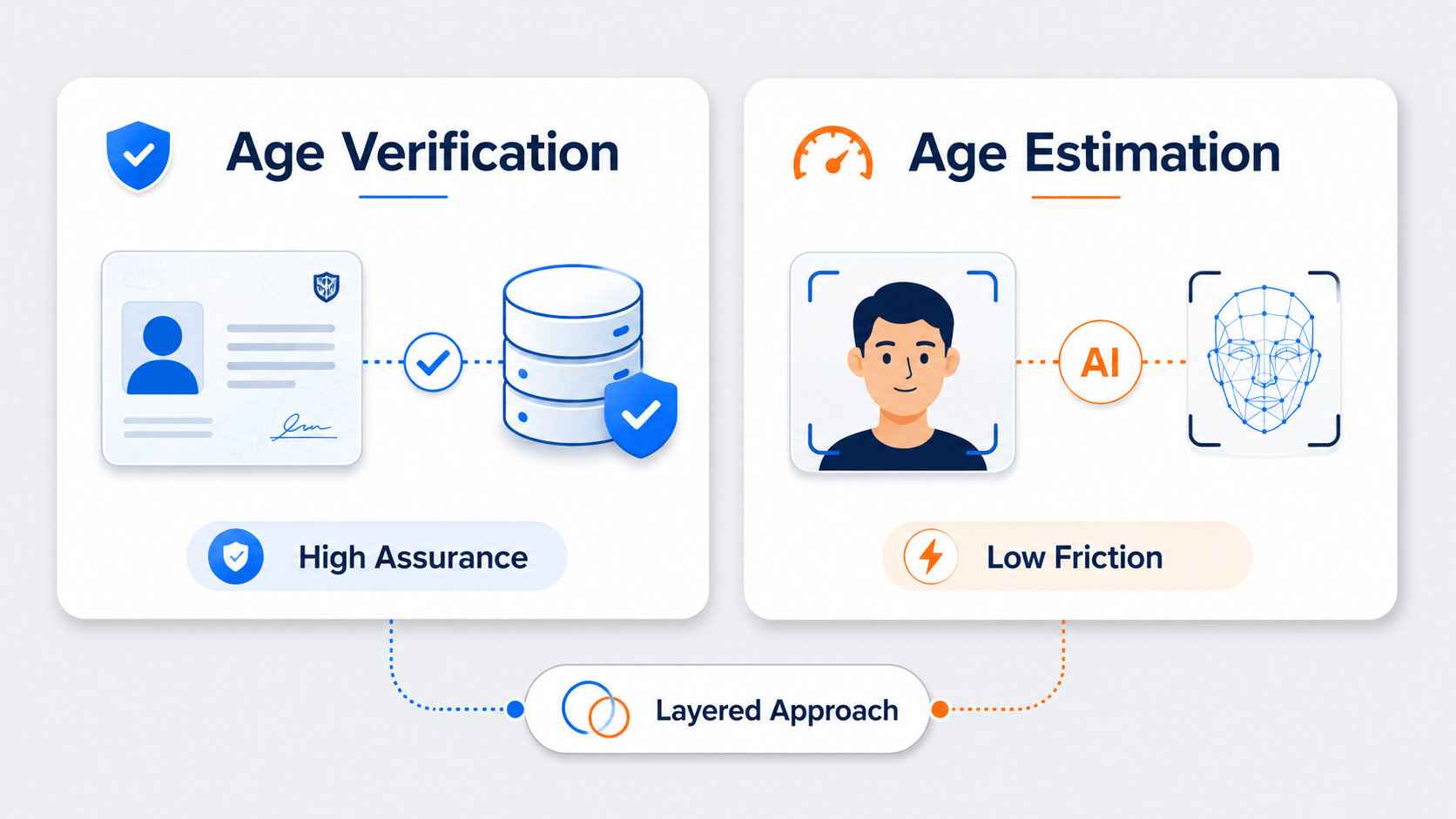
The two terms are used interchangeably in marketing, but they describe different mechanisms with different trade-offs, and choosing the wrong one for a use case is a common and costly mistake.
| Dimension | Age verification | Age estimation |
|---|---|---|
| Method | Document or database check of exact age | Facial analysis estimates likely age |
| Input | Government ID, records lookup | A selfie or face image |
| Assurance | High legal certainty | Probabilistic, threshold-based |
| Friction | Higher; can increase drop-off | Low; document-free, near-instant |
| Privacy exposure | Collects identity documents | Can return only an age estimate |
| Best for | High-assurance legal thresholds | First-layer screening and routing |
In practice, the strongest deployments treat these as layers rather than alternatives. Facial age estimation acts as a fast, low-friction first check that clears the large majority of users, and only those who fall near a sensitive threshold are escalated into a higher-assurance document verification step. This keeps friction and privacy exposure proportionate to risk, rather than forcing every user through an ID upload.
Why Age Assurance Is Becoming Mandatory
Regulatory pressure is expanding across multiple jurisdictions, although specific obligations vary by industry, platform, content, and location. Understanding this fast-evolving landscape is an important first step to planning a defensible deployment.
- COPPA (U.S.). Long-standing federal rules impose strict obligations on services directed at children under 13, making reliable age screening foundational.
- State age-verification laws. Statutes such as Louisiana HB 142 and Texas HB 1181 require age verification for access to adult content, and several have withstood legal challenge, prompting rapid adoption across platforms.
- Proposed federal legislation. Measures like the Kids Online Safety Act (KOSA) signal continued momentum toward stronger duties to protect minors online.
- UK Age Appropriate Design Code. Requires age-appropriate experiences for under-18 users, pushing platforms toward age assurance by design.
- EU Digital Services Act. Imposes age-verification and minor-protection expectations on large online platforms operating in the EU.
The businesses most affected are the classic regulated verticals: alcohol, tobacco and vaping, online gaming and gambling, adult content, and cannabis, along with social media and any platform hosting age-gated features. For many organizations, age assurance has moved from a nice-to-have to an increasingly important operational and legal necessity.
How Facial Age Estimation Works
Facial age estimation analyzes a face image, typically a live selfie, and estimates a person’s likely age without any identity document. A deep neural network reads features associated with aging, such as bone structure and skin texture, and returns an estimated age, often in under a second and entirely in-browser without an app download. The estimate itself is only half the system. The operational value comes from threshold logic: an organization decides which boundary matters for its use case, commonly 13, 16, 18, or 25, and builds challenge-age rules that allow a clearly-of-age user straight through, route a borderline user into additional checks, and escalate an under-threshold user appropriately.
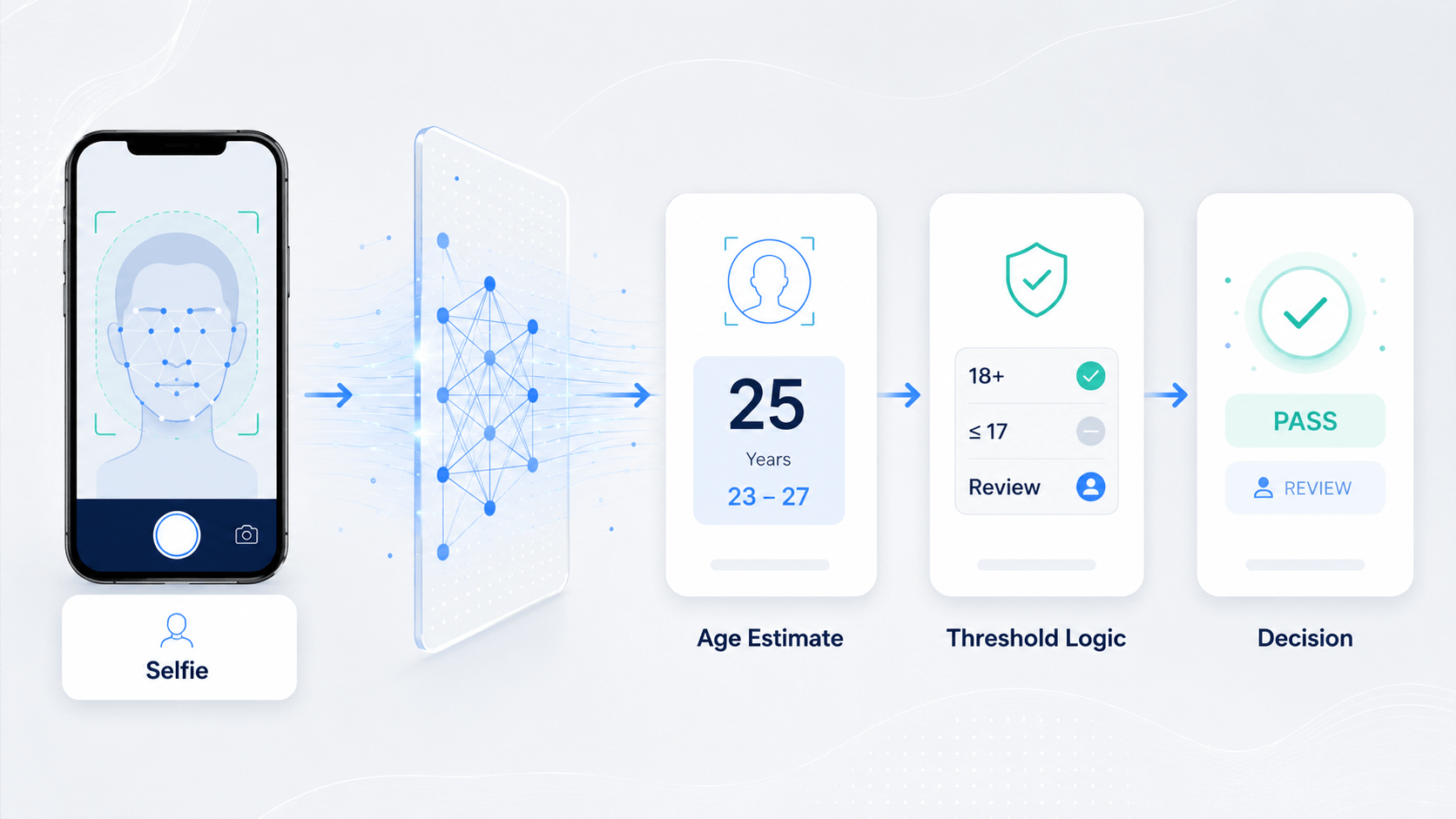
That threshold design is where age estimation earns its keep. It gives businesses an option between doing nothing and forcing every user through a high-friction document check, letting them apply stronger controls only where a user’s estimated age lands near a decision boundary.
The Accuracy Question: How to Read NIST FATE
Unlike visual gun detection, age estimation now has an independent, government-run benchmark. In May 2024, NIST published its first age-estimation evaluation in a decade under the Face Analysis Technology Evaluation (FATE) Age Estimation and Verification track. It measures accuracy primarily through Mean Absolute Error (MAE), the average gap between predicted and actual age, and it runs continuously as developers submit updated algorithms. For any buyer, published NIST FATE performance is the single most defensible accuracy signal available, and a vendor that cannot point to it is asking for trust on faith.
What matters is not just aggregate accuracy but performance at the boundaries that carry policy weight, around ages 13, 16, and 18, and consistency across demographic groups, since a system accurate only in aggregate can still fail specific populations. ROC’s approach is backed by benchmark-leading NIST FATE results, including ranking as the #1 U.S. age estimation provider, with a #1 position in Mean Absolute Error on the Child Online Safety dataset and on the Mugshot dataset, the conditions that make age estimation operationally meaningful.
The honest caveats matter too. Facial age estimation is most accurate for users 18 and above and is not recommended for children under 5, where limited training data for very young populations makes estimates unreliable. It is a probabilistic signal, not a birth certificate, which is exactly why threshold logic and escalation paths exist.
Protecting Age Checks from Spoofing and Deepfakes
An age check is only as trustworthy as the face presented to it. In real deployments, attackers try to defeat estimation with printed photos, replayed video, virtual cameras, and deepfakes, which is why serious systems pair age estimation with liveness detection. ROC combines age estimation with single-frame passive liveness detection, certified to iBeta Level 2 for presentation attack detection, plus camera injection attack detection to defend against synthetic and injected inputs. Together, these capabilities can help organizations assess whether an age-estimation session can be trusted.
Privacy by Design
Handling face images, especially in child-safety workflows, raises immediate privacy obligations, and privacy failures create their own regulatory exposure. The strongest age-estimation systems are built around data minimization and stateless processing: they analyze the image in real time, return only an age estimate or a pass/escalate decision, and discard the image immediately, retaining no biometric data and using nothing for retraining without explicit consent. This design is what makes GDPR-, CCPA-, and COPPA-aligned deployments possible, and it is a question buyers should ask first, not last, since a system that stores face images is a liability regardless of its accuracy.
Choosing Age Verification Software: An Evaluation Framework
The criteria below separate a compliant, defensible system from a checkbox that will not survive an audit.
| Criterion | What to require | Why it matters |
|---|---|---|
| Benchmarked accuracy | Published NIST FATE (MAE) results | The only independent, defensible accuracy signal |
| Threshold performance | Strong accuracy near 13/16/18 | Policy decisions happen at these boundaries |
| Demographic consistency | Fairness across populations | Aggregate accuracy can hide group failures |
| Anti-spoofing | Liveness and injection-attack defense | An age check is only as good as the face is real |
| Privacy design | Stateless, no retention, consent-based | Enables GDPR/CCPA/COPPA compliance |
| Deployment | Browser, mobile, SDK options | Must fit your onboarding without an app |
How ROC Approaches Age Estimation
ROC Age Estimation delivers benchmark-leading, NIST FATE-ranked age intelligence built for production workflows. It estimates age from a single selfie in under a second, supports configurable thresholds such as 13+, 16+, and 18+, and pairs with iBeta Level 2 passive liveness and injection-attack detection to keep sessions trustworthy. It is privacy-first by design, processing images statelessly and discarding them once an estimate is produced, which supports GDPR-, CCPA-, and COPPA-aligned deployments with zero human review.
It deploys through ROC Enroll for browser-based and mobile onboarding, or directly through the ROC SDK for custom integrations, and because age estimation sits inside ROC’s broader multimodal platform, organizations can extend into face recognition and full identity workflows over time without rebuilding their stack. As a proudly American-made company developing under a strict Code of Ethics, ROC treats fairness and privacy as core requirements rather than afterthoughts.
Conclusion
Age assurance is no longer optional, and the honor-system checkbox is no longer defensible. The practical path forward is a layered one: fast, privacy-preserving facial age estimation as a first check, benchmarked against NIST FATE and hardened against spoofing, with escalation to document-based verification reserved for the cases that genuinely need it. That balance – accuracy where it counts, friction only where necessary, and privacy by default – can help platforms meet their obligations without creating unnecessary barriers for legitimate users.
Looking ahead, the regulatory landscape is likely to continue evolving. The organizations that treat age assurance as serious infrastructure, judged by independent benchmarks and grounded in privacy-first design, will be better positioned to adapt to changing compliance requirements.
Learn More
If your organization needs to meet expanding age-assurance requirements without adding unnecessary friction, explore ROC Age Estimation or get in touch to discuss how document-free age verification fits your onboarding and compliance needs.
Future-ready insights.
Straight from the source.
Subscribe for Vision AI insights, product updates, and stories from the front lines of identity and intelligence.
Frequently Asked Questions
How accurate is facial age estimation?
Accuracy is now measured independently by NIST’s FATE Age Estimation and Verification evaluation, primarily via Mean Absolute Error. Leading systems perform strongly around the 18 boundary and across demographic groups. ROC ranks as the #1 U.S. age estimation provider in NIST FATE, including in Child Online Safety and Mugshot MAE. Accuracy is lower for very young children, where estimation is not recommended.
Age verification confirms a user’s exact age through a document check or database lookup, offering high legal certainty. Age estimation uses facial analysis to estimate likely age from a selfie, with no document, making it faster and more privacy-friendly. Many organizations use age estimation as a first layer and escalate to full verification only when a user is near a sensitive threshold.
Drivers include COPPA (U.S. children under 13), state laws such as Louisiana HB 142 and Texas HB 1181 for adult content, the UK Age Appropriate Design Code, and the EU Digital Services Act, with proposed federal measures like the Kids Online Safety Act signaling more to come. Regulated verticals include alcohol, tobacco, gaming, gambling, adult content, cannabis, and social media.
It can be, when built for it. Privacy-first systems process the image in real time, return only an age estimate or decision, and discard the image immediately, retaining no biometric data. This supports GDPR-, CCPA-, and COPPA-aligned deployments. Always confirm a vendor’s data-retention and consent practices.
That is the central risk, which is why estimation should be paired with liveness detection. ROC combines age estimation with iBeta Level 2 passive liveness and camera injection attack detection to defend against printed photos, replayed video, virtual cameras, and deepfakes, confirming the face is real and live.
ROC returns an age estimate in under a second from a single selfie, in a mobile browser without an app download, which keeps friction and abandonment low compared with document-based checks.
Common thresholds are 13, 16, 18, and 25, mapped to use cases like child-safety gating, content access, and alcohol or tobacco compliance. Organizations build challenge-age logic to allow, escalate, or block based on the estimated age relative to the relevant boundary.
It depends on the required assurance level. For lighter-touch gating it can suffice; for high-assurance legal thresholds, it works best as a first layer that escalates borderline cases to document-based verification. The layered approach balances certainty, friction, and privacy.
It should, and this must be verified. NIST FATE reports performance across populations, and demographic consistency is a key evaluation criterion because a system accurate only in aggregate can fail specific groups. ROC demonstrates leading performance across multiple demographic breakouts.
Through ROC Enroll for browser-based and mobile onboarding, or directly via the ROC SDK for custom integrations. Because it sits inside ROC’s multimodal platform, teams can extend into face recognition and broader identity workflows without rebuilding infrastructure.